Pavement parking 'encouraged' by local councils

 BBC
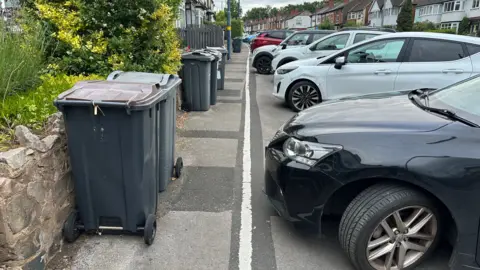
BBCHalf of all councils in England actively encourage parking on pavements through marked bays or signage, BBC research has found.
The Local Government Association said pavement parking was one of the most complained about issues, but "councils have to balance the needs of all users".
However, disability charities have said the practice makes streets harder to navigate for wheelchair users and people with limited sight.
Wheelchair user Hana Kitson said there were classes and activities she was unable to attend as she could not get past the cars parked on her street.
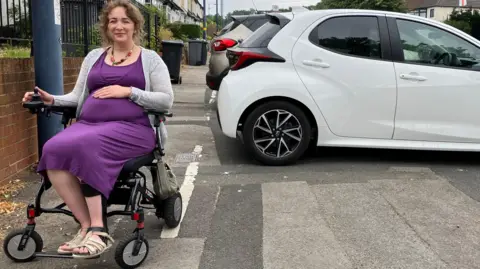
The Department for Transport said it was "giving councils stronger powers to tackle dangerous and inconsiderate pavement parking" - but on roads like Fordhouse Lane in Birmingham parking on the pavement is permitted.
Kitson, 39, lives near Fordhouse Lane and also experiences parking and access issues on her own street.
She said: "It narrows the pavement to the point that if you're using a pushchair or a wheelchair you can't easily get past."
She was very active when she worked as an army doctor, but since using a wheelchair after an accident she has struggled to access shops and events.
"I still try to be really active but I can't access those classes and community events... because I can't get past those cars."
Kitson said she was not anti-car or people being able to park near their home, but felt "we've become very car-centric".
"It's much more normal to have two working people or three working people within a household all of whom feel that they need a car, and public transport is not on time and it's not reliable and it's not necessarily outside your door," she added.
Said Zaidi, a Fordhouse Lane resident, said the road was not big enough for cars to be parked on both sides.
He argued there would be more room for pedestrians if all drivers "follow the rules and do not park across the white line".
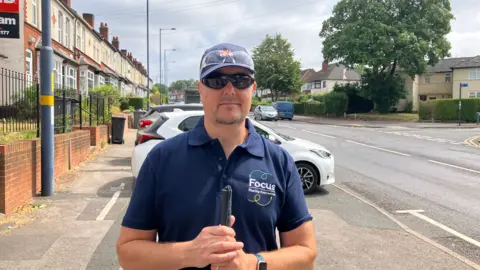
The National Federation of the Blind has called for a full pavement parking ban, arguing any parking on pavements "damages them in the longer term, leaving them in a worse state for pedestrians".
Rob Moulds, 57, from Birmingham, is visually impaired and uses a cane when walking. He compared trying to find a path between bins and cars as being "like a pinball machine".
"You're going from left to right, constantly hitting obstacles. It's disgraceful."
He said he understood the problem of a lack of parking, but argued the solution should not "be then to impact pedestrians because that's unfair on the pedestrians".
"Why are we being hindered? Why are we being penalised?"
Another Fordhouse Lane resident, Clive Hawkins, said the road would be "manic" if cars were not parked on the pavement, as it is used regularly by ambulances and buses.
"There are plots round the back where you've got garages but there's not enough to put all the cars, so obviously they have to stay where they are," he said.
Councillor Harris Khaliq, Birmingham City Council's cabinet member for city operations and digital, acknowledged the difficulties pavement parking could cause for walkers, cyclists and the disabled, but confirmed it was allowed in some locations in the city.
"The council has been pushing for new powers to keep pavements clear and has welcomed the government's decision to grant councils new powers," he said.
"We are awaiting guidance from government to help local authorities use these powers in a proportionate and locally appropriate way."
Birmingham is not the only council putting parking spaces on pavements. Of the 164 local authorities who responded to a BBC Freedom of Information request, just over half confirmed they do it too.
Only five of the 84 councils that have placed parking spaces on pavements said they had plans to remove those spaces.
The number of licensed vehicles in the UK hit a record high last year, with 42.3 million as of December 2025.
Cars have also been getting wider, with critics dubbing the trend 'carspreading'.
But pre-existing roads cannot simply expand, leaving less room for more cars.
A few parts of the UK have a general pavement-parking ban: London, Exeter and the whole of Scotland. Elsewhere, only the police can take enforcement action against vehicles blocking the pavement.
But the government has said it would give councils new enforcement powers against unnecessary pavement obstructions. From September, it will allow councils to take action outside of areas where a Traffic Regulation Order is in place.
In London, 27 of the capital's 33 local authorities said in their FOI responses that they allowed exceptions to the pavement parking ban through bays or signage in some locations.
A Local Government Association spokesperson said councils "have to balance the needs of all users".
"Sometimes, especially on older or tightly built streets, they have to allow some pavement parking – for example to ensure emergency vehicles, refuse trucks, and buses can safely pass," they said.
"The new powers are positive and will give more practical tools to deal with obstructive parking."
The charity Guide Dogs welcomed the government's plan.
Jessica Luke, the charity's regional policy and campaigns manager for the Midlands and East of England, said it was "vital that there is a consistency and clarity for everyone and not a postcode lottery of different rules".
She added the charity recommended at least two metres of space for wheelchair users or guide dog owners to be able to pass one another.
"For us, the regulatory framework needs to set out really clearly the space that must be left for pedestrians effectively."
Local Transport Minister Lilian Greenwood said: "Everyone should be able to use the pavement safely, and pavement parking can make it harder for people to get around - especially disabled people, older people and parents with pushchairs.
"We've been clear that streets should work for everyone, which is why we are giving councils stronger powers to tackle dangerous and inconsiderate pavement parking."