Wheelchairs 'forced into road by pavement parking'

 Charlie Stubbs / BBC
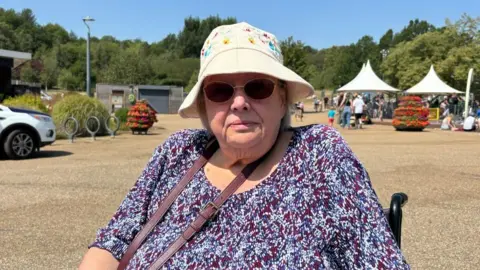
A woman says she has to navigate a road in her wheelchair every time she goes out because of people parking on the pavement.
Linda Anderson, from Telford, said she used to have problems when her children were in pushchairs but now she is older, she finds it as bad in her chair.
According to data obtained by the BBC, Telford and Wrekin Council is one of five authorities in the West Midlands that allow drivers to park on pavements.
The council said it was committed to tackling the issue and would use every legal power available.
Anderson said she goes out "once or twice a week" and needs a wheelchair to get around some of the time.
She thinks people "don't seem to care as long as they can park".
"You think to yourself that people are good and you would think ahead and think this might disrupt somebody's movements," Anderson said.
She added that once when she was out with her grandchildren with a pushchair, she was shouted at by a man that had parked on the pavement.
"I just said to him 'did you have to park on the pavement?' and he just gave me abuse," she said.
"I thought 'that's unfair because [he was] infringing on our space, not the other way about'."
 Charlie Stubbs / BBC
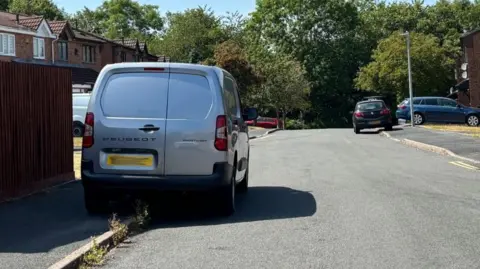
It is not just people with wheelchairs who are struggling, but also those with walking frames and mobility scooters, as well as those who are blind.
Harper, from Wednesfield, Wolverhampton, who uses a frame and scooter, said she struggles to get down the kerb on to the road when "big white vans" and bins had blocked the path.
"If you have got your mobility scooter, you have to carry on until there is a drop," she said.
"I can go off the kerb a bit better but then you have got cars parked next to each other and you can't get through.
"My friend has a bigger issue because she's partially blind so it can be a very [challenging] at times."
Isaac Occhipinti, from the British Parking Association, said he welcomed a widespread pavement parking ban, but thought there were limitations.
"Councils must strike a careful balance between the needs of motorists and the safety of pedestrians, particularly where space is limited," Occhipinti said.
"Without effective enforcement, they will not deliver the protection people expect."
He also argued that councils must provide more support for people to give up cars and use public transport instead.
 Charlie Stubbs / BBC
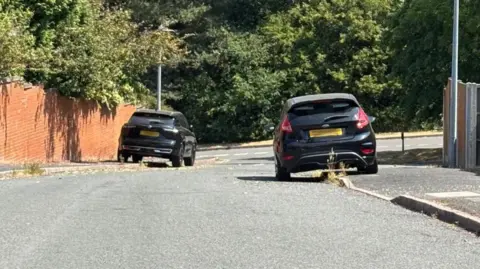
In some areas of Telford and Wrekin, vehicles can park partially on the footpath, while using designated bays, provided it does not cause an obstruction.
Disability campaigner Sarah Leadbetter, who is registered blind, uses a cane and has a guide dog, and says the bays are "disorientating".
"If you've got a bush overhanging on one side and a car parked on the other side, you can't get through," she said.
"That's forcing you into the road so that's not keeping us safe, especially when the car's coming towards you or behind you."
A spokesperson for Telford and Wrekin Council said the authority understood the impact pavement parking could have on residents.
But specific powers only applied in London, they said, and councils outside the capital did not have "blanket legal powers to issue penalties solely because a vehicle is parked on the footway".
They added: "We are committed to using every enforcement tool and legal power available to us where vehicles are causing obstruction, creating safety concerns or contravening existing restrictions."
The authority said it would investigate concerns in areas where pavement parking was a persistent issue and would continue to act when enforceable restrictions were breached, including double yellow lines and school keep clear markings.
"We are firmly on the side of residents who want safe, accessible streets," the spokesperson added.
Follow BBC Shropshire on BBC Sounds, Facebook, X and Instagram.