New pavement parking ban is 'not needed'

 BBC
BBCAn 18-month trial banning pavement parking on selected streets is not needed and is leaving people with nowhere else to leave their vehicles, some residents claim.
Swindon Borough Council said the restrictions, which could become permanent on Redhouse Way, Millgrove Street and part of Eastbury Way in Swindon, were in place to improve access for pedestrians, mobility users and pushchairs.
Councillor Daniel Adams said it was the "safest" option as pavement parking was putting pedestrians at risk.
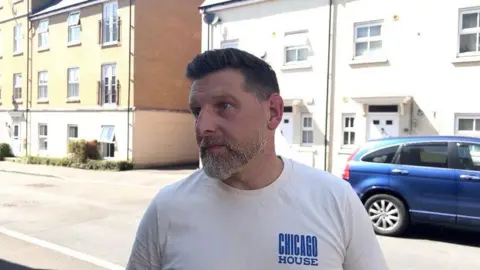
However, resident Kerry Wallace said the ban is not needed because they "never had an issue with parking" as some pavement are so wide you could fit three double pushchairs and a car on them.
While some sections of the pavement near Wallace's home are wide, others are narrower and her street was selected after people who use guide dogs were consulted, Adams added.

Wallace, who said there was not enough room for both her and her neighbour to park in "small" designated spaces behind their houses, said: "I have young children to get out of the car and I normally park right on the pavement and I have done for seven years."
She is now parking down a side street or in a Tesco Express car park, adding: "I don't think there has ever been a problem and everybody around here says the same thing."
Andrew Jordan, who has lived there for 10 years, believes the ban will not work as there is "nowhere else to park".
"They haven't applied enough spaces for each house. Visitor spaces are always taken up by people who have two cars...I'm not sure where else they're expecting us to park.
"I don't agree with people who park on the pavement but it's getting to the point where there's no other places to park," he added.
Signs have been installed on designated streets to alert motorists to the new rules.
Fines of £70, or £35 if paid within 14 days, have been issued by council wardens to anyone found in breach of the ban.
Adams said a "large amount" of fines were given out on the first day on 3 June, although official data has not been collarated yet, and "almost immediately" parking on pavements reduced.
 Daniel Adams
Adams, who instigated the trial, said as a resident in the area, he has witnessed first-hand the issues on streets selected for the trial. He also consulted with people who use guide dogs.
"For people with visual disabilities, physical disabilities, it really can make them feel trapped in their own homes.
"Guide dogs don't know how to navigate these obstacles and people in wheelchairs physically can't fit through some of the gaps...it creates a risk for pedestrians."
"If it does push cars into other areas then ultimately that person still has the responsibility" to park safely," Adams said.
Ruth Billingham, from the charity Living Streets, is working to prevent all pavement parking, which she says is dangerous.
"This trial in Swindon hopes to make streets more accessible, but it's been scaled back to only apply to three streets
"This illustrates the issues with a 'postcode lottery' approach – how can someone be sure their route is clear?" she said.
Parking on the pavement is not illegal outside London and Scotland, though drivers can be fined for blocking pedestrian access or obstructing traffic flow.
The trial will run for 18 months, with residents able to submit feedback before a decision is made on whether it will become permanent.
Follow BBC Wiltshire on Facebook, X and Instagram. Send your story ideas to us on email or via WhatsApp on 0800 313 4630.