Jet pioneer celebrated with new Royal Mail stamps

 Royal Mail
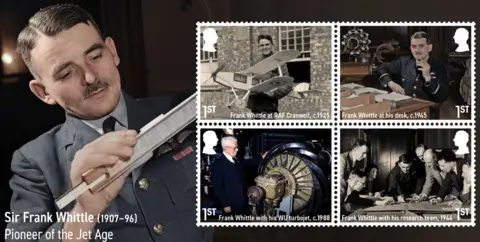
The pioneering work on the jet engine by Sir Frank Whittle has been celebrated with a new set of stamps from Royal Mail.
Whittle, who was born in Coventry and founded Power Jets in Rugby to build the aircraft engines he designed, before going on to continue his pioneering work in Gloucestershire, died 30 years ago this year.
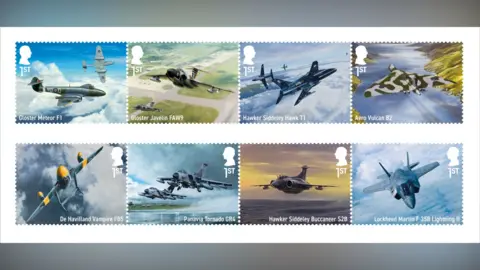
The stamps come in two sets, the first featuring four images of Whittle and his engines, while the second shows eight iconic British jet aircraft.
His son, Ian, said "It is a fitting tribute not only to my father's pioneering achievements, but also to the generations of engineers, designers and aviators who helped shape Britain's world-leading contribution to aviation."
Whittle was born in Coventry in 1907 and joined the RAF in 1923, training as an aircraft mechanic and graduating from RAF Cranwell as an officer in 1928.
 Royal Mail
 Royal Mail
He took out a patent on his proposals for a jet engine in 1930 and, without support from the government, formed Power Jets Limited in Rugby in 1936 to develop his designs for what would eventually become the turbojet engine.
It was one of those that powered Britain's first jet aircraft, built by Gloster Aircraft Company, which flew in 1941.
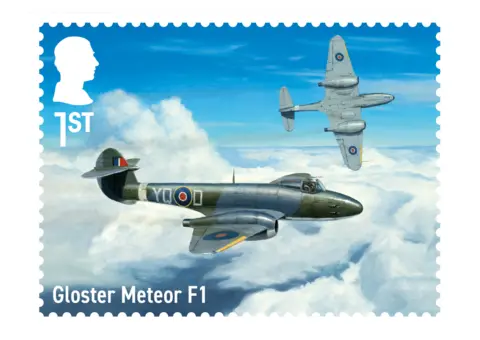
The lessons learned from that plane led to the introduction of the Gloster Meteor fighter in 1943, the first Allied jet aircraft to enter combat during the World War Two, powered by two jet engines based on his designs.
 Royal Mail
Whittle's work went on to see the technology he pioneered put Britain at the forefront of post-war aircraft design, leading to aircraft like the twin tail-boom De Havilland Vampire and the Avro Vulcan.
2026 is also a significant year for those aircraft as it marks the 80th anniversary of the introduction of the Vampire and the 70th of the Vulcan, the last of the so-called V-Bomber force.
The Vulcan is best known for flying more than 6,000 miles from RAF Waddingham in Lincolnshire to bomb Port Stanley during the Falklands War in 1982.
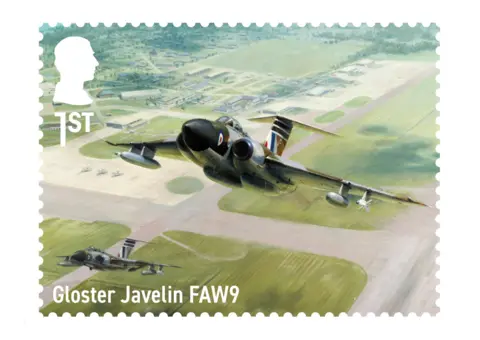
Those aircraft, along with six others, are all commemorated in the second set of stamps:
- Gloster Meteor F1: the first Allied jet fighter to enter combat during the World War Two
- De Havilland Vampire FB5: the first plane powered by a single jet engine to enter RAF service
- Gloster Javelin FAW9: an all-weather delta-winged fighter that served with the Air Force until 1968
- Avro Vulcan B2: the RAF's prime nuclear bomber, which flew the famous Black Buck missions to bomb the Falkland Islands during the war with Argentina in 1982
- Hawker Siddeley Hawk T1: best known as being the aircraft flown by the Red Arrows display team
- Panavia Tornado GR4: a multi-role jet made in the UK, Germany and Italy and the RAF's main strike aircraft during the Gulf War
- Hawker Siddeley Buccaneer S2B: a strike plane designed for the Fleet Air Arm and used by the RAF
- Lockheed Martin F35B Lightning II: an American-made jet used by the RAF and Royal Navy.
David Gold, from Royal Mail, said "Britain has a proud history of aviation innovation, and these stamps showcase some of the military jet aircraft that have played a significant role in that story.
"We are also proud to recognise the contribution of Sir Frank Whittle, whose development of the jet propulsion engine transformed aviation and changed the course of history."
Follow BBC Coventry & Warwickshire on BBC Sounds, Facebook, X and Instagram.