Everything you need to know about airport changes

 BBC
BBCWith the summer holidays finally here, many families in the West and South West are preparing to get away.
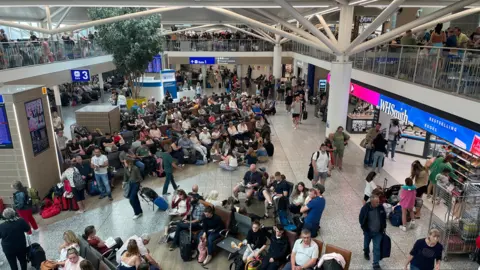
Bristol Airport - the third largest regional airport in England - serves up to 12 million passengers every year, with the highest amount of people travelling through it in August.
In recent months, the aviation industry has had a shake up with new luggage rules, entry requirements and passport laws.
Here is a guide of everything you need to know to avoid getting caught out before you fly.
What liquids can I take through security?
 Getty Images
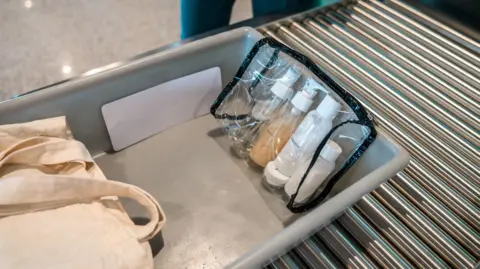
For years, passengers have had to separate their liquids into a clear plastic bag and ensure each container is no bigger than 100ml.
But many airports - including Bristol and Cardiff - have installed new high-tech CT scanners, which allow passengers to leave liquids and electronics in their bags at security.
Passengers departing Bristol Airport can now take up to two litres of liquids, although other airports are still enforcing the 100ml limit.
There are different rules at airports in other countries, so passengers should check security requirements before they travel.
What is the EES system?
 Reuters
A new border control system was rolled out across the European Union (EU) earlier this year.
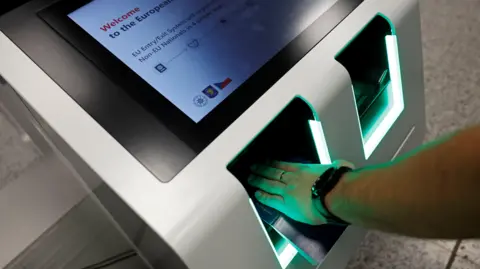
The new biometric Entry/Exit system (EES) requires passengers to register fingerprints and a photo at passport control. The system will later replace the manual stamping of passports.
The EES tracks passengers entering and leaving the Schengen free movement zone, which covers 29 European countries.
"Third country nationals" - including British travellers - must provide biometric data at passport control.
Some passengers, like children under 12, will continue to undergo manual checks by border staff.
Although the European Commission said the system has mainly been working well, there have been widespread reports of long delays at some airports which have led to some passengers missing their flights.
Airports and airlines typically advise passengers to arrive two or three hours before their departure time, but this often depends on the airline and destination.
Passengers can sign up to receive alerts from their airline or travel provider to help them plan ahead.
Changes to e-gates
 Alamy
AlamyThe Home Office has lowered the minimum age for e-gate users.
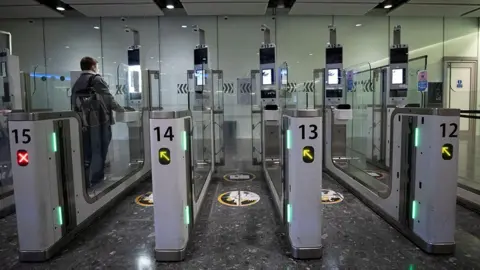
Children aged eight and nine entering the UK from eligible countries are able to use the technology at border control, providing they are at least 120cm (3ft 11in) tall and are accompanied by an adult.
E-gates are designed to speed up border checks by using a digital scanner.
Passengers entering the UK from EU countries, Australia, Canada, Iceland, Japan, Liechtenstein, New Zealand, Norway, Singapore, South Korea, Switzerland, the US, and members of the Registered Traveller Service can use e-gates.
The technology is in place at Bristol, Birmingham, Cardiff, East Midlands, Edinburgh, Gatwick, Glasgow, Heathrow, London City, Luton, Manchester, Newcastle and Stansted.
The 10-year passport rule
 Getty Images
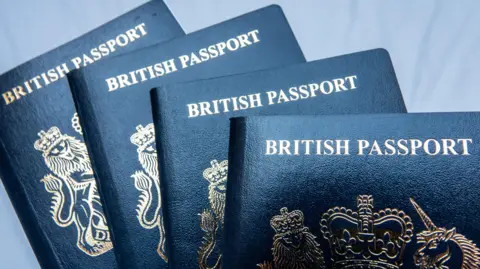
Passengers travelling to and from the EU are being reminded to check the expiry date on their passports.
UK citizens used to be able to carry up to nine months from an old passport over to a new one, but since Brexit, EU countries have stopped accepting passports issued more than 10 years ago.
Iceland, Norway, Lichtenstein and Switzerland also enforce the 10-year validity rule.
Passports must also be valid for three months after the return date.
British passports issued after 2018 are valid for exactly 10 years, while those issued before September 2018 may be valid for up to 10 years and nine months.
Some passengers have been caught out by the rule and been unable to travel.
Passports can be renewed online by HM Passport Office or by using a paper application from some Post Offices.
The process can take up to three weeks, but may take longer during peak travel times.
Emergency appointments can be arranged at passport offices, which offer a one-day and a one-week fast track service. However, the service costs more than a standard application.
What if you miss your flight?
 Getty Images
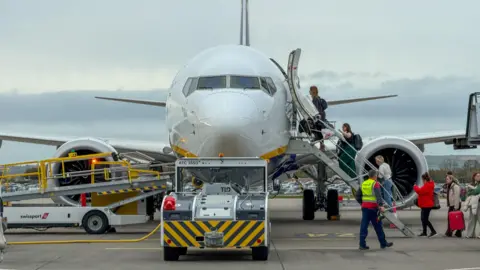
Airlines are under no obligation to book passengers on to another flight without extra charge.
Travel insurance is unlikely to cover the cost of a new flight, hotel, or any other costs incurred as a result of delays from factors like EES queues.
The policies do not cover routine processes - like border control checks - when travelling.
Passengers impacted by cancellations or significant delays caused by the airline have different rights.
Follow BBC Bristol on Facebook, X and Instagram. Send your story ideas to us on email or via WhatsApp on 0800 313 4630.