Summer at Gatwick Airport 'intense' as demand soars

 BBC
BBCSummer is "quite intense" for Gatwick Airport's senior engineering manager, who says he has 40,000 suitcases to deal with on some busy days.
Stevie Summers is responsible for the machinery that delivers luggage from passengers to baggage handlers.
About eight miles (13km) of conveyor belts take suitcases from check-in to take-off, handling 12 million items of luggage each year.
For summer 2026, the airport has 63 airlines operating flights - the highest ever number - to 230 destinations.
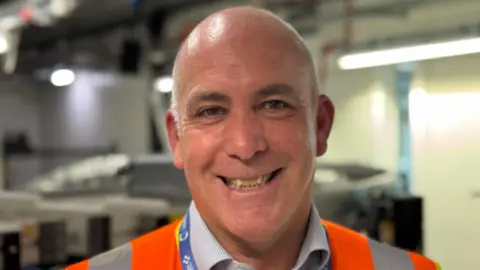
The baggage system runs for 20 hours each day, according to Summers.
"There are peaks and troughs with how our partners fly, but we're at it outside the 20 hours obviously doing our maintenance and all the other things we need to do to be prepared on a daily basis," he said.
The room is noisy as bags travel round the conveyor belts. There are 4,000 individual belts, software and hardware, as well as people's behaviour – what they attach to their suitcases and put in them - to contend with.
The team does a lot of seasonal planning to cope with higher demand in the summer months, working with colleagues across the airport to make sure that "on a bad day, it's seamless and you don't notice," Summers told the BBC.
"We drill ourselves to be ready for the worst day possible, so everyone takes pride in what they do and it's stressful but it's why we're here."
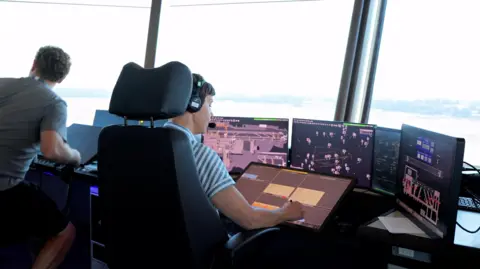
Once luggage – and passengers – have embarked their planes, it's the air traffic control teams who get the aircraft into the air.
Oscar Day has been in the industry for eight years.
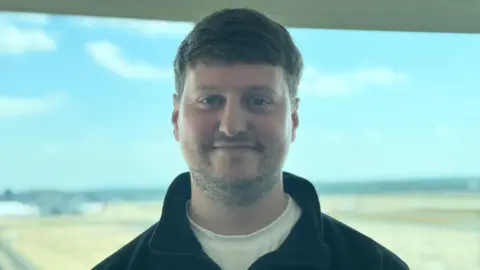
"It's sort of nerve-wracking when you first apply for the job…but it's such robust training that when it comes to validation [receiving their licence] you feel totally confident in the procedures and your ability and it's just enjoyable," he said.
Air traffic controllers at Gatwick are provided by external company NATS.
They cannot work for more than 90 minutes without a break due to the pressures of the role and the need for a heightened awareness of everything going on around them.
If air traffic controllers wish to move airport they have to undergo further location-specific training, which can take many months.
"It's much more enjoyable during the summer, it stops being a job then," Day said.
"It's much more interesting when you've got things moving, things going on and you just do the best you can to get them going as soon as you can."
The airport's busiest days are expected to be the first, second and third Sundays of August, with around 900 flights scheduled on peak dates.
'Business as usual'
On the tarmac, the runway is looked after by a team of nine who ensure it is maintained to operate 24 hours a day.
The wider airfield operations team works closely with air traffic control, keeps wildlife away from aircraft, and helps to marshal planes when needed.
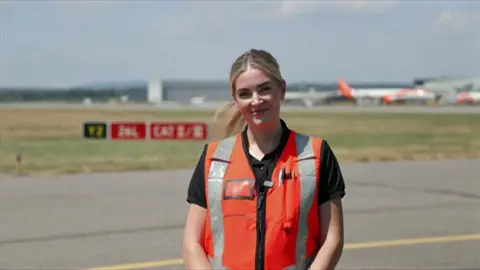
Airfield operations controller Danyell Wickham helps ensure the safety and compliance of the airfield.
Standing on the side of the runway, Wickham explained the team could deal with up to 900 aircraft movements a day in the summer "and 57 movements an hour sometimes".
"We also need to make sure that we get maintenance done in certain areas, so it's just making sure that everything lines up.
"We can close certain areas of taxiways or stands to make sure that the airfield gets the maintenance it needs."
Wickham said the summer period for her team was "business as usual" as they maintained the tarmac to a high standard all year round.
"The fact that we can take so many movements on a single runway is amazing," she said.
"Everyone works so well together, so it's really rewarding when you get through a really safe, compliant and a brilliant day."
Follow BBC Sussex on Facebook, on X, and on Instagram and listen to BBC Radio Sussex on Sounds. Send your story ideas to southeasttoday@bbc.co.uk or WhatsApp us on 08081 002250.