Can airport really go carbon neutral amid plans to expand flights?

 BBC
BBCGiant heat pumps, electric vehicles, and new fuel efficient planes are being ordered by an airport introducing major changes to cut its carbon emissions.
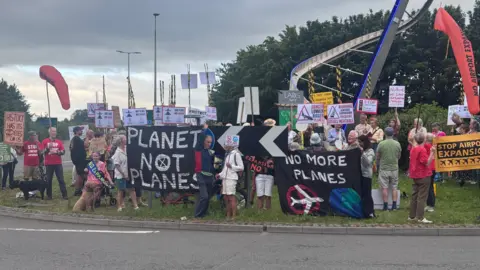
But climate campaigners say the measures "barely touch the surface" of the problem. They say 99% of the carbon emitted by the airport is from planes, and have urged council leaders to reject plans to allow the airport to expand its flights.
Mary Collett, from Bristol Airport Action Network, said: "With the weather like this at the moment, the unbearable heat, the fact that we can't grow food as easily, we just can't carry on expanding airports, we all just need to fly a bit less."
But like many regional airports, Bristol is keen to expand, and has applied to grow from 12 million passengers a year to 15 million, which airport bosses insist can be done "sustainably".
Dave Lees, the airport's chief exec, said new planes are greener than ever, and that Bristol will be "the first airport to be net zero by 2030" - but crucially this does not account for emissions from flights.
People's desire to travel seems limitless, with airlines able to sell more flights to more destinations. The UK Government has backed expansion of regional airports to "drive economic growth".
But as the impact of a changing climate is felt in repeated heatwaves, droughts and wildfires this summer, how can we fly around the world without costing the earth?
Greener planes?
Right now, councillors in North Somerset, Bristol Airport's local authority, are reading an ambitious expansion plan.
Airport chiefs wants to add another 15,000 flights a year, raising their cap to 100,000.
This means a bigger terminal building, and controversial new landing lights on ancient common land next to the airport.
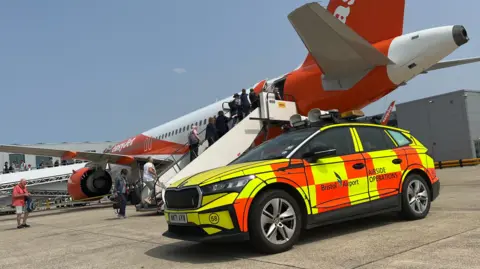
Many of the new flights are on EasyJet planes, and the airline has invested in new aircraft which it says cuts fuel use, and so carbon emissions.
The Airbus NEO jets, with wings designed nearby in Filton and built in the UK, have cut fuel consumption by 20%.
Kevin Doyle, EasyJet's UK manager, said: "Our roadmap is by 2050 to get to net zero, and this aircraft very much helps us on that path.
"Within Bristol we've actually got 13 of the 20 aircraft that are here from that next generation," he said.

But climate campaigners insist any cut in the fuel used per aircraft would be "overwhelmed" by the increase in flights.
Collett said: "When they are adding another 15,000 extra flights, being more fuel efficient isn't going to make much difference.
"People are flying on holiday to places where there are wildfires, where they can't go out of their hotel. What kind of world are we building here?"
A 'Zero Carbon Airport'?
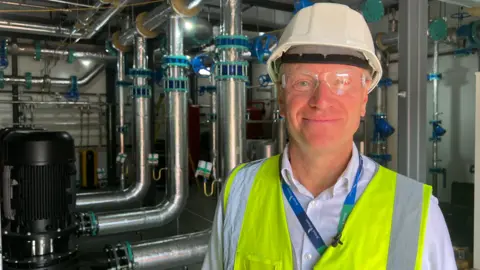
Bristol Airport has pledged to become carbon neutral by 2030 by switching to electric vehicles, and powering the site with solar panels and 22 new industrial scale heat pumps.
But this net zero target does not include emissions from flights. These vastly outweigh the amount of carbon produced by the airport site, and are accounted for separately by airlines.
"We're on a journey towards that transition to net zero," said Lees.
"It's not just a quick flick of the switch. That's going to take some years, and for aviation there are lots of levers we're pulling."

Members of campaign group Bristol Airport Action Network have welcomed the renewable energy improvements, but insist they are not the real problem.
"It's the aircraft. Aviation is the hardest sector to decarbonise, so we cannot carry on expanding airports," Collett added.
In 2024, Bristol Airport's direct carbon emissions were the equivalent of 3,680 tonnes of CO2, compared with 682,167 tonnes from indirect emissions including flights. That's equivalent to driving 2.12 billion miles (3.41 billion km) in a car - enough to circle the Earth around 85,000 times.
The UK Climate Change Committee has estimated that by 2040 aviation will account for a quarter of the country's carbon emissions. This is because other sectors are switching to renewable energy faster, and aviation has no realistic alternative to jet fuel from oil.
Meanwhile the Met Office has said that the summer's heatwaves, which have "smashed records", are becoming more frequent and intense due to human-caused climate change.
'Just fly less'
For campaigners, the only solution is to fly less and limit airport expansions until planes can run on genuinely renewable fuel, like electricity or possibly hydrogen.
Collett said: "With the weather like this at the moment, the unbearable heat, the fact that we can't grow food as easily, we just can't carry on expanding airports, we all just need to fly a bit less."
But the UK government has explicitly backed the expansion of regional airports outside London as a "driver of economic growth".
For aviation bosses, cutting carbon emissions as much as they can is an imperative. EasyJet, and other airlines, are investing in the latest, more fuel-efficient aircraft.
Standing by his new jet as passengers stream on to it, bound for a summer break in Croatia, Kevin Doyle from EasyJet defends putting more planes into the sky.
"There's a passenger demand for it," he insists. "That's why we've got our flights. And with the new aircraft, they are more fuel efficient than ever."
Follow BBC Bristol on Facebook, X and Instagram. Send your story ideas to us on email or via WhatsApp on 0800 313 4630.