As heatwaves strike, Europeans turn to prized Chinese air-conditioner

 Getty Images
Steven Scholtysek, 36, is no stranger to Europe's heatwaves. The German engineer has lived through sweltering summers since his childhood.
But this year the heat has been especially unbearable. Western Europe has experienced its hottest June on record, and cities across Germany saw temperatures rise above 40C (104F). The region is bracing for more heatwaves before the summer ends.
To make things worse, a few months ago Scholtysek moved into an attic apartment - the kind that's notorious for overheating.
"It's not possible to live a normal life in those flats, below the roof, in summer heat," says Scholtysek, who lives in the town of Hamelin, north-central Germany.
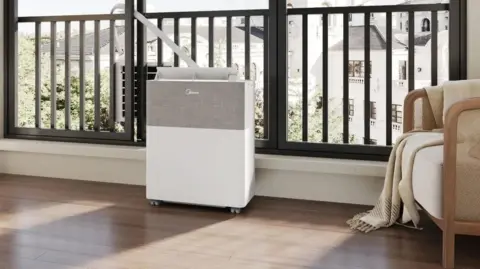
He soon stumbled upon the PortaSplit, a portable split air-conditioner made by Chinese home appliance giant Midea, designed to meet European regulations - an appliance that has become one of the most sought-after products in the region this summer.
"It was a game changer," he says.
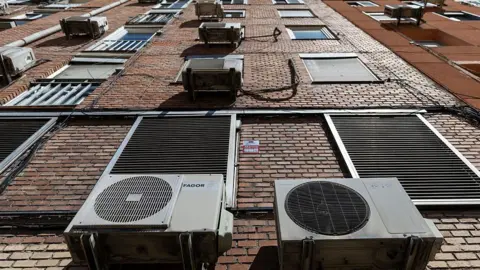
His experience is one that is becoming increasingly common across Europe - a region with typically low air-conditioning ownership rates, as heatwaves grow more intense.
Cooling measures
A previously little-known brand in Europe, Midea has become a household name this summer because of the PortaSplit.
Units have sold out in stores over the past few weeks, and models have even popped up on resale sites, where they are marked up to double or even triple its original retail price of around €750 (£639; $856).
There's even a site dedicated to tracking the availability of these units, called MideaFinder.
Much of the craze has centered around the models' ability to sidestep structural constraints, including strict historic-preservation rules in many European cities that restrict exterior-wall modifications such as drilling for external AC units.
 Midea
MideaThe PortaSplit, which comes with a lightweight outdoor unit that users can perch outside their windows themselves, advertises itself as "perfectly compatible with most European window types".
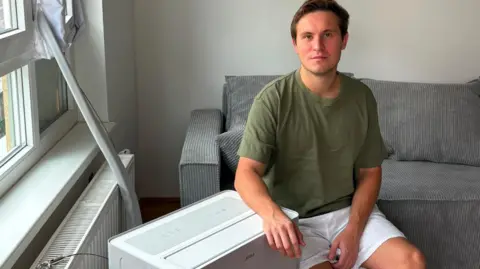
"Midea solved this problem in quite an interesting way," Denis Yurchak, a Vienna resident, tells the BBC.
Yurchak first came across the PortaSplit a few weeks ago, while researching air-conditioners to tide him through the heatwave.
From glowing online reviews to forums dedicated to exchanging tips about air-conditioners, the 27-year-old quickly realised there was "a kind of cult about Midea".
And since raving about his PortaSplit on X, he has also been co-opted into the community - he says he has been receiving curious messages about the air-conditioner every day.
During the worst of the heatwave, Yurchak said he "basically had it on 24/7".
 Denis Yurchak
In countries like France, Spain, Germany and the UK, Midea sales surged more than 70% year-on-year, the company told Chinese state media the Global Times - though its Europe office has declined to confirm these figures to the BBC.
And they're not alone.
Chinese company TCL Technology told the Global Times that its air-conditioner sales have jumped more than 300% in France alone.
Chinese manufacturer Gree, one of the world's biggest air-conditioner makers, told the BBC that their air-conditioners had seen "noticeably stronger demand this summer".
"Many of our customers are first-time buyers," Gree said in a statement. "The increasingly frequent and prolonged summer heatwaves have clearly changed consumer attitudes."
But the use of air-conditioners isn't without its drawbacks.
Air conditioning accounts for 7% of the world's electricity use, and releases 2.7% of the world's carbon dioxide (CO2) emissions from fossil fuels and industry, according to one 2024 report.
Environmental advocates and politicians across Europe have long opposed air-conditioners for their consumption of electricity. Some argue that the air-conditioners, which expel hot air outside, could exacerbate outdoor temperatures in densely populated areas.
Some residents simply see air-conditioners as a wasteful purchase for what is usually a week or two of uncomfortable heat - though for others, it is a necessary purchase.
In late June, hundreds of schools were forced to close as France recorded its hottest day on record. France's power utility announced days later that it would commit €80m (£68m; $91m) to installing cooling systems - including fans and air-conditioners - in schools and community leisure centres.
The World Health Organization's Europe office has recommended a "nuanced approach towards the use of AC", saying that while it is not a sustainable solution to dealing with extreme heat, it "remains crucial to protect populations at increased risk from high temperatures".
 Getty Images
Shaking off a 'Made in China' stigma?
All of this has been hailed by Chinese media as a win for Made in China goods - a label that is commonly associated with more low-quality, often cheaply made products.
"The fact that Chinese air conditioners have become a necessity for Europeans is not merely a trade phenomenon, but a microcosm of 'Chinese-style empowerment'," reads a commentary by state media outlet People's Daily.
In fact, European PortaSplit owners tell the BBC that they were surprised to find out it comes from a Chinese brand.
"The marketing and design, it was not typical to what I was used to of older Chinese products. It was more modern," says Scholtysek in Germany. "Also, when I got it, the quality was comparable to what I was used to from Europe or somewhere else."
Launched in Germany in 2024, the PortaSplit is advertised on its website as a combination of "German engineering" from Midea's research centre in Stuttgart with "Italian design".
This is part of a "general shift" in the image of Chinese tech products, Scholtysek says, from drone maker DJI to electric vehicle brands.
And after buying the PortaSplit, Scholtysek even decided to buy shares of Midea stock - a sign of his confidence in the company's prospects.
This confidence is also shared by those at Midea. Ralph Kobsik, the general manager of Midea's Europe operation, told the BBC in a statement that they "see considerable long-term growth potential in Europe".
He added that the company would "continuously invest in technologies that meet the specific requirements of European consumers".
One of those satisfied consumers is Adrien Olar in France, who recently bought his first air-conditioner: a Midea PortaSplit.
"This is maybe my first Chinese product," the 26-year-old says, describing it as a "revolution". For days before his PortaSplit arrived, he had resorted to squirting water on his face to keep cool at home.
But those days are behind Olar now: "It's like going into a fridge when I go into my room. It's a very, very good difference."