Trust changes baby growth monitoring after feedback

 Getty Images
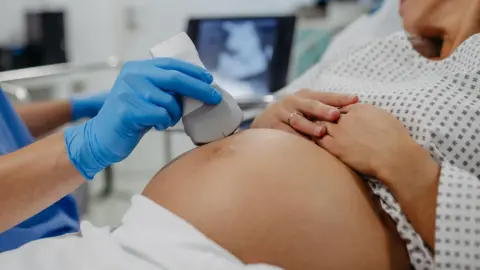
An NHS hospital trust is changing the way it monitors babies' growth in pregnancy following national reviews and concerns raised by bereaved parents.
Oxford University Hospitals Trust (OUH) said all women identified as having a risk factor for their baby not growing as expected will be offered scans beyond 36 weeks.
It follows feedback from recent reviews by Baroness Amos and NHS England.
The trust said the change would bring scanning in late pregnancy in line with the Saving Babies' Lives national guidelines, which are designed to reduce the rate of stillbirths.
OUH also announced it had commissioned an independent review into its policy of giving all women an extra scan at 36 weeks, which has been criticised for not following NICE guidelines.
The national maternity and neonatal review led by Baroness Valerie Amos found some families reported they were not being listened to at OUH, and felt the hospital trust "prioritised doing things the 'Oxford Way' over their care preferences".
 OUH
OUHDuring their visit, the investigation team considered the trust's practice in relation to antenatal ultrasound scanning.
The report, published in June, said NICE recommends that for uncomplicated, single pregnancies, two scans are performed - a dating scan between 11-14 weeks and an anomaly scan between 18-20 weeks.
It added that NICE states not to routinely offer ultrasound scans after 28 weeks for uncomplicated, singleton pregnancies.
But at OUH, all women including those without risk factors are currently offered a scan at 36 weeks as part of the Oxford Growth Restriction Identification Programme (OxGrip).
It is an antenatal care and foetal scanning pathway introduced in 2016 to identify babies at risk of foetal growth restriction and prevent stillbirths.
'Vital importance'
Amos' team raised concern the policy "impacts on its capacity to deliver scans to those women who have a clinical justification for requiring a scan" in later pregnancy.
Alice Topping, whose daughter Smokey died during labour at the John Radcliffe Hospital's maternity unit in September 2023, said her baby's death was "entirely preventable" after she went five weeks without a scan and had an induction timed "incredibly late".
Topping was 41 weeks and two days into her pregnancy when her daughter died.
She recalled how her midwife had ordered a scan after her bump height dropped - a known high-risk factor for stillbirth.
She also said she made 44 calls to the hospital in an attempt to get a scan after the request was refused.
An external investigation carried out by Maternity and Newborn Safety Investigations found parts of her care had not complied with national guidelines and staff had failed to listen or act on her concerns.
 Alice Topping
Topping said: "As growth restriction is the biggest preventable cause of stillbirth, the changes are of vital importance for families across Oxfordshire.
"Why has it taken nearly three years after our daughter's death for the trust to implement Saving Babies Lives, an initiative all trusts were supposed to have fully implemented long ago now."
She also said the changes raised further questions, adding: "How was a trust allowed to deviate from national standards for so long in such a high risk area?
"There is still no accountability for our daughter's death and for the babies who should be here if care had followed national guidelines in growth monitoring."
A spokesperson for OUH said they had acknowledged feedback from all recent reviews and from women and families.
"It told us that women wanted greater consistency and clarity in growth scan monitoring in late pregnancy," they said.
"In response, we are bringing our late-pregnancy surveillance fully into line with the Saving Babies' Lives Care Bundle.
"We are commissioning an independent review to examine our scanning pathway, and we will act on its findings."
OUH added that anyone with concerns during pregnancy, including reduced foetal movements, should contact the service for advice.
NHS England has been approached for comment.