US strikes hit Iran for seventh consecutive night

 Getty Images
The US military said it carried out the seventh consecutive night of strikes on Iran since President Donald Trump declared their temporary ceasefire agreement "over".
US Central Command (Centcom) said its forces "hit surveillance sites, military logistics infrastructure, underground weapons storage, and maritime capabilities".
Iran said it responded by targeting US allies in the region including Kuwait, which said a power plant, water distillation plant and an oil facility had been hit.
It marked a full week of renewed hostilities which also saw the US reimpose a blockade of Iranian ports and Tehran declare the Strait of Hormuz shut, as their preliminary deal to end the war faltered within a month of its signing.
They agreed to stop fighting in mid-June to enable talks for a permanent peace, but negotiations appeared to make little headway and Trump declared the deal over on 8 July.
Kuwait's state news agency said on Saturday that an oil facility had suffered significant damage, and reported injuries resulting from "repeated Iranian attacks".
Jordan's military also said it had intercepted 10 Iranian missiles fired into its airspace overnight, without reporting any damage, while Bahrain said its air defences had "thwarted" Iranian attacks.
The secretary general of the Gulf Cooperation Council said the attacks on Kuwait, Jordan and Bahrain were "a grave violation of international law" and accused Tehran of deliberately targeting civilian infrastructure in action constituting "war crimes".
Jasem Mohamed Albudaiwi, who leads the council representing six states - Saudi Arabia, Kuwait, Qatar, Bahrain, the United Arab Emirates and Oman - said the "dangerous escalation" required international accountability.
It came as Iran's Deputy Foreign minister Kazem Gharibabadi told state media that Tehran had been "engaged in negotiations" but had suspended its obligations under the deal after the US "carried out these aggressive actions".
The ceasefire was largely observed, despite Iranian attacks on oil tankers to force them to comply with its demands that ships seek authorisation to cross the Strait of Hormuz - through which a fifth of the world's oil and liquefied natural gas ordinarily transits - followed by US strikes.
 Reuters
Centcom said its latest wave of strikes had ended after several hours at 21:30 ET on Friday (02:30 BST Saturday).
"US forces employed fighter aircraft, aerial drones, and warships in addition to other assets," it said in its statement.
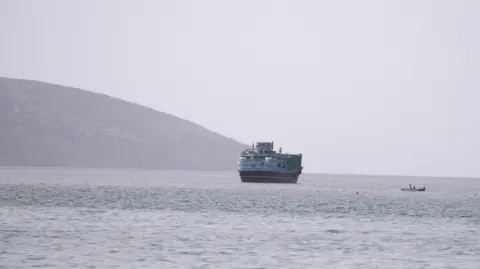
Explosions were heard in the central city of Yazd and at Qeshm island and the port of Bandar Abbas next to the strait, Iranian state media reported.
BBC Persian has verified two videos showing damage and debris on and near the twin Shahid Mirzaei tunnels, a route running north of Bandar Abbas.
Local authorities also said an attack on electricity facilities and desalination pumps at a plant near Jask had left about 10,000 people in 20 villages without drinking water.
Meanwhile, more than 100 telecommunications masts were knocked out of service, disrupting landline, mobile and internet services in northern Hormozgan province.
The US military also denied a report in Iran's Fars news agency that two oil tankers "exploded and caught fire while passing through a mined route south of the Strait of Hormuz". Centcom said: "Like most IRGC claims, this is false."
The latest attacks came after Iran's armed forces claimed on Friday to have attacked multiple US military facilities across the Gulf region in Kuwait, Bahrain, Jordan and – for the first time – Syria, which the US denied.
Sources told the BBC's US partner CBS news that several American service members were injured during Iranian attacks on two Jordanian bases over the past week.
The US meanwhile denied Tehran's earlier claims that the US attacked civilian infrastructure in Iran, including bridges, a train station and an airport.
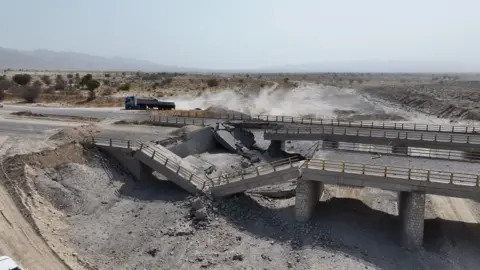
BBC Verify and BBC Persian verified footage of damage to Gariveh Bridge, after night videos showed a ball of flames on top of it.
Daylight images showed a crumbled stretch of road with rubble around the broken bridge. Provincial authorities in the affected region, Hormozgan province, said seven people were killed in the attacks.
A White House spokesperson told the BBC the US had "carried out strikes exclusively on military targets, including military logistics infrastructure".
The US also said it had destroyed a control tower in the port of Chabahar, with Defence Secretary Pete Hegseth sharing an image of the tower collapsing as it was hit by a strike. Centcom said the tower was part of an IRGC maritime surveillance network.