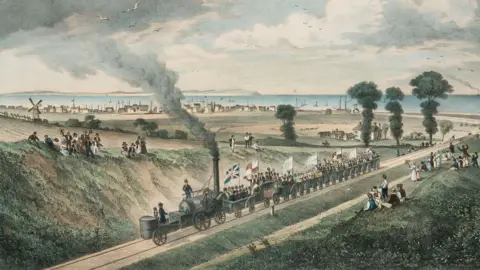
The seaside engine created by George Stephenson

 Science & Society Picture Library
A 19th Century steam-powered passenger railway service between the north Kent coast and the city of Canterbury has been described as "pioneering".
The Canterbury and Whitstable Railway, known by many as The Crab and Winkle Line, was originally intended for taking freight from the coast to the city.
The six-mile (9.6km) railway line was officially opened on 3 May 1830.
Peter Banbury, from Whitstable Museum, told Secret Kent: "The concept of passengers suddenly formed in people's heads as a way of making money."
The railway option had been chosen after experiments involving carts and a canal hit quicksand and were abandoned.
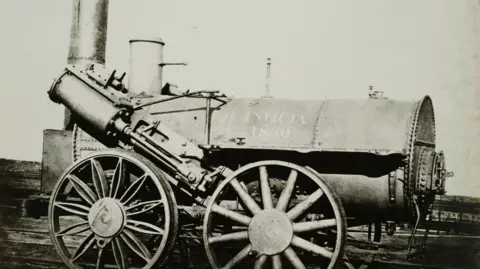
The Invicta locomotive was developed as a step up from George Stephenson's Rocket.
Stephenson, who had a formidable reputation in the north of England, took over the design of the project.
Invicta still exists and can be visited at Whitstable Museum.
Banbury said: "Invicta was the improved version of Stephenson's Rocket.
"It had similar characteristics, but it also has a four-wheel drive.
"This is because Whitstable is on a hill, and to get up it it needed lots of traction.
"It was a really powerful modification of the Rocket with more steam production and a bigger fire."
 Science & Society Picture Library
Invicta was steam-driven for the first two miles out of Whitstable.
"Then everything stopped, a rope was attached to the wagon and it was pulled uphill by a stationary engine."
Banbury said: "It was hugely innovative."
The passenger service lasted in different guises until 1931 when the railway became freight only.
"Motor transport came in. It allowed you to stop off in various places and take different routes," added Banbury.
The railway finally closed in 1952.
Today, a national cycle route follows what would have been most of the line's journey.
Follow BBC Kent on Facebook, on X, and on Instagram and listen to BBC Radio Kent on Sounds. Send your story ideas to southeasttoday@bbc.co.uk or WhatsApp us on 08081 002250.