Water firm has avoided hosepipe bans for 30 years

 EPA
EPAAs Severn Trent Water's Howard Perry says, it has been "very hot this year".
With three heatwaves under our belts so far, the Met Office has described 2026 as an "extraordinary year" with more days above 30C already than during the whole of 1976 - a year famous for its scorching summer.
June was the warmest ever for England, the forecaster said, as well as the second hottest for the UK and Wales in records dating back to 1884.
And as we wilt in the heat and try to keep ourselves cool and hydrated, Severn Trent says we are using more water than ever before.
Despite this, it has managed to avoid enforcing any restrictions, including hosepipe bans - with the last coming 31 years ago.
However, the company says it needs help from customers to keep that record going.
How much water are customers using?
Severn Trent supplies more than eight million people in England and Wales, including 4.8 million properties in the Midlands.
It said 11 July saw the highest demand for water on record.
For that day, and for some preceding days, people used almost 2.4 billion litres, which was 400 million litres more than usual, Severn Trent said.
The volume was enough to provide water to two million people, or the equivalent of 700 million pints.
"We have seen very, very high levels of water consumption right across the region and that is creating some pressure for us on the network," said Perry, Severn Trent's water networks operations lead.
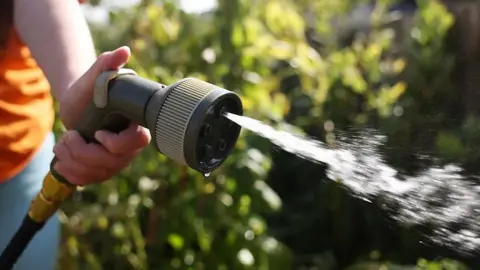
The company put the higher demand down to more people using water for activities like watering gardens and filling paddling pools.
It said people could help out by doing things like using a watering can instead of a sprinkler, letting lawns recover naturally, reusing water from paddling pools on plants and running washing machines and dishwashers with full loads.
The firm said it was this help from customers, coupled with its work tackling leakage and its investment in pipes that had helped it maintain its three-decade record.

What about elsewhere?
The situation for Severn Trent is not unique - but the firm's ability to stave off regular bans seems to be.
Over the company's border to the east, Anglian Water says it is seeing record levels of demand, the equivalent of having "four additional Milton Keynes" to supply on the hottest days.
Dr Geoff Darch, head of strategic asset planning at Anglian, said because of this "huge additional demand" it had made the "difficult but necessary decision" to bring in a ban from Saturday 11 July.
Affinity Water, Cambridge Water, South East Water and Southern Water have also followed suit already this summer.
While water firms restricting use during droughts is nothing new, the benchmark was the infamous summer of 1976, when a long-running drought ended up with household supplies restricted and standpipes introduced.
The summer of 1995 again saw widespread hosepipe bans - including the last time Severn Trent brought in the measure.
Other firms have since needed to restrict use in 2006, 2012, 2022, and last year.
How are water supplies looking?
According to the latest reading on its website, taken on 13 July, the capacity of Severn Trent's reservoirs was at about 77.4%.
"That is OK for the time of year," Perry said, "but… if consumption is high through the summer, it can drain those [the reservoirs] down quicker than we would like.
"That's why it's important customers use water wisely."
At Tittesworth Reservoir near Leek, Staffordshire – one of the company's smallest – capacity was at about 55%.
"It does drain down a bit more quickly than some of our others, so it's not unusual, but it is one of the early warnings for us to be getting the message out," Perry added.
"If customers use water wisely, that gives us the best chance of getting through the summer without any restrictions."
Perry said overall, the reservoirs were in better shape than they were last year due to 2026 being wetter.
"If you cast your minds back to last year it was very hot but it was also very dry," he added.
"It's been a bit wetter so our reservoir position is broadly in a better place than it was last year, which is good."
 Severn Trent Water
How are leaks being managed?
According to government figures, Severn Trent lost 88.25 litres of water every day per property through leakages from 2024 to 2025.
The firm said its engineers take them "very seriously" and fix up to 121 leaks per day across the network.
Perry said a major part of a water company's duty was to reduce leakages, which he said the firm was doing "every single year".
"That's an important part of making sure there's enough water to go around," he added.
"We've been repairing more and more leaks every year. We've got people out 24/7 fixing all the leaks we find."
Asked why so much was being lost through leaks, he said it was down to the "ageing infrastructure" and Severn Trent was investing money in upgrading it over the next few years.
"Ultimately, to reduce leaks you've got to repair them, which is why we need to be finding and repairing them all the time," he added.
Perry said a third of leakages happen on customers' properly and urged people to report them immediately.
"What we do behind the scenes is make sure we're prepared and ready to go to repair those leaks as soon as soon as possible."
How does it keep water supplies from getting low?
Perry said the company had a few ways it could move water around the network from a variety of sources.
He also said its 24/7 operation to fix and reduce leaks across the network, along with urging customers to think about their usage, made a "huge difference".
"That's often an easier and cheaper way of getting to the same thing - which is making sure everyone gets enough water," Perry added.
However, there were areas like north Staffordshire, which was "at a bit more risk" than other parts of the region.
Perry put this down to the "legacy of the network" along with the rise in demand caused by increasing population sizes.
He said the firm was looking at moving more water to north Staffordshire, when needed, from areas where it was more readily available.
Severn Trent is also planning to construct a 21-mile (34km) pipeline from Carsington Water in Derbyshire to Tittesworth.
Perry said: "That's the sort of long-term infrastructure investment we consider all the time to make sure there's enough water not just this year but in future years as well."
Could we still see a hosepipe ban?
Perry said the company took pride in not needing to enforce a hosepipe ban since 1995.
"That's the product of lots of work going on behind the scenes every day to avoid that," he added.
But he said the best chance to continue avoiding one was if customers used water wisely.
"Our reservoir position is in a pretty good place but we've got some hot and dry weather coming along and none of us can predict the weather for the rest of the summer," he added.
"Customers can really help us to avoid any of those restrictions."
Follow BBC Stoke & Staffordshire on BBC Sounds, Facebook, X and Instagram.