Sark fire hotspots continue on 'tinder dry' island

 Gordon Dawes
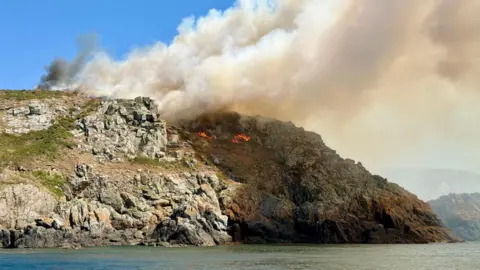
A fire chief says "tinder dry" conditions are causing "hotspot" areas on Sark where it takes "the slightest thing" to start a fire.
Kevin Adams, Chief Fire Officer for Sark Fire and Rescue Service, said eight hotspots had been identified over the last three days, after a blaze on 10 July was declared a major incident, and he added rain was needed to break the cycle.
A hotspot is an area of elevated temperature which can be detected by satellite thermal sensors and make a fire more likely.
Adams said fire crews based in Little Sark were checking known hotspots morning and night, after the earlier blaze took 30 hours and 40,000 litres (400 tonnes) of water to put out.
'Conserve water'
Meanwhile, Adams said the assistance of his 16 crew, volunteers and Guernsey Fire was "invaluable" when a major fire broke out on 10 July.
He said they had to fight the fire "from six different places in one go".
"It was just vast," he added.
On the ongoing hotspots, he added: "It's continuous, we need some appreciable rain and that's what we're missing."
He said it was a case of tackling the at-risk areas while also "trying to conserve water".
"There was a hot spot this morning, there were three yesterday, there were four the day before. It's going to continue," he added.
"It's been a dry spring and a very dry summer and everything is tinder dry. It just needs the slightest thing to start it."
Adams said the path in the area of the fires would likely be closed "until the end of the year", with gorse that acted as a "safety barrier" now burnt down, leaving the path "very close to the cliff edge".
"It's all slippery and unsafe because it's all so dry," he added.
Thanking volunteers who helped tackle the major incident blaze, he said they had raised £12,000 through donations for firefighting efforts.
"It will make better resilience for us if when it happens again."
He said he hoped this was not the "new normal" because many things would have to change, including preparations at the start of summer.
Follow BBC Guernsey on X and Facebook and Instagram. Send your story ideas to channel.islands@bbc.co.uk.