Sheryl Crow: 'Resurrecting Tupac with AI is hateful'

 Getty Images
Sheryl Crow has something to get off her chest.
Over the years, the nine-time Grammy winner has never been scared to voice her opinion.
Known for the classic roots rock of songs like My Favourite Mistake and All I Wanna Do, she has also used her voice to campaign on issues like gun control and climate change.
Now, she has her sights set on Artificial Intelligence.
The title track of her new album, Evolution, grapples with the impact of AI on people and the planet.
Speaking to the BBC, she characterises the technology as a “slippery slope” and “a betrayal” that “goes against everything humanity is based on”.
Her attention was focused on the software last year, after meeting a young songwriter who’d been employing it in her work.
Frustrated that male artists wouldn’t listen to her demos, Crow's acquaintance paid to have an AI clone of singer-songwriter John Mayer replace her vocals.
When Crow heard the song, she was so “terrified” that she was “literally hyperventilating”.
“I know John and I know the nuances of his voice,” she says. “And there would be no way you’d have been able to tell that he was not singing that song."
Her horror deepened when Drake used AI to resurrect the voice of late rapper Tupac Shakur on his song Taylor Made Freestyle earlier this year.
The track was subsequently removed after lawyers from Tupac's estate threatened to sue, but Crow says it should never have been released in the first place.
“You cannot bring people back from the dead and believe that they would stand for that,” she protests.
“I’m sure Drake thought, ‘Yeah, I shouldn't do it, but I'll say sorry later’. But it’s already done, and people will find it even if he takes it down.
“It's hateful. It is antithetical to the life force that exists in all of us.”
 Will Scown
As the mother of two teenagers, she’s worried about the implications of AI not just in music, but in politics and society.
If voices and likenesses can be faked, how do we stop the spread of misinformation? And what happens to the workforce when AI takes over everyday tasks?
“I talk to my kids about it,” she says.
“I'm like, ‘You're growing up with this thing and it doesn't seem dangerous to you because you're a frog in a pot of water. But the water is only just starting to boil, and you won’t realise it's getting hotter until we're all floating on the top’.”
The star has already called on politicians to enact tighter controls on AI - but although she’s concerned about the rapidity of its progress, she also sees a sliver of hope.
“AI can do lots of things, but it can't go out and play live,” she says.
“So as long as we have live music, as long as we have hands holding a paintbrush, all is not lost.”
'I wanted swagger'
Live music is on her mind because Crow has just wrapped up a week of UK concerts in historic venues like Blenheim Palace and Hampton Court.
The setlists leaned heavily on her first four albums, including 1990s radio staples like Everyday Is A Winding Road, Soak Up The Sun, My Favourite Mistake and Leaving Las Vegas.
The 62-year-old says she’s content playing the hits.
“What a gift, to be able to go out and play at my age. I literally look at my band and go, ‘I can't believe we're still getting to do this!’” she laughs.
Relaxed and convivial despite her jetlag, Crow exudes just enough rock star energy to turn heads as she walks through the BBC in a plum velvet waistcoat and flared blue jeans.
But despite 50 million record sales, she gives the impression that her career is one big happy accident.
In a way, it is.
'More swagger'
Born in Missouri, Crow was a high-achiever at school becoming an all-state track athlete and a majorette - but she never quite fitted in, constantly finding herself “on the periphery of a lot of different groups”.
Music was her outlet. Rejecting “corporate” bands like Boston and Foreigner, she gravitated towards the grit and glamour of blues and rock.
“I wanted more swagger, you know? Led Zeppelin, The Rolling Stones, that kind of thing.”
Her first group didn’t offer much opportunity for swagger. A covers band playing weddings and events, their repertoire consisted of hits by Huey Lewis and Heart. “All the greats from 80s,” she grimaces. “Not my favourite period of music.”
After school, she studied classical piano, then moved to St Louis to become a music teacher, while moonlighting as a club singer.
“One night, a producer came in and asked if I’d come in and sing a couple of jingles for him, and those jingles paid me more money than all my years of teaching.”
She made enough from Toyota and McDonald’s to move to LA, armed with a demo tape of her commercials.
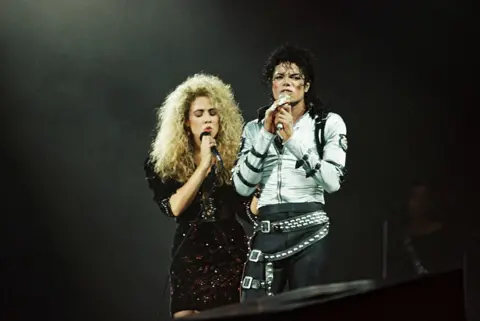
That led to more work as a session singer and, eventually, a stint on Michael Jackson’s Bad tour (he used to throw sweets at her over the dressing room wall).
“After the Jackson tour, I’d had all this exposure and I tried to get a record deal,” she says.
“But I wasn’t a technical singer like Whitney Houston or Mariah Carey, and I wasn’t interested in doing the dance music thing like Madonna and Paula Abdul.”
 Getty Images
Eventually, A&M Records took a punt – impressed by a self-produced demo that was heavily influenced by Sting and Peter Gabriel's solo albums.
They paired her with Sting's producer, Hugh Padgham, but once the album was finished, Crow lost confidence in the material.
“I couldn't find myself in it. The songs were sort of innocuous and it didn’t really represent who I wanted to be.”
When she told the label, they weren’t impressed.
“That record cost a lot of money. I’m talking $450,000 in 1990s money, and they needed to make that money back.
“So it was really, really hard. They weren't in a hurry to put me back in the studio.”
Scrapped album
In the end, she fell in with a songwriting collective, the Tuesday Music Club, through her then-boyfriend Kevin Gilbert. Each week, they’d gather in Pasadena and try to write a complete song before dawn broke.
The sessions were recorded by Michael Jackson’s producer Bill Bottrell for “about two cents” and released as Crow’s debut album in 1993.
Blending roots, Americana, emotional confessions, melody and intelligence, the album was slow to catch fire. It didn’t even chart for the first seven months of release.
In the UK, Danny Baker was an early champion, playing the singles Run, Baby Run and Leaving Las Vegas on BBC Radio 1 - but it was the slice-of-life bar room anthem All I Wanna Do that turned the album's fortunes around, much to Crow’s surprise.
“I was not convinced by All I Wanna Do,” she says. “I felt it was a throwaway from a drunken night of jamming .
“But on reflection, there was something very authentic to the spirit of that song. There was a lot of burnout and apathy at the time, with this old guy [George Bush Sr] in office, but also the great hope of Bill Clinton appealing to the MTV audience. So I think the song captured a moment."
 Getty Images
A top five hit on both sides of the Atlantic, it helped Tuesday Night Music Club sell more than11 million copies worldwide… but Crow still felt like an outsider.
Grunge and alternative rock were in the ascendance, and no-one knew quite what to do with this country-coded throwback rock singer.
“I wasn't cool to Pearl Jam,” she recalls. “I certainly wasn't cool to Smashing Pumpkins.
“But what wound up happening was I got embraced by people I loved. The Rolling Stones took me on the road with them and Bob Dylan invited me to open for him. What an incredible gift.”
Flirting with Fleetwood
Dylan donated an unreleased song, Mississippi, to Crow’s third album, The Globe Sessions. She went on to record a Bond theme, Tomorrow Never Dies, and duets with Prince and Johnny Cash.
She was even considered to replace Christine McVie on Fleetwood Mac's 2003 world tour.
“There were talks, yeah, but I kind of blew it,” she says.
“I talked about it in the press. And I think Lindsay [Buckingham] got really…” She stops herself before she says the wrong thing.
“I mean, I love everyone in that band. And I feel honoured to be able to say that. Just knowing them has been amazing.”
 Getty Images
 Getty Images
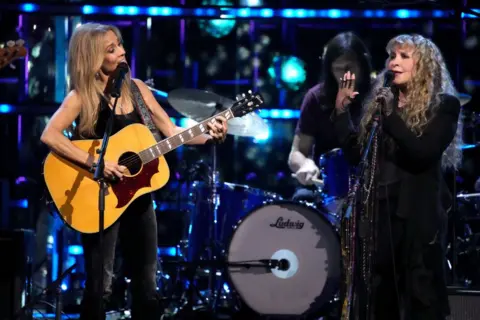
Stevie Nicks has been a huge presence in her life before and since.
Last November, she turned up to support Crow upon her induction to the Rock and Roll Hall of Fame.
“I am so proud of you," Nicks told the singer. "It's a very elite club for us women. I found out at four o'clock in the morning and had to dance around my room for you.”
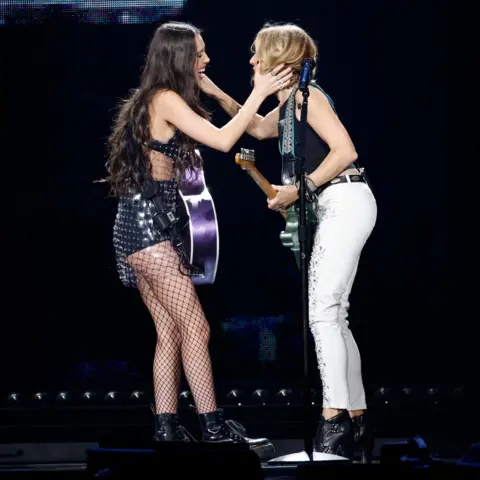
Also joining the celebration was Olivia Rodrigo, who has spoken glowingly of Crow's influence on her songwriting.
She’s not the only one.
Indie supergroup Boygenius wrote their breakout hit Not Strong Enough as a response to Crow’s song Strong Enough; Kacey Musgraves recorded her Golden Hour at Crow’s home studio in Nashville; and St Vincent recently phoned up for advice on producing her new album.
Crow is blown away by all the love coming her way.
“It’s amazing,” she says. “The young women right now that are playing and singing and writing authentically is blowing my mind because, 15 or 20 years ago, I really worried that everything was just dance routines and lip syncing and boobs and lips.
“I was just like, ‘When are we going to have young female songwriters who pick up guitars and gut wrenchingly tell us about where they're at?
“And I'm seeing that now from Olivia Rodrigo and Taylor and Boygenius and Courtney Barnett. It’s so fun. I feel so optimistic.”
 Will Scowns
And what if her sons decide to follow her onto the stage?
They've already made a brief (but cute) appearance during her Glastonbury set in 2019 and the singer says she’ll be supportive, no matter where life takes them.
“I try to help my kids navigate life, as opposed to trying to orchestrate their lives,” she says.
“There's nothing off limits. I even tell my kids, ‘If you drink, my phone is on, you call me to come get you, you will not get grounded’.”
Isn’t that because they could easily look up her youthful misdemeanours on Google?
“We talked about that!” she laughs. “I talked about the fact that I cannot believe I'm alive, you know?
“I remember late nights of recording out in Pasadena and driving my own car home, and not remembering how I got there. I'm very lucky, some people aren’t.
“I tell my kids, ‘Don't count on the angels’… But there are angels.”