Who is new chancellor John Healey? Labour veteran who quit as defence secretary

 EPA
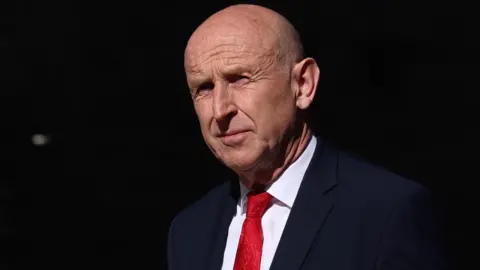
EPAJohn Healey - who has been announced as Andy Burnham's Chancellor of the Exchequer - is seen as the ultimate safe pair of hands.
Which made the 66-year-old's resignation as Sir Keir Starmer's defence secretary just over a month ago all the more shocking.
Healey's assessment of the government's much-delayed defence investment plan - that it fell "well short of what is required for defence and the country at this dangerous time" - was devastating and undoubtedly hastened Sir Keir's departure from Downing Street.
Now he's in charge of the funding not just of defence - but of every arm of government.
He replaces Rachel Reeves, who had served as Sir Keir's chancellor since Labour's 2024 landslide election win.
Loyal, and not someone who briefs against colleagues to journalists or indulges in political games, he has been around the top of the Labour party for three decades.
His resignation came days before Andy Burnham's pivotal by-election in Makerfield, adding to the sense that Sir Keir's premiership was falling apart.
Healey earned plaudits from across the political spectrum for resigning on a matter of principle.
He had clashed with Reeves, the woman he is now replacing, pointedly saying in is resignation letter that the Treasury had been "unwilling" to "commit the resources that the nation needs to defend the country at this time of rising threats".
His return to government in the most vital job of all in cabinet after the prime minister is an even bigger surprise than his resignation, given that his name had not been mentioned as a frontrunner in the increasingly feverish speculation about who Burnham would choose.
Sources told the BBC that Burnham and Healey "have the same outlook" on many of the prime minister's priorities, including reindustrialisation, the cost-of-living, and driving growth across the country.
The softly-spoken Yorkshireman has a remarkable record as someone who has been on the Labour frontbench almost continuously since 2001.
Born in Wakefield in 1960 and educated at Lady Lumley's Comprehensive School, Pickering, and Peter's School in York, he studied social and political science at Christ's College, Cambridge.
Before entering politics, he worked as a journalist, briefly editing Parliament's in-house magazine The House, before becoming a disability rights campaigner and trade union official.
He is married and has one son.
He first came into Parliament in Tony Blair's landslide general election in 1997 as MP for Wentworth, a former mining area north of Sheffield, which following boundary changes is now Rawmarsh and Conisbrough.
He retained the seat with a majority of 6,908 in the 2024 general election, with a Reform UK candidate in second place.
In the early 2000s, he held a string of ministerial posts, including housing, local government in the Blair and Gordon Brown governments.
He spent five years at Brown's Treasury where he oversaw policies such as the child trust funds and attempts to regenerate and devolve power - the Regional Development Agencies, later scrapped by the coalition government.
Speaking to the BBC's Political Thinking with Nick Robinson earlier this month, Healey said: "The Treasury's a paradox. You have some of the very best and brightest officials in the Treasury, but you have too often a Treasury orthodox that's a dead hand on dynamic government."
He added that maintaining financial stability was a key function of the Treasury but "also it can and it has to drive economic growth, raise levels of productivity, support business competition, investment for the for the future".
And he claimed the department "was in denial about the commitment that the UK has rightly made to NATO and to our people" to increase defence spending to 3% of GDP, which would not come until 2034/35 under current plans.
"The Treasury still often sees defence as a drain on public spending and not the driver of economic growth that we've demonstrated in two years," he told Nick Robinson.
Healey's other area of expertise is housing. He served as shadow housing secretary when Jeremy Corbyn was Labour leader, despite supporting a failed attempt to oust Corbyn in 2016.
 PA
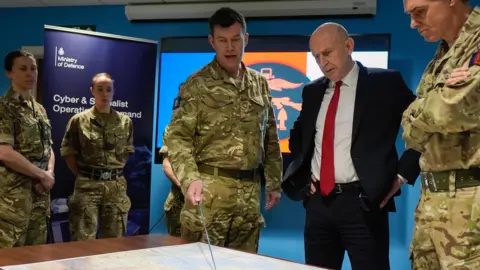
PAWhen Sir Keir was elected Labour leader in 2020, he made Healey shadow defence secretary, becoming defence secretary when Labour came to power four years later.
Healey was a staunch supporter of Ukraine in its war with Russia and made several trips to the country to meet President Zelensky.
At his first meeting with Nato allies, in September 2024, he said he was "confident" Labour could honour a commitment to increase defence spending and "make the decisions that allow us to set out a long-term plan to make our forces better equipped to fight and to deter the threats we face".
Healey also drove investment in housing for armed forces families, with a £9bn spending plan.
Despite his low key style, he proved capable of delivering stern warnings to the UK's enemies.
In April this year, he delivered a message to Russian President Vladimir Putin, in a briefing on "covert" operations by Russian sumbmarines, saying: "We see you.
"We see your activity over our cables and our pipelines, and you should know that any attempt to damage them will not be tolerated and will have serious consequences."
Following the announcement of the defence investment plan, he condemned what he called "Treasury trickery" and the lack of clarity on what new money the Ministry of Defence would get.
Healey also made clear that he wanted a clear plan to increase UK defence spending to 3% of GDP by 2030.
Now he's the chancellor he will have the opportunity to set out that plan himself, and if he is true to his words, it can only mean more positive news for his successor as defence secretary.