'Progress made' on bid to agree Stormont budget at castle talks

 James Manning/PA Wire
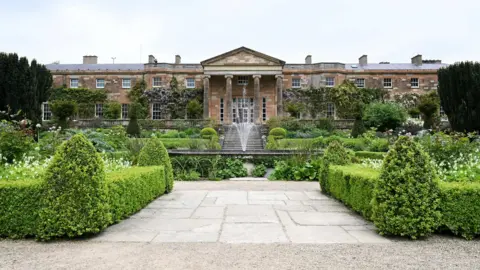
Some progress has been made in the process to agree a Stormont budget as the local parties meet government ministers at Hillsborough Castle on Thursday.
There had been hope that Stormont could agree a multi-year budget in January for the first time in more than 10 years, but that did not happen.
Public services in Northern Ireland have been operating with contingency budgets since the start of the financial year in April.
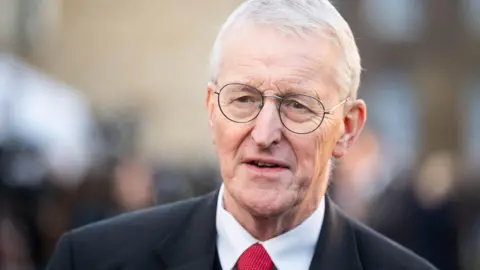
Speaking after the meeting on Thursday, Northern Ireland Secretary of State Hilary Benn said they have "agreed a programme of work" that will "look, first of all, at the pressures that the Executive's finances are facing".
This work will begin on Friday and will involve officials from the Treasury, the Northern Ireland Office and the Northern Ireland Civil Service.
"We certainly have had a productive day in our talks with the party leaders. There's been a lot of plain speaking and we are making some progress," Benn told the media.
Benn said the Treasury needs to "fully understand" the financial pressures the Executive is facing, adding "that detailed work can now begin with full disclosure".
He said the work will also look at the Executive's plan for "fiscal sustainability and efficiencies and public services transformation".
"What we're all agreed on is we can't deal with this by finding another one-off fix. We need a long term sustainable plan for the future of Northern Ireland's finances and this is the start of a political process with that objective in mind."
Senior officials have already warned that some services will face cuts if a budget is not agreed by the end of this month. Local ministers said they needed more funding from central government before they could reach agreement.
 Tim Rooke/REUTERS
'Willingness' across political spectrum
Following the meeting, the Democratic Unionist Party (DUP) leader Gavin Robinson told the media "it is clear to us from our engagement that while the willingness is there across the political spectrum in Northern Ireland, this exercise is around trying to get the best advice necessary for the Prime Minister".
He added that if the outcome of the process that the Secretary of State was hoping for on Thursday was that "our government should have access to the financial information from each of our departments, I answered that in five minutes".
"We could have been out of the building in five minutes," Robinson said.
"The idea that the open book process that concluded a couple of months ago didn't culminate in a good understanding of departmental information is a strange place to be," he said.
"But there is now collective agreement that information should be made available and I hope that allows the Chief Secretary to the Treasury, the Secretary of State and the government more generally to understand and appreciate some of the real financial challenges that are going to need to be grappled for the people of Northern Ireland."
Earlier, Robinson told BBC Radio Ulster's The Nolan Show the meeting must focus on structural change.
He said that "when it comes to revenue raising it's not sufficient to keep pouring more and more money, whether it's raised here or from London, into a bucket that is full of holes".
Speaking as he arrived for talks, Ulster Unionist Party (UUP) Leader Jon Burrows said before the public should be asked to pay more, the executive needed to "cut waste".
First Minister Michelle O'Neill said this will be the seventh Prime Minister she has worked with in 10 years.
"That shows you the chaos that underlines the chaos of Westminster," O'Neill said ahead of the meeting.
"I had a real sense of deja vu this morning, a real sense that we come here, we make our case, we'd actually all be united in making our case for a funding model that our people deserve and then potentially what happens at the end of these processes is that we get some sort of cash injection that's a one off, that does not fix the underlying problem that we have."
What do local ministers want?
They say they need more money to be able to agree a viable budget which can deal with financial pressures, such as public sector pay deals.
Their main argument is that Northern Ireland is under-funded in comparison to Scotland and Wales.
They have received some support for that position from the NI Fiscal Council, an independent budget watchdog.
Last month the council found that Scotland and Wales were currently funded above their levels of assessed need while Northern Ireland was at or slightly below its assessed funding need.
It said it was "mathematically possible" that Stormont could get between £1bn and £3.5bn extra per year if it was funded like the other devolved administrations.
However it warned that extra funding to this level was "only one of the options available to Treasury, and it does not seem the most likely".
What has the Treasury said?
The Treasury recently completed an "open book" review of Stormont's finances.
It was conducted after the executive overspent by £400m last year.
It pointed to a range of areas where local ministers could make decisions to raise more money or cut costs.
It said there could be up to £3bn a year extra to spend on public services if ministers increased rates, introduced water charges and made thousands of workers redundant.
It suggested that if the civil service was cut back to the equivalent size of the service in England it would save almost £400m a year.
However, it added that this example was "illustrative" and did not account for all caveats.
The review was controversial and the Fiscal Council questioned some of the specific conclusions.
The tone of the review suggests that the Treasury would expect Stormont to agree to some reforms in return for any additional funding.
What is the shortfall?
Stormont departments have spending pressures of up to £1.6bn this financial year, a tax and spending watchdog has warned.
"Pressures" refers to the gap between what departments say they need and what is available.
Pressures do not automatically become overspends as departments can attempt to manage them through efficiencies, postponing projects or getting additional funding.
The NI Fiscal Council said that Stormont departments have identified a shortfall of "around £1.4–£1.6bn" even after considering "significant efficiency and savings measures."
How did we get to this point?
 PA Media
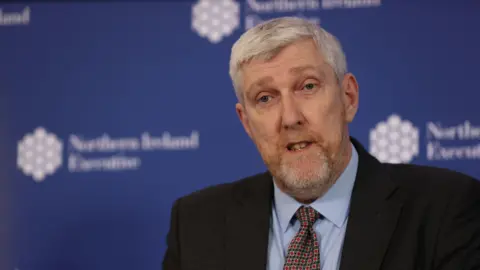
The Finance Minister, Sinn Féin's John O'Dowd, sent his budget proposals to executive colleagues on Christmas Eve before releasing them for public consultation in early January.
The hope was that Stormont could agree a multi-year budget for the first time in more than 10 years.
However, the draft was rejected by other parties with the deputy first minister, the Democratic Unionist Party (DUP)'s Emma Little Pengelly, describing it as "deeply flawed".
Sinn Féin later reached consensus with the other parties that more money would be needed from Westminster before a budget could be passed.
Speaking on Good Morning Ulster, O'Dowd said there was a "substantial gap between what is available to me to distribute and what the needs and pressures are on those departments".
He said that while "Scotland and Wales are funded significantly above their need", NI is funded below its need.
O'Dowd called for fairness and sustainability as well as change.
He said "household water charges are off the table".
What is Stormont's opposition saying?
The Social Democratic and Labour Party (SDLP) leader at Stormont, Matthew O'Toole, earlier said the "seriousness of our budget chaos can't be overstated".
He added that key programmes were already being delayed or cancelled and people would soon be laid off.
Alliance leader Naomi Long said Thursday's meetings could not just be a case of a "white knight riding in with a cheque book", adding that was not a formula for sustainability.