How these twins' rare growth disorder could provide the key to preventing cancer

 JORGE PEREZ / BBC
Nestled in southern Ecuador's network of Andes mountains is the town of Piñas, whose 8,000 inhabitants live in houses scattered across a valley.
This remote town is home to an unusually high number of people living with Laron syndrome, a rare genetic condition that prevents the body from growing taller than 1.2m (3.9ft).
María Luísa Romero and her twin sister, María del Cisne, both have the condition but they say being there for each other has helped them.
"We're always strong, we pool our strength and one defends the other," María Luísa explains as she sits on a sofa next to her sister.
Living with Laron syndrome can be challenging, the sisters say. But researchers believe it may provide an unexpected advantage - the incidence of diseases such as cancer and diabetes among Laron patients is lower than in the general population.
They hope that studying this could lead to the development of treatments to prevent cancer.
"The idea is to be able to replicate, through a drug or a diet, what happens in people with Laron syndrome, in other people without the syndrome," says endocrinologist Dr Jaime Guevara, who has been studying it for 40 years.
"It would be a great contribution from this wonderful community to the world."
 JORGE PEREZ / BBC
Those who have Laron syndrome, also known as growth hormone insensitivity, are unable to use the growth hormone that their body makes.
The genetic mutation is named after paediatrician Zvi Laron, who identified it while treating patients in Israel, 60 years ago.
Globally, 840 people are known to have the condition, with the majority living in the southern Ecuadorean provinces of El Oro and Loja.
Originating thousands of years ago in Indonesia, it moved west as its carriers travelled along merchant routes, Prof Laron believes. He says Sephardic Jews with the mutation later migrated to different continents and some travelled to the Americas.
According to Prof Laron, they settled in isolated areas and after generations of marrying within their group, a particularly high incidence is now found in Ecuador.
Living near others who have the syndrome has helped with the challenges, the twins say, as it means they know they are not alone.
"We can tell each other about the things that happen to us, the good and the bad, because we definitely share many of the challenges we have to face every day," explains María del Cisne.
 JORGE PEREZ / BBC
It was more difficult when they moved away to study in another area of the country, María Luisa adds.
"They had never seen short persons like us there, so everyone looked at us strangely. They pointed at us. It was odd."
A new research paper documenting all known cases of the mutation, identified between 1966 and 2025, is set to be published by Prof Laron, who is based at Tel Aviv University, later in July.
"It is the first time we know the exact number of Laron syndrome patients and the many variants of the growth hormone receptor defects," he tells BBC Mundo.
The thought that they might be helping scientific advances helps patients cope with the challenges of living with the rare syndrome, those affected say.
The twins have been part of a major study led by Dr Guevara, who had noticed that the incidence of diseases such as cancer and diabetes among Laron patients was lower than in the general population.
 JORGE PEREZ / BBC
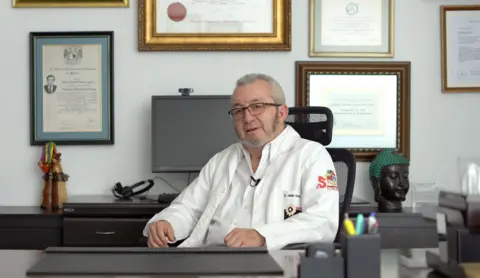
To try to determine why, he joined Dr Valter Longo, a specialist in ageing from the University of Southern California in the US, to replicate what happens in the body of a person with Laron syndrome.
First, the scientists studied about 100 individuals with Laron syndrome and about 1,600 relatives of normal height who lived in the same villages.
During the following 22 years, the team did not find any cases of diabetes among Ecuadoreans with Laron syndrome and only observed one case of non-fatal cancer.
However, among individuals of normal height, 5% were diagnosed with diabetes and 17% with cancer.
Since it was assumed that both environmental and other genetic risk factors were the same in the two groups, the researchers concluded that the reason - at least among adults who had already passed their growth period - was the activity of the growth hormone.
 JORGE PEREZ / BBC
The team bases its conclusion on the fact that Laron syndrome is caused by a mutation in the growth hormone receptor in the liver. This leaves those living with Laron unable to generate a hormone called Insulin-like Growth Factor 1 (IGF-1), and means their growth stops at a short stature.
Dr Guevara says that his team's theory is that IGF-1 prevents cancer cells from dying - a process called apoptosis – and that patients with lower levels of IGF-1, as is the case with Laron patients, will have lower incidence of cancer.
The pair have continued with their research since they published their results, but point out that more work is needed before any treatment can become a reality.
While studying 70 patients in Israel over 58 years, Prof Laron has also observed and documented potential protection against cancer.
He, too, believes the syndrome could provide the molecular foundation for scientists to develop future treatments.
And he acknowledges that lack of IGF-1 in Laron patients is a "major factor" contributing to the low number of incidences of cancer.
But Prof Laron believes IGF-1 levels only account for part of the explanation, as Laron patients who received treatments containing IGF-1 as children to help them grow, also did not develop cancer.
He says that there is ongoing research being carried out on mice and pigs to determine the full reason - these animals are commonly used for research as they are genetically very similar to humans.
"I will try to find out the answer for as long as I work," he adds.
 JORGE PEREZ / BBC
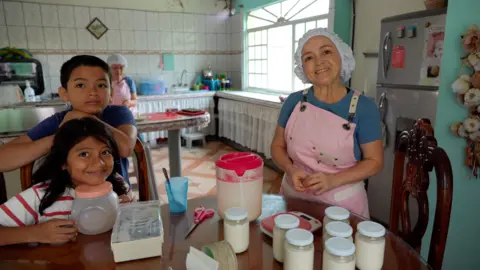
The findings from Dr Guevara's research led the twins to mistakenly believe that they were immune to cancer and other diseases - but María del Cisne was diagnosed with colon cancer two years ago.
She underwent surgery and received chemotherapy treatment.
The sisters say the diagnosis was a wake-up call for them: "That made us realise that we weren't, as we thought, completely immune to these diseases. We had to take care of ourselves, we had to exercise, we had to watch what we ate."
Laron syndrome is recessive, meaning that for people to present symptoms they must have inherited the gene from both parents.
The twins have a child each, Matías and Lucía, who do not have Laron syndrome and, at eight years old, are already taller than their mothers.
 JORGE PEREZ / BBC
For those born with Laron, there is hope in the form of a drug called Increlex.
The medication, which was first developed 15 years ago, can result in increased height if administered during growth spurts.
But accessing the drug can be difficult and it has several limitations - it can only be given to children between the ages of two and 18 and in some cases has serious side effects.
It can cost more than $800 (£600) per bottle, as it is only produced by one pharmaceutical company. A child with Laron syndrome needs at least three bottles per month, costing $2,400, Dr Guevara explains.
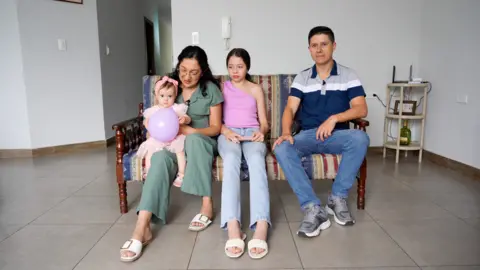
One of those struggling to get hold of the drug is Mayra Loaiza.
Her two-year-old daughter, Camila, was supposed to start her treatment six months ago, but still has not received her first dose.
Mayra, who also lives in Piñas, worries how this could affect Camila's growth.
"I want my daughter to have as normal a life as possible. I don't want her to be discriminated against because of her size," she says, adding that she is confident the drug will boost Camila's height.
Twins María Luisa and María del Cisne, who are 40, are among those who missed the window for taking the drug.
While they wonder how different their lives might have been had it been available in their youth, they say they have learned to live with their short stature.
"We now accept ourselves as we are, but the treatment would have saved us a lot of heartache," says María Luisa.
"I've accepted myself as I am, I accept myself, and I thank God for who I am."