Row escalates in Ukraine over army chief's future

 Reuters
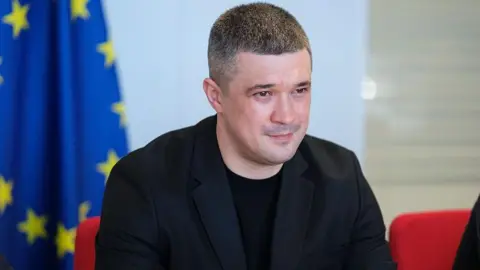
Protesters in Ukraine have threatened nationwide demonstrations if Mykhailo Fedorov is not reinstated as defence minister, as President Volodymyr Zelensky scrambles to quell outrage over the decision to oust him.
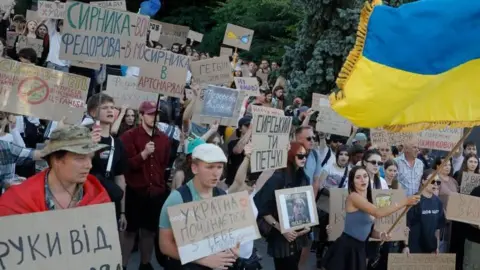
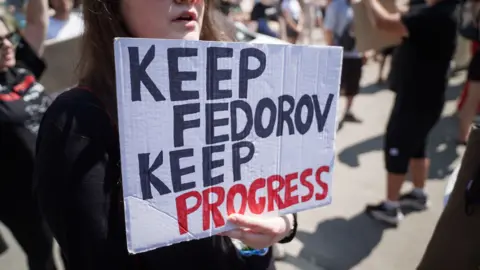
Over the past week, thousands in Kyiv and other cities have taken to the streets to protest against Fedorov's removal and demand the dismissal of Oleksandr Syrskyi, the commander of Ukraine's armed forces.
Army veteran Dmytro Koziatynskyi said in a social media post that if Syrskyi is not dismissed by Friday and Federov reinstated, "we will begin an open-ended nationwide protest".
No protests are scheduled before then, and Ukraine is waiting, anxiously, for a resolution. Over the weekend, Ukrainian media reported that Zelensky was consulting ministers and generals in an effort to resolve the crisis.
Amid a welter of rumours, the general staff was forced to deny reports that Gen Syrskyi was about to be – or even had already been – sacked. Another report suggested that Fedorov had refused an offer to return to a different position in government.
Kyrylo Budanov, head of the president's office, urged Ukrainians to remain calm.
"The situation surrounding the latest internal changes has caused strong emotions," he wrote on Tuesday.
With the noisy calls of angry protesters echoing around the tight confines of Ivana Franka Square, within earshot of the presidential palace, Budanov said the government was taking note.
"I understand people who express their position…..The position of society has been heard."
 Getty Images
With large numbers of demonstrators directing their anger towards Gen Syrskyi – seen by many as representing outdated Soviet-era military doctrines, Budanov, a former head of military intelligence, warned people "not to hate anyone".
"The enemy is closely monitoring our every internal dispute and is waiting for us to start fighting among ourselves," he wrote.
"The work is under way. There will be results."
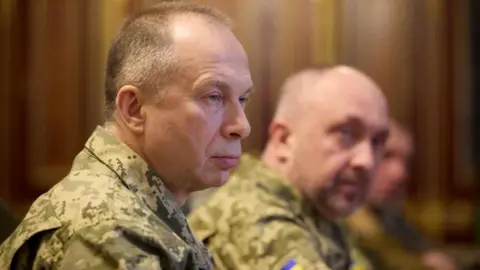
On Monday, the beleaguered but usually silent 60-year-old Gen Syrskyi hit back against his critics, publishing a long defence of his record and urging readers not to focus on his widely-reported rivalry with 35-year-old Mykhailo Fedorov.
Despite Zelensky's claim last week that the two men could not even bear to sit in the same room, Syrskyi said it had been a surprise to learn that he had a conflict with the minister.
 EPA/Shutterstock
"I perceived our relationship as a working one," he wrote in an op-ed for the Militarny website.
"If I offended anyone, Mykhailo Albertovych [Fedorov], I'm sorry."
The general said the issues of military contracts, procurement and mobilisation currently being aired in the press and boiled down to pithy slogans on pieces of cardboard carried aloft by protestors were a great deal more complicated than most people realised.
"Decisions on which people's lives depend are not made with slogans," he said. "Real work, not the public drama surrounding it, wins the war."
Like the ousted defence minister, the commander-in-chief avoided directly personal attacks, but the object of much of his criticism was pretty clear.
"Presentations should not turn into self-representations," he wrote, in a thinly veiled swipe at Federov's long, detailed news conference last week.
"Behind each slide there should be a document, a budget and a procedure," the general went on. "Otherwise, instead of a decision the army gets disappointment."
Syrskyi's problem however is that most Ukrainians, especially the younger ones, seem to trust Federov's analysis of what needs to change in order for Ukraine to win the war, not the general's.
More than anyone, Federov is seen by many as driving innovation in the military, gradually improving Ukraine's chances of beating back its numerically superior enemy.
"Right now, the war is changing, so we need new ideas and a new structure," 44-year-old law company employee Tetiana Makarenko told me at one of the protests over the weekend.
"It's often said that a small Soviet army can't defeat a big Soviet army. It's time to change the mindset and start the new type of war."
Federov's six months at the helm in the defence ministry have coincided with a string of military successes for which the minister, not always fairly perhaps, is credited.
"We had this feeling because we saw the changing situation," Makarenko said. "We had the feeling that we can do this."
In his article, Syrskyi hit back at those accusing him of a lack of strategy, or that he had failed to embrace new technology.
"The strangest reproach that I have heard is that I supposedly do not want to fight with drones," he said, pointing out that he had presided over the creation of an unmanned systems force as a separate branch of the military.
 Matthew Goddard/BBC
But drones, despite being responsible for the lion's share of Russian casualties, were not enough, he argued.
"I cannot transform a million-strong army to drones in two months and say: now we fight like this."
Syrskyi said he was not at war with the defence ministry but with Russia. But while he mounts his defence against a host of critics, speculation has fallen on who Zelensky might choose to replace him.
The candidates include Mykhailo Drapatyi, commander of the Joint Forces, Andriy Bilekskyi, commander of the Third Army Corps, Oleh Apostol, commander of the Airborne Assault Forces and Ihor Obolenskyi, commander of the National Guard Corps.
All have distinguished military records, but crucially all are from a much younger generation of officers. At 46, Biletskyi is the oldest while Apostol and Obolenskyi are both 39.
At just 35, the youngest possible candidate is Brig Gen Denys Prokopenko, another National guard commander, whose "Azov" Regiment, while politically controversial for its alleged far-right connections, achieved near mythic status during the bitter siege of the southern port city of Mariupol in 2022.
Held as a prisoner of war by Russia following the collapse of the city, Prokopenko returned to Ukraine as part of a prisoner exchange in July 2023, quickly resuming his command despite Russian demands that he remain outside the country until the war was over.
Zelensky says he is still working out "what adjustments need to be made to Ukraine's defence strategy" and has thanked everyone "for their openness, honesty and substantive contributions".
With Russia expected to resume its attacks on Ukraine's energy infrastructure this autumn, the president says "Ukraine must enter August as strong as possible".
As the protests fall silent for now, the country waits for the president to make a series of possibly fateful decisions.