Five headaches Andy Burnham will have to deal with as PM

 BBC
BBCWhen Andy Burnham enters No 10 Downing Street, he will inherit some formidable and complex problems that successive prime ministers and governments have attempted to address - mostly without success.
BBC Verify has looked at five big policy challenges Burnham will face and the approaches he might take to address them.
Welfare: Cutting £58bn sickness and disability bill
 Getty Images
The cost of sickness and disability benefits for people of working age has grown rapidly since the Covid pandemic and now stands at around £58bn a year.
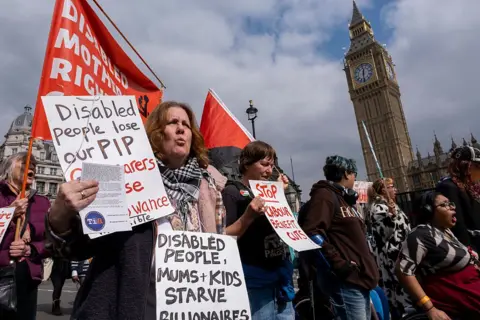
The biggest driver of the increase is the number of people claiming Personal Independence Payments (Pip) - a working age benefit designed to support people with disabilities that increase their living costs.
The number of people claiming Pip is forecast to rise from four million today, to five million by 2030.
The share of people who are younger and claiming Pip for mental health problems or neurodevelopmental disorders such as ADHD is also rising fast.
The previous Conservative government attempted to reform the working age disability welfare system but the cost continued to rise during their time in office.
Last year, Sir Keir Starmer's government tried to reduce the Pip bill by £5bn a year by 2030 by tightening eligibility - but had to do a U-turn after a revolt by Labour MPs.
A recent interim report by the disability minister, Sir Stephen Timms, co-produced with disability groups, accepts that Pip is "not fit for purpose".
The final Timms report is expected to propose reforms to the system later this year, which Burnham could adopt.
There has been speculation this could involve offering young people with mental health problems therapy or other support rather than cash.
But there remains the risk of backlash from disability groups and potentially Labour MPs if the reforms are considered unfair.
Burnham has recently said he does want to reduce the welfare bill, but by encouraging people into work and not through "crude cuts".
Defence: Finding £9bn extra a year
 Getty Images
After a delay of almost a year, Starmer finally published the government's Defence Investment Plan in June.
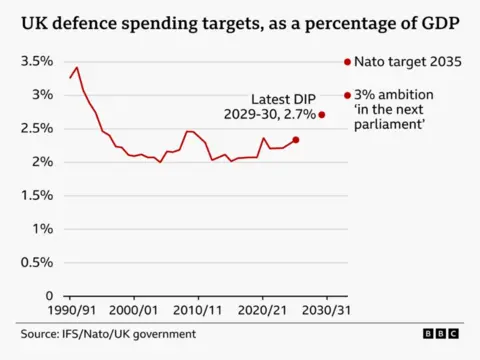
This led to an outcry in some quarters because it only took defence spending to 2.7% of GDP by 2030.
And it was not fully funded, requiring savings to be extracted from other Whitehall departments.
The pressure on Burnham to lift defence spending to 3% of GDP by 2030 from the former defence secretary John Healey, who resigned over the issue, and the defence establishment will continue.
But this would cost an additional £9bn a year relative to the current plans.
Another challenge for Burnham is the new Nato target of raising defence spending to 3.5% by 2035. That would cost an additional £24bn a year relative to current plans.
Some have suggested this could be paid for by the Treasury issuing special "war bonds", to avoid the need to raise taxes or cut spending elsewhere.
Another challenge for Burnham if he does spend more on defence is reforming defence procurement - buying and developing planes, ships, vehicles and weapons - which has been historically wasteful.
Of 47 major defence investment spending projects only three were rated "green" by the National Infrastructure & Service Transformation Authority in 2025, meaning likely to be successfully delivered on time and at the right quality.
Social care: Two million older people living with unmet care needs

The social care system in England - which is delivered mainly by independent providers rather than the NHS - is widely perceived as underfunded and unfair.
Public funding is means tested and it is estimated that there are two million older people in England now living with some unmet need for social care.
And around 10% of people aged 65 and over face lifetime care costs above £100,000 for their care.
And he made an attempt to reform it when he was health secretary in Gordon Brown's cabinet, though his plan was abandoned after Labour lost the 2010 election.
A government-commissioned report by the economist Andrew Dilnot in 2011 proposed a state-funded cap on lifetime care costs, of around £35,000, meaning no one would be required to pay more than that to fund their own care.
The principle of a state-funded cap was accepted by Conservative ministers, but the Dilnot system was never implemented.
Former Prime Minister Theresa May put a separate plan for a new system of social care support into the 2017 Tory manifesto, which proposed including the value of a person's home in the means test for care received in an individual's home - and did not initially mention a cap on lifetime contributions.
This proved controversial because homeowners could have been required to contribute more towards their care costs based on the value of their property.
But the former PM was forced to reverse course within days and the proposal was blamed for the loss of the Tory majority in that election.
Labour's 2024 manifesto pledged a new "national care service".
But Starmer kicked the reform can down the road when he became PM and commissioned Baroness Casey to produce a review on options for reform, instructing her to deliver her final report by 2028.
Burnham has suggested he will ask Baroness Casey to report back sooner - by the end of 2026 - and could choose to implement her recommendations.
But any reform is likely to cost money, likely billions of pounds a year.
In the past, Burnham has suggested changing inheritance tax to pay for social care reform, floating the idea of a 10% levy on all estates.
However, polling frequently suggests inheritance tax is widely regarded as the least fair tax. It should be said more recently he has said he is open to getting rid of inheritance tax completely and instead moving to tax "the wealthy properly while they are alive".
Housing: 1.5m new homes promised, only 204,000 delivered last year
The government promised to deliver 1.5m new homes in England over the five years of this Parliament, which would imply an average annual rate of 300,000.
But it is badly off track, with only 204,000 delivered in the 12 months to March 2026.
Burnham has said he wants to deliver "the biggest council house building programme since the post-war period", though he has not defined what this means.
But the facts are stark. English councils built just 1,970 homes to rent in 2025, down from a construction rate of almost 200,000 a year in the 1950s.
The Starmer government has already committed to spend around £4bn a year in state subsidies to deliver around 30,000 "social and affordable" homes a year, which includes homes for people to buy.
Burnham could devote all of this money to councils or housing associations to try to increase the amount of new council and social housing being built.
But it is estimated that to deliver major uplift in these forms of housing would require an extra £13bn per year of state subsidy on top of the existing £4bn per year spending commitments.
Burnham could potentially attempt to borrow to fund more public housing, but he would have to ensure this was consistent with the fiscal rules he has also said he will retain.
Neets: Getting a million young people into work
 BBC/ISCRE
Just over one million young people in the UK aged 16-24 are not in employment, education or training (Neets), around one in seven of the total.
The UK's Neet rate was in the middle of the pack of European Union countries in 2015. But in 2025 it had risen to the second highest, after Romania.
One of the possible contributing factors to that rising Neet rate is that the number of 19- to 24-year-olds starting apprenticeship courses has fallen by a fifth since what is widely regarded as a botched reform of the system in 2016 by the previous government.
A recent government-commissioned report by former Labour cabinet minister Alan Milburn described the Neet rate as an "urgent national crisis"; he will propose policy recommendations later this year.
Burnham will be able to pick up these proposals, although they might come with an up-front cost attached if they involve greater investment in training opportunities or guaranteed work placements.
Is it possible we will see more support for vocational training?
Burnham has said recently that the school system is too focused on the university route.
But many governments in recent decades have proclaimed a need for a greater focus on support for non-graduates, yet have often still tended to focus more attention and resources on university students and higher education, rather than on vocational qualifications and further education.
