Massive expansion for Plymouth, Exeter and Torbay

 Devon County Council
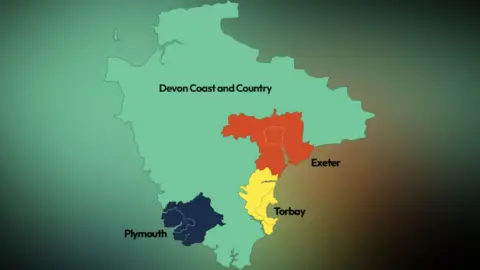
Plymouth, Exeter and Torbay will all expand to take on council services in surrounding areas in the biggest changes to local government for more than 50 years.
Towns like Ivybridge and some villages in the South Hams will form part of a Greater Plymouth Council with Exeter set to take over the running of coastal towns like Exmouth and Dawlish while Torbay will expand in all directions.
The rest of Devon - from Holsworthy in the west to Seaton in the east - will be bundled together to form one new council responsible for everything from waste and recycling to libraries and housing.
The changes were announced in Westminster on Thursday as part of a national local government reorganisation.
'Council tax increase'
Devon County Council leader Julian Brazil said the county had been "betrayed".
"This is a deceitful decision," he said. "People in Devon, their council tax will be going up and their quality of services will be going down.
"It's also going to cost tens of millions to implement.
"That money is going to be spent on breaking contracts, making people redundant and then rehiring them.
"We're almost certainly going to take it to judicial review."
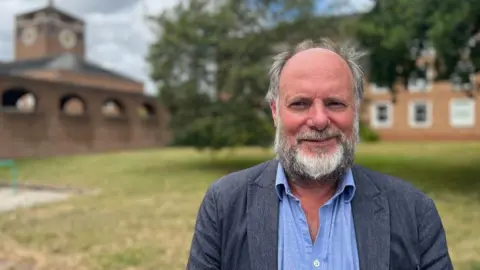
Councillor Phil Bialyk, leader of Exeter City Council, has welcomed the announcement.
"Local government reorganisation is a unique opportunity to build a brighter future with stronger services and local accountability," he said.
"It simplifies things for residents and communities by just having one tier of local government running services.
"Exeter and Plymouth's joint submission recognised the importance of Devon's growth areas while ensuring all four new councils have the scale to deliver high-quality services. I am delighted the Government has recognised this."
He said there was no immediate change, but people would receive more information in the coming weeks.
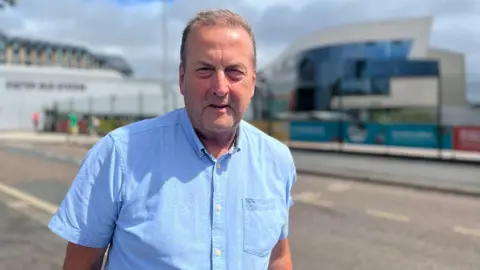
Steve Race, Labour MP for Exeter, said it was "increasingly unsustainable for Exeter to remain a poorly funded district council".
"Creating a unitary authority for Exeter will secure local democracy, provide the opportunity to improve local services, and create sustainable economic and jobs growth," Race said.
"Under a new unitary authority on boundaries that include Exeter's wider economic footprint, Exeter will be better placed to unlock new opportunities for jobs, housing, innovation, and investment."
All of the district and county councils across the country are being abolished to make way for unitary authorities as part of the government's plans for the reorganisation of local government.
In Plymouth and Torbay, all council services are run by unitary authorities that are already in place - Plymouth City Council and Torbay Council.
Elsewhere in Devon, this means instead of a two-tier system where council services are split between district and county councils, there will be unitary authorities - each responsible for all services and decisions on issues from bin collections and fixing potholes to social care and planning.
Plymouth, Exeter and Torbay all backed the plan to have three urban councils and one covering rural areas.
In a joint bid, Plymouth and Exeter said the plans would give Plymouth "the scale" to unlock "growth and opportunity" and would make Exeter a "stronger urban centre, able to coordinate development across its natural economic area".
The bid said the plans would "unlock the potential of our two cities and the three towns in Torbay to turbocharge economic growth and prosperity for the nation and drive the dynamism of our coast and countryside communities".
Torbay wanted to retain its current boundaries but will now expand to take in parishes from Kingswear to the south and Teignmouth to the north.
All of the district councils wanted to see three unitary councils, known as the 4-5-1, deal with Plymouth as a standalone authority and the rest of Devon split in two.
What happens next?
May 2027: Elections will take place for "shadow" councils for each of the unitary authorities. The shadow councils will then work on the transition of services in partnership with the previous authority.
April 2028: The shadow councils cease to exist and effectively become new authorities in charge of all services.
After April 2028: The Boundary Commission will carry out a full review of councillor numbers before the second elections, according to the Local Government Association.
Devon could then be in the running for the four new councils to form a strategic authority which would be run by a directly-elected mayor for Devon.
Parishes and populations
Exeter City Council has published a complete list of all of the parishes which will run as part of the expanded areas of Exeter, Torbay and Plymouth.
Exeter will expand from a current population of 138,000 to 260,000 by taking over the following parishes:
Ashcombe, Aylesbeare, Bicton, Brampford Speke, Broadclyst, Budleigh Salterton, Cheriton Bishop, Chudleigh, Clyst Honiton, Clyst Hydon, Clyst St. Lawrence, Clyst St George, Clyst St Mary, Colaton Raleigh, Colebrooke, Cranbrook, Crediton, Crediton Hamlets, Dawlish, Dunchideock, East Budleigh, Exminster, Exmouth, Farringdon, Hittisleigh, Holcombe Burnell, Huxham, Ide, Kenn, Kenton, Lympstone, Mamhead, Netherexe, Newton St Cyres, Otterton, Poltimore, Powderham, Rewe, Rockbeare, Shillingford St George, Sowton, Starcross, Stoke Canon, Tedburn St Mary, Upton Pyne, West Hill, Whimple, Whitestone and Woodbury.
Torbay will expand from a current population of 140,000 to 232,000 by taking over the following parishes:
Abbotskerswell, Berry Pomeroy, Bishopsteignton, Broadhempston, Coffinswell, Denbury and Torbryan, Haccombe with Combe, Ideford, Ipplepen, Kingskerswell, Kingsteignton, Kingswear, Littlehempston, Marldon, Newton Abbot, Ogwell, Shaldon, Stoke Gabriel, Stokeinteignhead, Teigngrace and Teignmouth.
Plymouth will expand from a current population of 272,000 to 305,000 by taking over the following parishes:
Bickleigh, Brixton, Cornwood, Ermington, Harford, Holberton, Ivybridge, Newton and Noss, Shaugh Prior, Sparkwell, Ugborough, Wembury and Yealmpton.
What does this mean for services and council tax?
If you live in somewhere like Ivybridge you will currently have your bins collected by South Hams District Council and potholes on local roads will be fixed by Devon County Council.
From April 2028, a newly-formed Greater Plymouth Council will be responsible for all of those council services.
It is unclear what this will mean for council tax levels but for 2026/27, the council tax for a band D property in Plymouth is £2,440 while in Ivybridge it is £2,720.
If you live in Newton Abbot and you want to extend your house you currently have to apply to Teignbridge District Council, but after April 2028 all planning matters will be dealt with by Torbay Council.
District councils currently set housing targets for their areas which can dictate whether major housing developments are approved or rejected.
For people living in Budleigh Salterton for example those targets are currently set by East Devon District Council but in the future will be set by Exeter City Council.
Social care for adults and children is currently managed by Devon County Council in most of the county but will now be managed by the relevant unitary authority - a change which threatens to bring about a "more uncertain future" according to the county council leader.
Follow BBC Devon on X, Facebook and Instagram. Send your story ideas to spotlight@bbc.co.uk.