Strawberry fields - Hampshire's summer fruit heyday
Enjoying a bowl of strawberries is one of the pleasures of the English summer - for more than a century, Hampshire has been supplying the country with its first crops of the season.
A combination of soil conditions and climate saw the county become a major hub for strawberry growing towards the end of the 19th Century.
Swanwick - on the railway line linking Portsmouth and Southampton - was one of the busiest stations in the country. It wasn't people filling up the platforms - it was strawberries.
Radio Solent's Rose Lyle explores the history of Hampshire's strawberry growing industry.

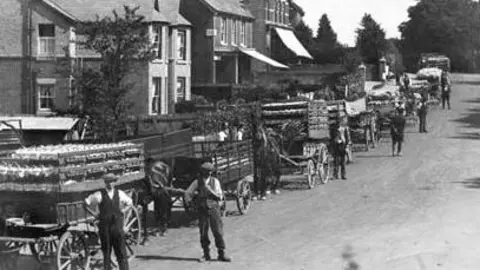 Hampshire Records Office
The development of the railways meant fruit could be picked and transported to the London market and beyond on the same day to ensure peak freshness.
The strawberry-growing industry in the nearby areas of Locksheath and Warsash was largely down to farmer Lewis Linn who arrived in the area in the late 1880s.
Jo Burnham from Warsash Local History Society said: "He recognised that in this particular area the soil had really good drainage and we have a lot of sun as well.
"So he thought it'd be perfect for growing strawberries.
"Around that time, Swanwick station was also built so that allowed them to transport all these strawberries that they were growing up to various markets."
At the height of the strawberry-growing boom, more than 20,000 tonnes of berries were being loaded up at Botley and Swanwick stations each day.
The early-morning trains became known as "strawberry specials" and growers from across the county were keen to get their produce on board.
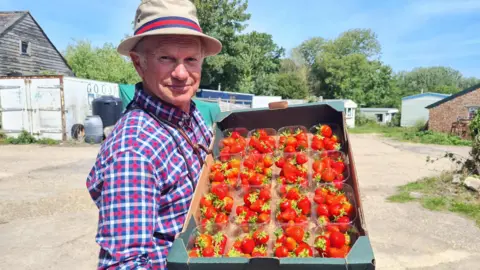
Brian Goodall is a fourth generation strawberry grower in the New Forest.
His family's strawberry farm near Lymington is still a popular pick-your-own attraction.
"We have always been a good place to grow English early strawberries because of the proximity to the sea and our hopefully lack of late frost that will kill flowers.
"So it's always been a good spot with high light intensity as well."
With old varieties of strawberries - Royal Sovereign and Cambridge Favourite and Vigour - the south coast would have the first crops of strawberries each summer.
But with a short picking season of only about three weeks, he recalled the need to get strawberries onto the train as quickly as possible.
"So they would start picking very early in the morning and start packing them as soon as they were picked.
"They put covers on top of the trays and then run them down to Lymington Pier where there was a steam train waiting with a goods carriage.
"It would then take the fruit straight from there at eight, nine o'clock in the morning up to Swanwick on the other side of Southampton."
In Swanwick, a train would be waiting to take an "immense" load of strawberries from growers across the country, bound for retailers and wholesalers as far as Cardiff, London, Edinburgh and Aberdeen.
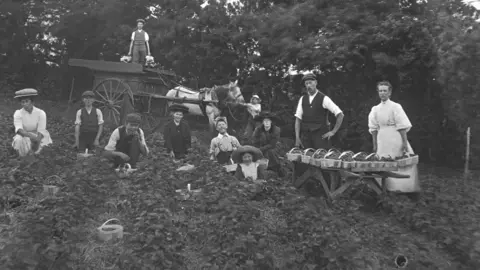 Hampshire Records Office
Picking strawberries was a massive seasonal effort - from local workers keen to earn some extra cash to travelling communities passing through.
A letter from a schoolmaster in Titchfield in 1880, held in the Hampshire Archives, documents the impact that strawberry picking had on school attendance.
"Out of 166 children on the books the average attendance last week was but 129. In other words 37 children were absent every time the school was opened.
"This week threatens to be even worse. There are 48 children away this morning. Strawberry picking is given as the reason," he wrote.
After World War Two strawberry growing in Hampshire started to decline as the county struggled to compete with imported berries from abroad.
European countries were able to provide much earlier fruit and for a fraction of the price.
But strawberries will forever be a part of Hampshire's identity. You can find the names of heritage varieties in
Local pubs, such as the Talisman and Sir Joseph Paxton bear the names of heritage varieties of strawberries.
And a popular walking route called the Strawberry Trail connects those railway stations that were once so jam-packed with fruit.