Removing Glyndŵr name from university 'wrong message' about Welsh identity

 BBC/Royal Commission on the Ancient and Historical Monuments of Wales
Removing "Glyndŵr" from a Welsh university's name "sent the wrong message about confidence and pride in Welsh identity", a Reform Senedd member has said.
Wrexham Glyndŵr University decided in 2023 to change its name to Wrexham University, partly due to the city's higher profile with the successful football club.
Cristiana Emsley, MS for Fflint Wrecsam, called for the restoration of Glyndŵr's name.
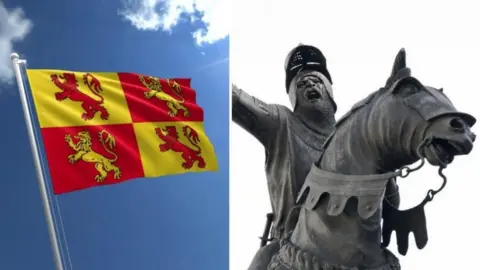
Culture Minister Heledd Fychan said "I can't think of any other country" where such a decision would be made to remove the name of the last Welshman to be Prince of Wales, who led a rebellion against the English crown.
Wrexham University said the change "was not a move away from our Welsh identity".
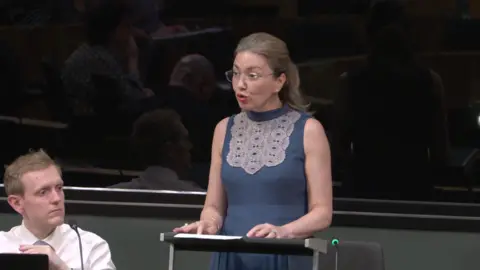
Speaking in the Senedd, Cristiana Emsley said: "In 2022 Wrexham Glyndŵr University announced that it was considering removing 'Glyndŵr' from its name, reportedly in part because it was perceived by some as too Welsh, or difficult to pronounce.
"Regrettably, the name of Owain Glyndŵr was officially dropped from the university in 2023."
 Senedd Cymru
Emsley told the culture minister: "You were not in government at that time.
"But as Plaid Cymru's spokesperson for culture, sport and international affairs, and given your long-standing commitment to promoting Welsh language and heritage, I haven't been able to find any public statement, Senedd contribution, press release or media interviews in which you expressed concern about the proposal."
She asked: "Looking back, do you believe that removing the name of Owain Glyndŵr from one of Wales's universities sent the wrong message about confidence and pride in Welsh identity?"
She also asked if the minister supports efforts to restore the name.
 Wrexham University
Fychan replied: "I think you raise an incredibly important point in terms of our heritage, our history and, perhaps, the lack of learning that there has been of that history and heritage.
"The fact that anyone thinks that Owain Glyndŵr is a difficult name to pronounce in this nation that he was so proud to lead tells us everything.
"I can't think of any other country where that sort of thing would happen.
"I think we do have to ensure that more history is taught in our schools."
The minister referred to the Bannau Brycheiniog and Eryri national parks as examples of an increasing number of organisations that use a Welsh language name.
'Committed to celebrate the legacy of Owain Glyndŵr'
Wrexham University vice-chancellor Joe Yates told the BBC: "We are rooted in our community, proud to be located in Wrexham, and proud of our Welsh history and heritage.
"Our decision to re-brand to Wrexham University/Prifysgol Wrecsam reflected this commitment and connection to place, while not altering who we are and what we do.
"The change reflects our strong identity as a civic university rooted in Wrexham, and was not a move away from our Welsh identity."
He added, "we are also committed to continuing to celebrate the legacy of Owain Glyndŵr. One example of this is through our links with the Owain Glyndŵr Society, which presents an award to one of our top graduates every year."
 PA Media
The university used to be known as the North East Wales Institute of Higher Education (NEWI), before it was granted full university status in 2008.
After that it was known as Wrexham Glyndŵr University, with the name being a tribute to prince Owain Glyndŵr, who had his home in nearby Sycharth, and who had tried to establish the first universities in Wales.
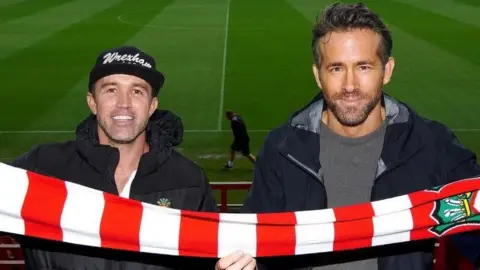
In 2023, referencing the high-profile takeover of Wrexham AFC, the Welcome to Wrexham docuseries and the recently acquired city status, the university said it was "proud to be located in Wrexham, a place which is gaining worldwide attention for a number of reasons".
Who was Owain Glyndŵr?
 Getty Images
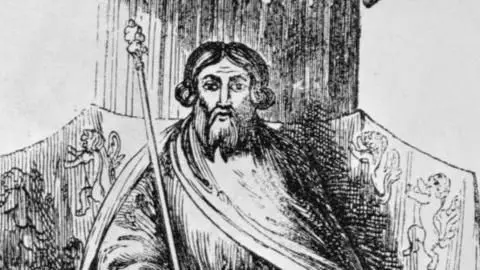
Owain Glyndŵr instigated a 15-year revolt against the rule of King Henry IV and claimed the title Prince of Wales, before Wales was reconquered by the English.
More than a hundred years earlier, Llywelyn ap Gruffydd - the last prince of an independent Wales - had been killed in battle and his head sent to Edward I, the English king.
Edward I then invested his son Edward II as the Prince of Wales, and since then the title has customarily - though not always - been given to the heir apparent.