Summary

  • The US has confirmed it has lifted its naval blockade of Iranian ports, as the Iran deal comes into effect

  • Meanwhile, Iran's supreme leader, in a written message, says he initially disagreed with the deal, but allowed it to go ahead after assurances from the Iranian president

  • Mojtaba Khamenei also says that US President Trump came to the agreement "out of desperation"

  • Earlier, US Vice-President JD Vance said the 60-day period to reach a final agreement with Iran had begun

  • He defends the deal, saying that Iran will not receive money or sanctions relief unless it meets obligations from the agreement

  • The 14-point memorandum of understanding says the Strait of Hormuz will reopen and sets out a $300bn plan for Iran's "reconstruction" - here's what's in the deal

  1. What is the difference between Trump's and Obama's Iran deal?published at 17:07 BST 18 June

    Vance is asked about the differences between Barack Obama's Iran deal and the one negotiated by Donald Trump, and why he thinks Trump's deal is "superior".

    He says the first element is that the Gulf states "love this deal because they think it makes Iran weaker".

    Vance also says Obama's deal "bribed" Iran with US money, which he says Trump's deal does not allow.

    He adds that Obama's deal allowed enrichment, while Trump's deal "will lead to the destruction of enriched material".

    For context: In his first term, Trump scrapped the 2015 Obama-era nuclear accord known as the Joint Comprehensive Plan of Action, which took several years to negotiate and was in force between 2016 and 2018. You can read more about the Obama deal in a post from BBC Verify.
  2. Israel 'has to defend this peace process'published at 16:54 BST 18 June

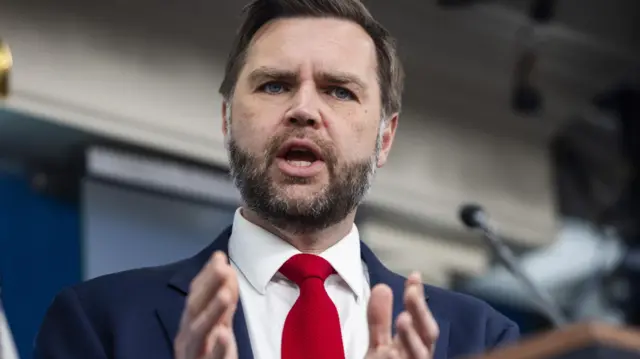
    US Vice President JD Vance speaks to the media about the Iran-US memorandum of understanding in the White House Briefing Room in Washington, DC, USA, 18 June 202Image source, EPA

    Next, Vance is asked about Donald Trump's attitudes to Israeli Prime Minister Benjamin Netanyahu, referencing Trump's recent criticism of Israel's actions in Lebanon.

    Vance says he does not want to withdraw Israel's right to self-defence - but adds that Israel, "just like everyone else, has to defend this peace process".

    "We seem to be right on the cusp of a major breakthrough in the agreement and then all of a sudden there's a major explosion that goes off in a civilian population centre in Beirut," Vance says, explaining Trump's frustration. "That's not acceptable," he adds.

    Vance says he wants closer co-ordination with Israel and a "regional framework" that can cut off money going towards Hezbollah and stop Hezbollah attacking Israel.

  3. International waterways should be free of tolls - Vancepublished at 16:52 BST 18 June

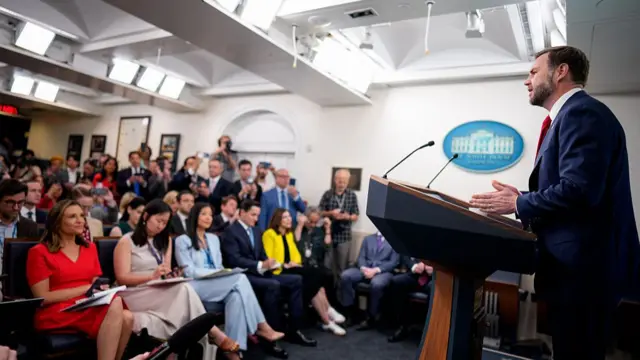
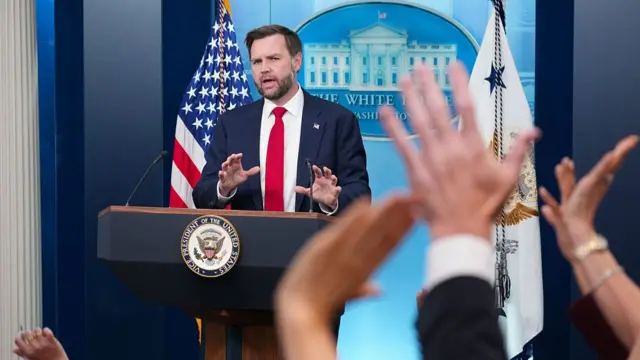
    US Vice President JD Vance takes questions from reporters during a press briefing in the Brady Briefing Room of the White House in Washington, DC, on June 18, 2026Image source, Getty Images

    At the news conference, Vance is asked about the possibility of Iran imposing tolls on the Strait of Hormuz.

    He says international waterways should be free of tolls and that he doesn't want the strait to be used as a "choke point" for the global economy again.

    Vance says the final negotiations of a peace deal will set the terms for what happens next, adding that Gulf states will "figure out a proper security framework" for the strait in the future.

    He adds that the US has "all the cards" in negotiations and Iran will have to "give us the things that are necessary" to get the benefits of the peace deal.

  4. Analysis

    Vance also makes his case to a domestic audiencepublished at 16:50 BST 18 June

    Bernd Debusmann Jr
    White House reporter

    As can be expected, Vance is framing the agreement with Iran as a victory - and putting it in terms that the Trump administration hopes will soothe a domestic audience that is keen on petrol prices going down.

    Notably, Vance was quick to point to the 12.5 million barrels of oil, he says, went through the Strait of Hormuz, and petrol prices dropping below $4 (£3) a gallon for the first time since Operation Epic Fury began on 28 February.

    "And more importantly, they're going to keep falling," he added.

    While the president himself has been largely dismissive of the domestic pressure he was facing in the US, administration officials and senior Republicans are keenly aware that Americans were growing increasingly exasperated with high petrol prices.

    Those concerns, polls show, dwarfed wider concerns about regional geopolitics and security issues in the Middle East - and could have potentially been damaging to the party in the midterm elections.

    Critics of the Trump administration will point out that the Strait of Hormuz was open before the president chose to initiate military operations. Petrol prices were also lower.

    The main question for many here in Washington then becomes whether the administration can ultimately convince Americans that something was gained from this war and that it was worth short-term economic unease.

  5. US wants Lebanese government to police south of country, Vance sayspublished at 16:48 BST 18 June

    Vance is asked when the 60-day negotiation period begins, and he says it starts today.

    He is then asked how the conflict between Israel and Iran-backed Hezbollah in Lebanon relates to the peace deal.

    "This is about regional peace," Vance says, adding that the US expects Hezbollah to stop firing at Israel, and that the Israelis "are not going to be going wild in Lebanon".

    He explains that "sometimes these ceasefires are a little messy", saying there has been "radical progress" in bringing the conflict to an end, but admits there will be "little flare-ups from time to time".

    Vance concludes by saying the US wants to see the Lebanese government policing the south of the country, so that Hezbollah is not "taking over the country" and Israel is "not attacking southern Lebanon or Beirut either".

  6. Vance says US will not lift 'economic chokehold' unless Iran changes behaviourpublished at 16:45 BST 18 June

    J.D. Vance speaks during a news conference in the Brady Press Briefing Room at the White House on June 18, 2026 in Washington, DC.Image source, Getty Images

    Vance is asked what is stopping Iran from getting a nuclear weapon in the future.

    The vice-president says Iran would need "a lot of money" after the US destroyed "billions of billions" of nuclear infrastructure. He says the US has Iran in an "economic chokehold" that "we're not going to release until they fundamentally change their behaviour".

    "What would that look like? That would mean a real inspections regime. That would mean a real enforcement regime," he says, adding that the change in behaviour would also mean the destruction of the enriched uranium stockpile.

    He says only if Iran shows and "verifies" a change in behaviour will it be able to get money and integrate into the global economy.

  7. 'Pragmatists' in Iran are winning the argument, Vance sayspublished at 16:40 BST 18 June

    Vance says there are "real divisions" within Iran about how to proceed.

    He says the "pragmatists" in Iran are "winning the argument", which is what the US wants.

    Asked about the possibility of the Iranian leadership changing its behaviour, Vance says Iran "recognises the leverage the United States has over them".

    He adds that he doesn't know if this will lead to a change in behaviour, but says, "isn't it worth trying?"

  8. Vance says 12.5 million barrels of oil flowed through Strait of Hormuz after deal signedpublished at 16:36 BST 18 June

    J.D. Vance speaks during a news conference in the Brady Press Briefing Room at the White House on June 18, 2026 in Washington, DC.Image source, Getty Images

    Vance says the Iran deal is already "bearing real fruit for the American people", adding that 12.5 million barrels of oil flowed through the Strait of Hormuz after the signing of the memorandum of understanding (MoU).

    The US vice-president says Iran has not fired on any ships moving through the strait, while the US has allowed about a dozen ships to pass through the US naval blockade.

    He says Tehran's nuclear programme and conventional military are "still destroyed", as is its ability to "threaten" neighbouring countries.

    Vance also says part of the MoU has been "misrepresented", mainly referring to a $300bn (£224bn) reconstruction fund that Iran may be given access to as part of the deal.

    He adds that "not a single penny" will be sent by the US to Iran, and says Iran will only benefit from the deal "if they comply fully and change their behaviour".

  9. Vance news conference beginspublished at 16:25 BST 18 June

    JD Vance as news conference at White HouseImage source, White House

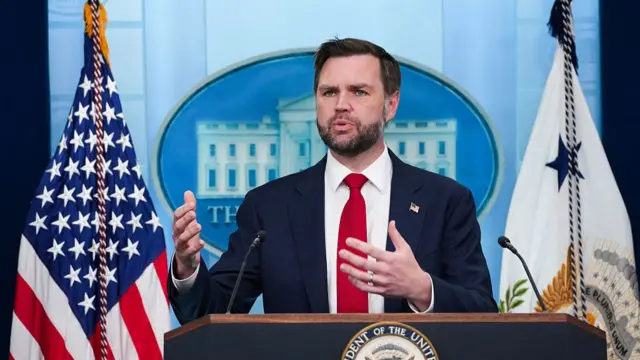
    US Vice-President JD Vance is speaking to journalists now.

    You can watch live at the top of the page.

  10. Analysis

    White House on PR offensive since details of deal emergedpublished at 16:23 BST 18 June

    Gary O'Donoghue
    Chief North America correspondent, reporting from Washington DC

    The White House has been on something of a PR offensive since the details of this deal came out - and there’s a reason for that. In several areas, the words of the agreement don’t always match the spin coming out of the Trump administration.

    One part in particular is really getting under the skin of the Republicans. That’s the commitment that the US, alongside regional powers, would help establish a reconstruction fund for Iran worth at least $300bn (£224bn).

    Ted Cruz, the Texas Republican senator, has already warned that this would be a huge mistake - if that is indeed what the deal entails.

    Bill Cassidy, another Republican who is no friend of Donald Trump's, called the agreement a "tremendous foreign policy blunder".

    He would say that, but even so, there will be others in the party who think so too, even if they aren't prepared to say it out loud.

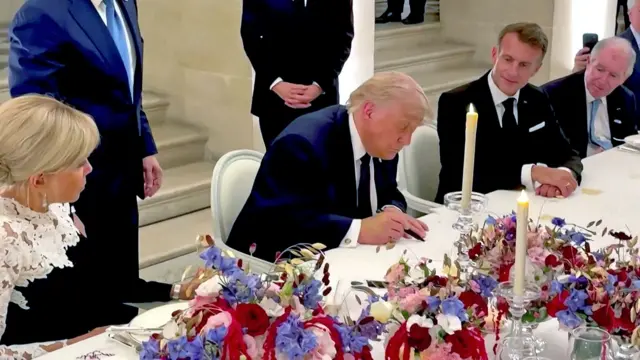
    President Trump’s critics will find it hard to resist the historical parallels of him having signed the deal in Versailles. They might use a term that begins with R: reparations.

    The administration would firmly reject that characterisation, and we’ll hear their argument made forcefully by Vice-President JD Vance when he takes questions at the White House shortly.

  11. Expert says nuclear aspect of deal 'a real question mark'published at 16:09 BST 18 June

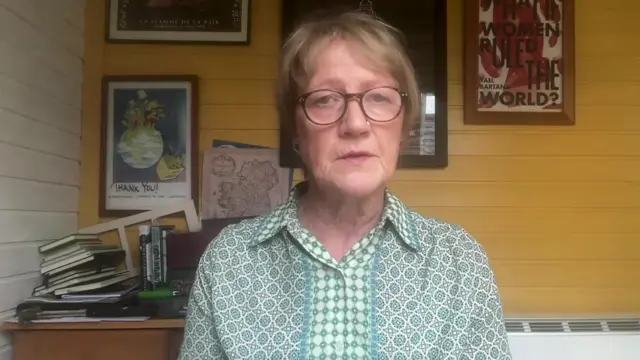
    Patricia Lewis speaking to her webcam in her office. She's got round glasses on and a patterned, light green shirt
    Image caption,

    Patricia Lewis is an independent nuclear expert

    Several analysts have spoken to the BBC on the News Channel.

    Joel Rayburn, who was the senior director for Iran, Iraq, Syria and Lebanon on the National Security Council during Trump's first administration, says there could be several "hiccups" on the way to a full peace deal.

    He says Iran's negotiating tactic is often to "move the goal posts and stuff more concessions in in the 11th hour" - especially on issues where the two sides are far apart, like nuclear weapons.

    But for now, Rayburn says both sides are focused on reopening the strait, so he's "not surprised" by the lack of detail on other, longer-term issues.

    Independent nuclear expert Patricia Lewis echoes this, saying the nuclear aspect of the deal is "a real question mark" at the moment - as it seems Iran is "getting a lot" for "very little in return".

    • JD Vance's White House briefing is happening soon - you can watch live at the top of the page
  12. US Vice-President Vance to hold news conferencepublished at 15:48 BST 18 June

    US Vice-President JD Vance will soon hold a news conference after the signing of a memorandum of understanding between the US and Iran.

    This comes after news that the official signing ceremony, which Vance was due to attend in Geneva on Friday, has been cancelled, according to Pakistan.

    We'll bring you text updates on all the key points, and you can also watch live at the top of this page.

  13. Switzerland signing ceremony cancelled, Pakistan foreign minister tells BBCpublished at 15:31 BST 18 June
    Breaking

    Carrie Davies
    Pakistan correspondent

    Pakistan’s foreign minister, Ishaq Dar, told BBC Urdu that tomorrow’s signing ceremony in Geneva is cancelled as the memorandum of understanding has already been signed remotely.

    A senior Pakistan official initially told the BBC that Pakistan’s Prime Minister Shehbaz Sharif was postponing his visit to Geneva, saying: "The next phase will proceed through separate technical-level tracks on multiple issues under this comprehensive framework."

    Questions were first raised about the event’s prospects after Sharif changed his post early this morning on X, removing the paragraph that said "Pakistan with the support of co-mediator State of Qatar will host the official ceremony as scheduled on 19 June 2026 in Switzerland, to commemorate this landmark event and commence with the technical level talks".

    Behind the scenes this morning in Pakistan, sources reassured the BBC the event was still on. But by early evening that plan had changed.

    Sharif was one of the signatories of the MoU as a mediator.

  14. Iran 'did not trade its dignity for any threat or pressure', says presidentpublished at 15:28 BST 18 June

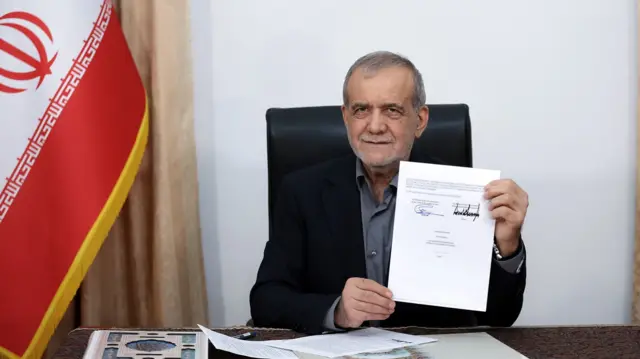
    Iranian President Masoud Pezeshkian signs a memorandum of understanding aimed at ending the war between Iran and the United States, brokered by Pakistan, at his office in Tehran, Iran, on June 18, 2026Image source, Getty Images

    Iran "did not trade its dignity" in the memorandum of understanding signed with the US, says Iranian President Masoud Pezeshkian.

    Posting on X, alongside an image of the signed Persian-language version of the document, he writes: "This text is the reflection of the voice of a nation that did not trade its dignity and independence for any threat or pressure.

    "What was recorded today was the result of national resilience, political rationality, and responsible diplomacy."

  15. Oil is flowing and stocks are roaring, Trump sayspublished at 15:20 BST 18 June

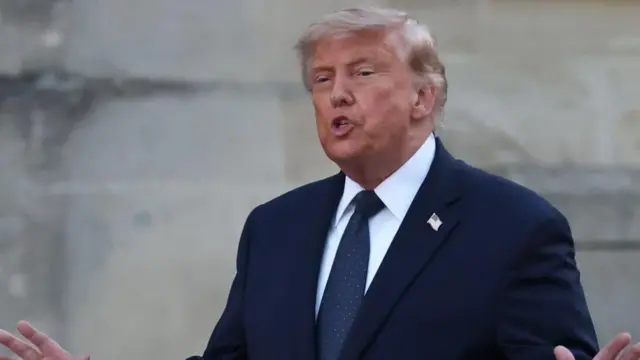
    Donald TrumpImage source, EPA

    Donald Trump says "oil is flowing" and Iran "can never have a nuclear weapon" in a new social media post after signing the peace deal in France on Wednesday.

    Writing on Truth Social, the US president lists a series of achievements that he seems to link to the deal.

    "OIL IS FLOWING, IRAN CAN NEVER HAVE A NUCLEAR WEAPON (THE WORLD WILL BE SAFE!), THE STOCK MARKETS ARE ROARING, JOBS ARE AT RECORDS, AND PRICES ARE DROPPING (AFFORDABILITY!)," he writes.

    "OUR COUNTRY IS STRONG, SAFE, AND RESPECTED LIKE NEVER BEFORE. “YOU’RE WELCOME!”

  16. Further Israel-US-Lebanon talks set for next week - Lebanese presidencypublished at 15:09 BST 18 June

    Lebanese President Joseph Aoun (L) meets with the US Ambassador to Beirut, Michel Issa (R), to discuss the latest regional developments amid ongoing strikes between Iran and Israel, in Beirut, Lebanon, on June 8, 2026Image source, Getty Images

    The next round of negotiations between the US, Israel and Lebanon will take place from 23 to 25 June in Washington DC, Lebanon's presidential office has announced.

    A statement says President Joseph Aoun has briefed the negotiating team on his directives, which include the "final cessation of hostilities" and the "withdrawal of Israeli forces from the lands they occupy".

    Israel, which has been fighting Hezbollah in Lebanon, says its forces are still operating in the country within a security zone extending about 10km (6.2 miles) into the southern border.

    The Lebanese presidency also says Lebanon will ask for the deployment of the Lebanese army "to the international borders", the return of Lebanese prisoners and the "launch of the reconstruction campaign".

    This comes as Israel’s Prime Minister Benjamin Netanyahu faces pressure to reject Lebanon's inclusion in the deal signed between the US and Iran.

  17. Analysis

    Limited agreement reached, but more complex negotiations lie aheadpublished at 14:46 BST 18 June

    Jon Donnison
    Reporting from Jerusalem

    Reaching this limited agreement was torturous enough. Now the more complex negotiations need to take place and initially at least there are only 60 days to do it.

    Top of the list are Iran’s nuclear ambitions and its stockpile of enriched uranium. But there is also its ballistic missile programme and its support for proxy groups in the region.

    Critics of the deal, and there are plenty here in Israel as well as in the United States, say too many concessions have already been given to Iran. They point to the waiving of oil and fuel export sanctions, and the intention to create a $300bn (£224bn) reconstruction fund to help rebuild the country.

    Iran has also said that after 60 days it will introduce tolls for ships to pass through the Strait of Hormuz which is slowly beginning to reopen.

    Trump signing a document while seated next to President Macron and his wifeImage source, X/White House
    Image caption,

    Donald Trump signs the agreement last night at the Palace of Versailles during a state dinner with French President Emmanuel Macron

  18. Iran will probably stick to deal, but US is another question - Middle East expertpublished at 14:27 BST 18 June

    Ghoncheh Habibiazad
    Senior reporter, BBC Persian

    Iran will probably stick to the terms of the ceasefire deal, an expert says, but it's less clear whether the US will do the same.

    Sina Azodi, director of the Middle East Studies Program at George Washington University, tells the BBC it's "historically accurate" to say Iran usually keeps its word when it comes to Iran-US deals.

    "I think they will abide by it," he says.

    "The question is - based on the history of US reneging on its commitments - will the the US abide by the deal and unfreeze the assets?"

    US Defence Secretary Pete Hegseth said earlier today that if Iran doesn't comply with the terms in the memorandum, then the US is "more than able to reimpose an ironclad blockade".

    Donald Trump has even threatened to "bomb the hell" out of Iran if it doesn't stick to the agreement.

    But Azodi says it's unlikely war will resume "given how it negatively impacted the US."

  19. BBC Verify

    Iranian tankers on the move after US blockade liftedpublished at 14:10 BST 18 June

    By Thomas Copeland

    The US naval blockade has been lifted after the deal with Iran was signed last night, ending days of confusion about whether American forces would continue to enforce it.

    "Iran has wasted no time in getting its tankers back into circulation," Michelle Wiese Bockman from Windward Maritime Intelligence tells BBC Verify.

    We reported yesterday that Iran had sent three ships loaded with crude oil over the blockade line while another empty tanker crossed back towards Iran.

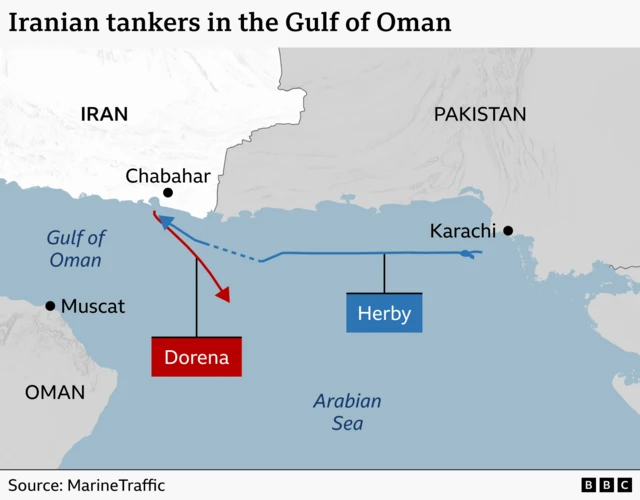
    We’re seeing similar activity today with another Iranian tanker, Dorena, sailing out of the Gulf of Oman this morning. Ship-tracking data from MarineTraffic shows it is loaded with as much as two million barrels of oil but does not list its destination.

    A BBC Verify graphic showing the courses of two Iranian ships. Herby has returned to Chabahar from off Karachi, Pakistan, while Dorena has left the port loaded with oil

    Tracking also shows an empty Iranian tanker called Herby sailed to the port of Chabahar from Pakistan, where location data shows it had been loitering for six weeks.

    Shipping experts TankerTrackers.com have identified Herby as being the unnamed ship the US military said it had intercepted in April.

    All of these vessels are still sanctioned by the US alongside their owner, the National Iranian Tanker Company. But Bockman says the scale of movement in recent days suggests Iran feels confident it will imminently receive US sanctions waivers.

  20. Three killed after Israeli strikes in southern Lebanon - state mediapublished at 13:51 BST 18 June

    Three people have died in Lebanon after Israeli strikes targeted the towns of Kfar Tebnit and Zebdin this morning, according to the state-run National News Agency.

    The Israel Defense Forces haven't confirmed any strikes in Lebanon today, but say Israeli forces continue to operate in the country, within a security zone extending about 10km (6.2 miles) into the southern border.

    As a reminder, the US-Iran deal commits the US and its allies to ending hostilities in Lebanon.