Summary

  1. Germans brace for record-breaking June temperaturespublished at 11:41 BST 23 June

    Bethany Bell
    Reporting from Germany

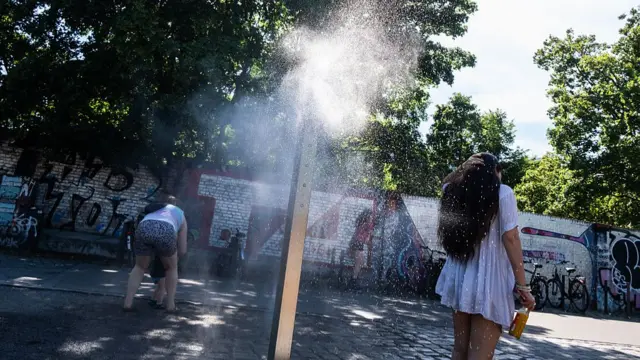
    A woman strokes her hair while she stands next to a mist spraying fountain in the middle of a stone paved street, with a wall of graffiti in the background. To her left is a woman in leopard print shorts and white top tending to her childImage source, Getty Images
    Image caption,

    A woman cools off at a mist spraying fountain in Berlin

    In Germany, people are bracing for record-breaking June temperatures on Friday, when it could get as hot as 40C (104F) in the west and south-west of the country.

    After several people drowned in Germany over the weekend, the German Life Saving Association (DLRG) has been urging people not to underestimate the dangers of swimming.

    The Conservation Association for German Forests has warned that, with the heatwave continuing across the country, the risk of forest fires is rising dramatically. It said: “Lighting any kind of fire in the forest or at the edge of the forest is only permitted at designated fire pits.”

    Postal workers from Deutsche Post have been advised to wear long-sleeved shirts and caps.

    The DHL Group say they could also order Bermuda shorts from their corporate clothing catalogue. They’ve also been told to apply sunscreen, drink plenty of water and stay in the shade as much as possible.

    The DAK health insurance company has set up a hotline on how to deal with the heat.

  2. 'My epileptic seizure trigger is extreme heat'published at 11:30 BST 23 June

    Alex Emery
    Your Voice reporter

    Stephanie Reed smiles at the camera while standing in a shop with jars, bottles and candles on the shelves behind her. She has long brunette hair with blue eyes and is wearing a white top with short sleevesImage source, UGC

    Stephanie Reed, 39, from Chorley, says her epilepsy is made worse by hot weather.

    “My epileptic seizure trigger is extreme heat. I’ve had seizures after a shower, on a hot airport tarmac waiting to board a plane, playing netball. Even out jogging in November," she explains.

    "Ironically I find it manageable abroad because there’s air conditioning and cold pools."

    The former teacher used to work in a school in Hackney and would have to take lessons outside if the temperature rose above 25C (77F).

    "Schools need to do whatever they can to keep children safe. This week is going to be a challenge, even in Lancashire," Stephanie says.

    She now runs an eco-shop in Chorley town centre, but fears she may have to close on Thursday due to the extreme heat.

    Your voice graphic
  3. What are the rules for schools during a heatwave?published at 11:26 BST 23 June

    Hayley Clarke
    Education reporter

    Two boys running in their school yard. They are running towards the door with their backpacks on.Image source, Getty Images/SolStock

    We’re seeing lots of questions on social media around the rules for schools in this hot weather.

    The Department for Education (DfE) directed us to their blog, external, which contains guidance for schools.

    Red alerts indicate significant health risks, so schools should manage heat for all pupils and staff, it says.

    The DfE “don’t normally advise schools to close”, because of the importance of attendance.

    Instead, school leaders should make sure they take “any steps necessary” to make sure children are safe and comfortable.

    This advice includes:

    • Relaxing uniform rules
    • Wearing loose clothing and sunhats with wide brims
    • When outdoors, encourage children to stay in the shade
    • Use sunscreen with high SPF
    • No vigorous physical activity
    • Ventilate: open classroom doors and windows
    • Close the windows when the outdoor air becomes warmer than the air indoors
    • Hydration: provide and encourage children to drink more water than usual

    Teachers and school staff should also look out for signs of heat stress, heat exhaustion and heatstroke.

  4. Met Office confirms 29,000 lightning flashes across southern England overnightpublished at 11:16 BST 23 June
    Breaking

    Simon King
    Lead weather presenter, BBC Weather

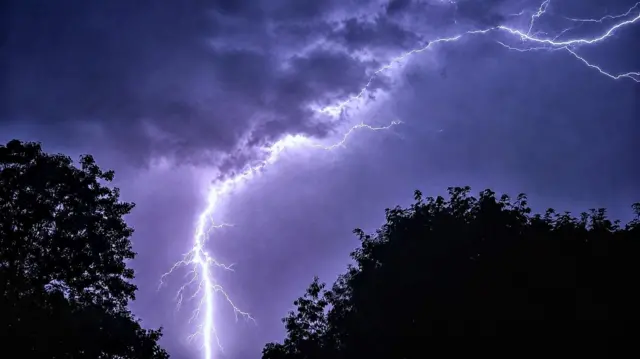
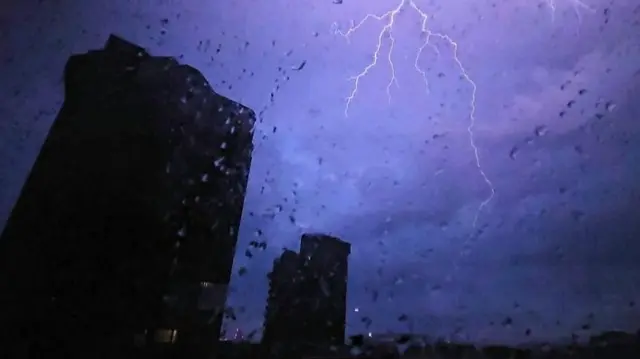
    A bolt of lightning erupts from a cloud over the black silhouettes of two trees at nightImage source, BBC Weather Watchers / Peter Barrett
    Image caption,

    A bolt of lightning captured on camera over Greater London last night

    There were 29,000 flashes of lightning last night and early this morning across southern England, the Met Office has confirmed.

    This includes lightning that goes from cloud-to-cloud as well as the more "striking" cloud-to-ground fork lightning.

    This number of lightning strikes isn’t particularly uncommon for storms developing after a hot and humid day, but the frequency and intensity of the lightning would have been spectacular.

    While thunderstorms were forecast to track east across southern England last night, there is always going to be some uncertainty about the exact location of where, and how intense, they might be.

  5. French PM says 40 people have drowned since start of heatwavepublished at 11:08 BST 23 June
    Breaking

    The Prime Minister of France, Sébastien Lecornu, says 40 people have drowned in France since the start of the heatwave last Thursday.

    "These are mainly young people," he said at a crisis meeting for ministers.

    He added that "they are the first victims of the crisis we are facing".

  6. Warm weather deters Bordeaux holidaymakers... but attracts unwelcome guestspublished at 10:57 BST 23 June

    Chris Bockman
    Reporting from Cap Ferret in south-west France

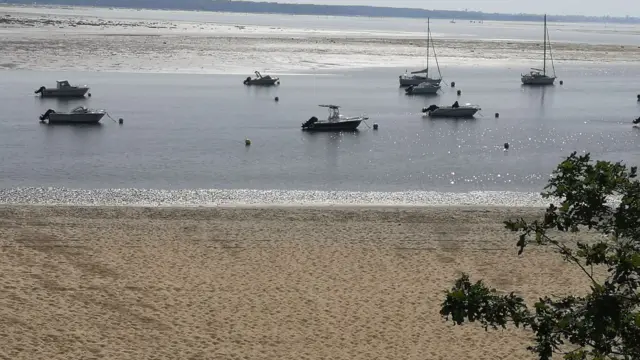
    Boats are seen moored in shallow waters in the sea next to a sandy beach. They are spaced evenly apart with some powered by motors and others with unfurled sails

    The Bordeaux region has seen the hottest temperatures across France over the past two days and it's likely to continue for at least two more.

    Last night Cap Ferret, an upmarket beach resort 37.2 miles (60km) from the city, recorded temperatures of around 30C (86F) at midnight. I haven't seen anything like that except in Dubai.

    The sun is so intense and with so little wind - holiday makers are scarce on the beaches, deserting bars and restaurants for their hotels and holiday homes.

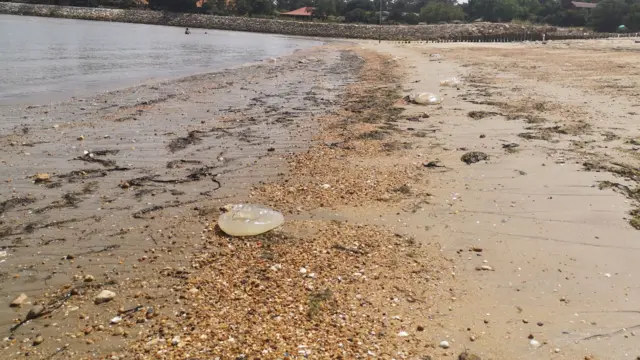
    Another deterrent is thousands of large jellyfish washing ashore.

    Local authorities told me the unusually warm water has brought them into the Baie d'Arcachon, though they assured me they were not dangerous.

    The picture shows the shoreline of a beach where the sand meets the sea. It is covered in seaweed and patches of pebbles, while a lone jellyfish with see-through skin sits on the sand after being washed ashore
    Image caption,

    A jellyfish washed ashore in Cap Ferret

    Of course, it gets very hot in south-west France every summer but rarely so early in the season and each wave of extreme heat seems to last longer.

    What’s worrying is that it could get far worse in July and August.

  7. France sees hottest night since records began, official forecaster sayspublished at 10:51 BST 23 June
    Breaking

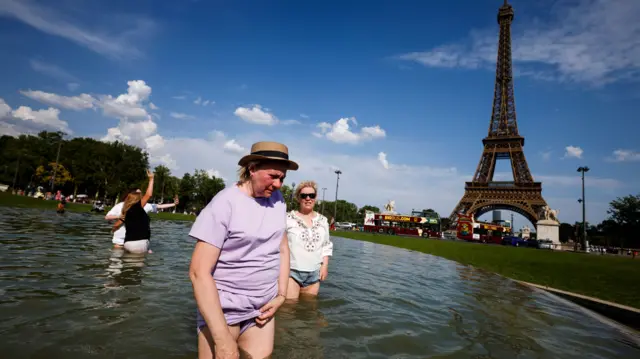
    People cool off in the Trocadero Fountain by the Eiffel Tower, in Paris, France, 20 June 2026Image source, EPA
    Image caption,

    Parisians were cooling off from the searing heat near the Eiffel Tower in Paris over the weekend

    Last night was the hottest night recorded in France since measurements began in 1947, according to France's official weather forecaster.

    Météo-France recorded a provisional night-time temperature, averaged across 30 stations, of 21.6C (70.9F) from Monday into Tuesday.

    The previous record was 21.4C, recorded in July 2019, reports France's Le Monde newspaper.

  8. Morning temperatures already reaching high 20s in parts of UKpublished at 10:38 BST 23 June

    Simon King
    Lead weather presenter, BBC Weather

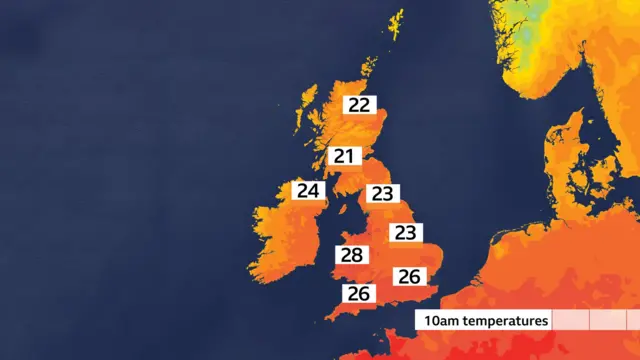
    A heat map of the UK which shows temperatures at 10am. They are 26 degrees in the South East and South West, 28 degrees in Wales, 23 degrees in the midlands and the North East, 24 degrees in Northern Ireland, and 21 and 22 degrees in south and northern Scotland

    Temperatures are now starting to rise quickly across the UK, particularly in Wales and southern England where they are now in the mid to high 20s.

    The highest temperature at 10:00 BST is 27.7C (81.9F) in Whitchurch, Pembrokeshire.

    Heat will continue to build into this afternoon with a maximum of around 36C expected around Greater London.

    This would exceed the current highest June temperature of 35.6C - so we’ll keep you updated on if that happens.

    You may have noticed it feeling more humid today and that will be a noticeable feature of this heatwave. Higher humidity makes it feel hotter because our body can’t sweat and cool itself down as much.

  9. Analysis

    This could be a cool summer in the UK's futurepublished at 10:31 BST 23 June

    Justin Rowlatt
    Climate editor

    What is striking meteorologists is not just how hot it may get - but how early in the summer it is happening.

    Temperatures close to Britain’s all-time high are being threatened in June. That is why scientists say this is much more than a story about a few uncomfortable days.

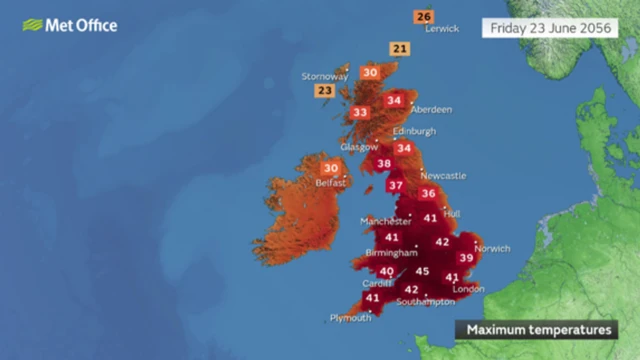
    At a media event yesterday, the Met Office looked back at the famous 1976 heatwave - the one that set the June record - and asked a simple question: what would a similarly severe UK heatwave look like in 2056?

    The answer was stark.

    Temperatures could peak at 45C (113F) in England, 41C in Wales, 38C in Scotland and 30C in Northern Ireland.

    Remember, that is not a forecast for Asia or Africa. It is the Met Office’s best guess for the UK’s climate in just 30 years’ time.

    A map showing the maximum temperatures that could be experienced by the UK in 2056Image source, Met Office
    Image caption,

    The maximum temperatures that the UK could experience in 2056, as modelled by the Met Office

  10. Girl who drowned in River Seine among France's heatwave deathspublished at 10:14 BST 23 June

    Hugh Schofield
    Reporting from Paris

    About 20 people have drowned in France since the start of the weekend - a spike directly attributable to the heatwave.

    According to sports minister Marina Ferrari, too many people are seeking to cool off in unmonitored rivers and canals without appreciating the risks.

    Just a short distance from where I live, a 13 year-old girl drowned in the River Seine on Sunday evening.

    She had gone with her family to Fontaine-le-Port, where locals regularly take a dip. But she did not know how to swim.

    Nearby, in the heatwave in May, a four-year-old girl died in similar circumstances at the outdoor sports centre of Bois-le-Roi.

    The southern Paris suburbs are densely populated, and through them runs a river which in this testing heat is proving a fatal temptation.

  11. How do current UK temperatures compare to memorable 1976 heatwave?published at 09:58 BST 23 June

    Sarah Keith-Lucas & Simon King
    BBC Weather

    Trafalgar Square, London, 8th June 1976. People use fountains to keep cool.Image source, Getty Images
    Image caption,

    People keeping cool by London's Trafalgar Square fountains in 1976

    The current heatwave comes 50 years after perhaps the most memorable one the UK has experienced.

    There were an incredible 15 consecutive days, from 23 June to 7 July 1976, where somewhere in the UK recorded a temperature of 32.2C (90F) or higher.

    Meanwhile, London Heathrow notched up 16 consecutive days of 30C (86F) or more at about the same time.

    The peak of the two-month-long heatwave in 1976 was 35.9C, while the UK is expected to reach several degrees hotter over the next few days - at 39 or even 40C.

    Humidity will also be higher, making it feel particularly uncomfortable.

    Londoners relaxing on a summer day near The Serpentine in Hyde Park, London, UK, 25th June 1976Image source, Getty Images
    Image caption,

    Londoners in 1976 relaxing on a summer day near The Serpentine in Hyde Park

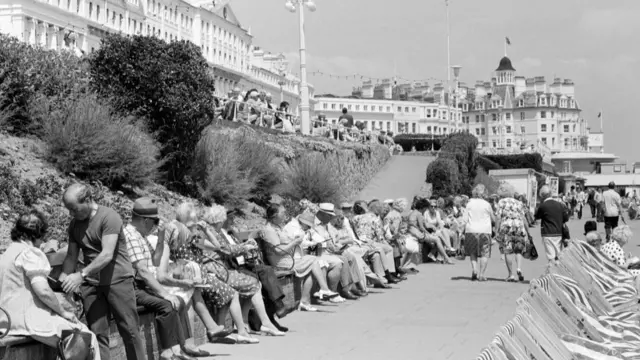
    Holidaymakers enjoying themselves at Eastbourne, East Sussex, during the summer of 1976, 19th June 1976Image source, Getty Images
  12. Old Wye Bridge between England and Wales closes amid heatwavepublished at 09:56 BST 23 June

    Antonia Matthews
    BBC Wales

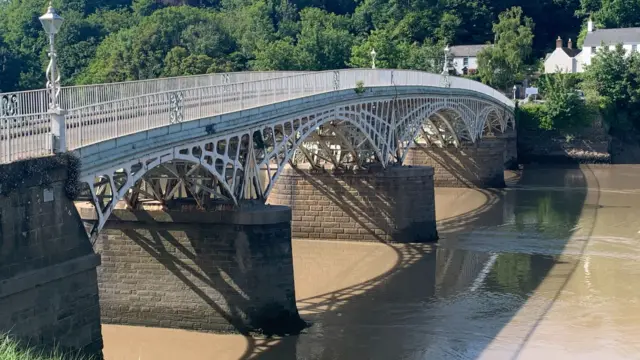
    An image of Chepstow's Old Wye Bridge, an 106m long cast iron and stone bridge from 1816Image source, Getty Images
    Image caption,

    Chepstow's Grade I listed Wye Bridge, which links England and Wales, will close from 11:00 BST due to the soaring temperatures

    The heatwave has already led to disruption in Wales, with one of the oldest crossings between Wales and England completely closing, as well as some public services.

    Chepstow's Old Wye Bridge, which closed to vehicles in October due to structural issues, will also shut to pedestrians and cyclists from 11:00 BST due to the structure being sensitive to changes in temperature above 30C (86C).

    There is also disruption on the Transport for Wales network, while concert organisers at an event in Cardiff are increasing the number of free water stations and welfare facilities on site.

    Waste and recycling crews will be starting their rounds earlier than usual in several counties and Newport council has decided to close the city’s museum, art gallery and central library until Friday.

  13. Flooding and power outages in south-west Englandpublished at 09:37 BST 23 June

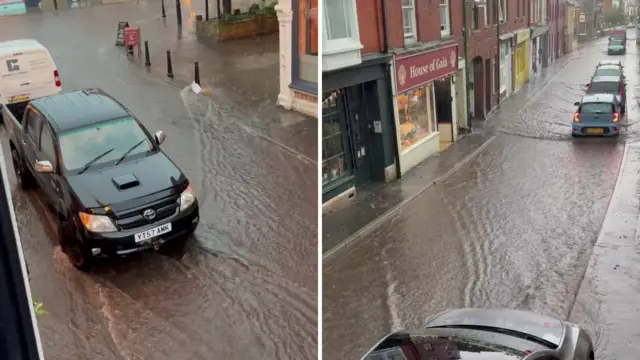
    Image showing flooding on a street in Glastonbury SomersetImage source, Thomas Frampton-Harris

    Footage sent in to the BBC shows flooded streets in Glastonbury, Somerset, on Tuesday morning following thunderstorms in the area last night.

    Hundreds of homes in Shepton Mallet, Glastonbury and Bristol were also briefly without power on Monday evening due to the weather, according to the National Grid.

    Avon Fire and Rescue Service says a lightning strike was believed to be the cause of a house fire in Emersons Green, Bristol, on Monday evening - with no injuries reported.

  14. Why is it still so hot when there were storms last night?published at 09:32 BST 23 June

    Sophia Herod
    BBC Weather presenter

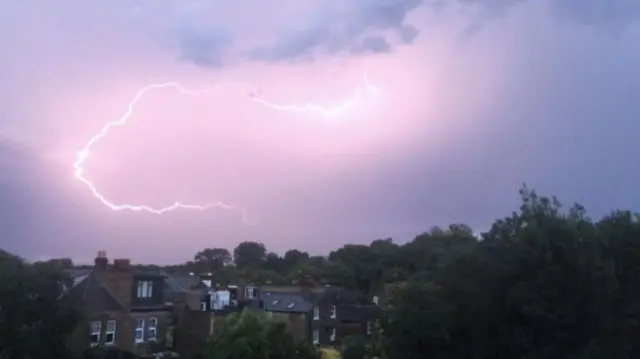
    Lightning seen in Chelsea, London, overnightImage source, Weather Watchers Leigh

    Thunderstorms bellowed across southern and eastern parts of England last night, bringing intense and heavy rainfall. In fact some areas saw nearly an inch of rain last night.

    This isn’t unusual after a period of warm weather. However, thunderstorms are actually more likely after hot and humid conditions.

    Thunderstorms form when warm air is underneath much colder air, making the atmosphere unstable and allowing for tall cumulonimbus clouds to form.

    The hot weather continues and the humidity will be increasing today, so this may not be the end of the stormy weather.

  15. Three men dead after going missing in Rhine river, German police saypublished at 09:25 BST 23 June

    Bethany Bell
    Reporting from Germany

    Police in Germany say three men who went missing in the Rhine river in Hesse in Germany have been found dead.

    The men aged 23, 27 and 50 had been reported missing on Saturday evening. The 50-year-old had gone swimming. The other two were non-swimmers.

    Police investigating the cause of the deaths don’t believe they were suspicious.

    Several people drowned in Germany over the weekend.

    As the heatwave looks set to continue, the German Life Saving Association (DLRG) is urging people not to underestimate the dangers of swimming.

    On Friday, temperatures could reach 40C (104F) in some parts of the west and south-west of Germany. If so, the previous heat record for the month of June will be broken.

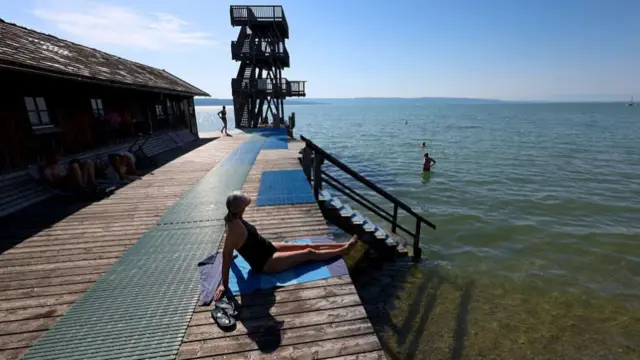
    A woman in a black bathing suits and sun cap sits on a wooden jetty next to a wooden diving tower at a lake where other people are also swimmingImage source, Getty Images
    Image caption,

    People pictured swimming in Lake Ammersee, southern Germany

  16. Amsterdam rolls out 'cool-down' spotspublished at 09:11 BST 23 June

    Anna Holligan
    Reporting from the Netherlands

    People shelter from the sun under umbrellas in Vondelpark in Amsterdam, the Netherlands, 19 June 2026. Due to the warm weather, the National Heat Plan is in effect nationwide.Image source, EPA
    Image caption,

    A man and woman sheltering from the sun in Amsterdam's Vondelpark last week

    Amsterdam is rolling out a network of “cool‑down” spots across the city, offering residents a place to escape the worst of the heat.
    These spaces, in libraries, city farms, theatres, churches, community centres and even supermarkets, provide seating, drinking water and toilets, and many are open to pets as well.

    In the pilot phase, most of the 12 cool‑down spots will be concentrated in Nieuw‑West, the district that city modelling identified as facing the greatest heat risk.

    It is a response to the growing number of tropical days, with temperatures above 30 degrees, as the climate warms.

    Officials weighed up how much shade is available, how many vulnerable residents such as young children and older people live there, and how quickly homes heat up.

  17. Analysis

    Why this heatwave might feel particularly badpublished at 08:58 BST 23 June

    Matt McGrath
    Environment correspondent

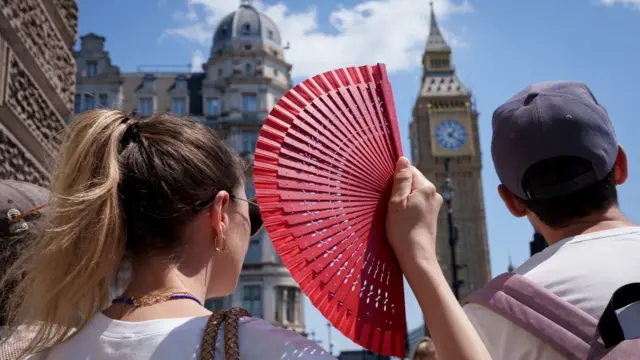
    A woman in a white t-shirt with a brown handbag and blonde hair fans herself with a red fan, to her right is a man in cream tshirt with a purple backpack and cap. They are both facing Big Ben in the background in LondonImage source, Richard Baker/Getty Images

    This week’s temperatures are going be even more of a challenge compared to other heatwaves.

    That's because it will be much harder to sweat away the heat due to the high level of moisture in the air, the Met Office says.

    While the mercury may rise as high as 38C (100F) by Thursday, forecasters will also be focusing on what’s called the Dew Point, a measure of how humid the air is, and how much water it’s holding.

    The Met Office says this Dew Point figure could rise to 22C – far higher than the single figures recorded during the record-breaking heatwave of July 2022.

    We can only cool ourselves when our sweat evaporates into the air. If it’s already full of moisture, evaporation slows and it’s far harder to shed heat in this way.

    So, even though the temperatures may not be as high as they were in previous hot spells, it could actually feel far worse.

  18. Temperatures soar as heatwave in Italy intensifiespublished at 08:50 BST 23 June

    Davide Ghiglione
    Reporting from Rome

    A tourist dips his hands into the cool water of the fountain in front of the historic Pantheon Basilica to escape the scorching heat in Rome, Italy on June 22, 2026.Image source, Getty Images

    Italy's heatwave is intensifying, with the number of cities under the highest health alert, a "red" warning, rising to 15 on Tuesday, up from 12 the day before.

    Major cities including Rome, Milan, Florence, Turin and Venice are now under this top-level alert, which signals conditions that can pose health risks even to healthy adults, not just the elderly or chronically ill.

    The number of cities under red alert is expected to rise further on Wednesday.

    The surge in extreme heat comes just as the government revived emergency labour protections through its new infrastructure decree.

    Companies that halt or reduce operations because of dangerous heat waves can now access state-backed furlough support, shielding workers most exposed to the sun, including farm and construction workers, from having to work through the hottest hours.

    Authorities say the heatwave is likely to continue through the end of June and possibly into early July.

  19. Photos capture intense storms overnightpublished at 08:37 BST 23 June

    Stormy weather has been pictured overnight in parts of England, from Somerset to Kent.

    Here are some of the latest images sent in to BBC Weather Watchers.

    Streatham Hill, Greater London, overnightImage source, BBC Weather Watchers / Stevie Streatham Hill
    Image caption,

    Forked lightning pictured over Streatham Hill in London

    Lightning over Lambeth, greater London, overnightImage source, BBC Weather Watchers / Kurious Kate
    Image caption,

    An electric display lights up the night sky over London's borough of Lambeth

    Lightning over Brasted, Kent, overnightImage source, BBC Weather Watchers / Gardener Patrick
    Image caption,

    Lightning was also seen over Brasted in Kent last night

  20. Why does the railway get so affected by hot weather?published at 08:23 BST 23 June

    Katy Austin
    Transport correspondent

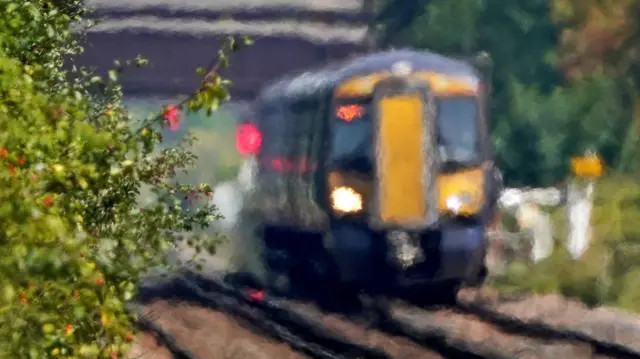
    A train passes through heat haze on a railway line in Ashford, Kent - pictures on September 5, 2023Image source, PA Media

    Network Rail has urged passengers to only travel to, from or within areas covered by the extreme heat warnings on Wednesday and Thursday only if "absolutely necessary".

    This is because extreme heat can have a big impact on the railways.

    Steel rails are designed to cope with the temperatures expected of Britain’s climate, but heat above what they’re engineered for can cause rails to buckle.

    Another example of what can be affected by heat is technology like signalling equipment, which you could crudely compare to the railway’s traffic lights and are absolutely crucial for trains to run safely.

    Overhead power lines, especially older ones, can end up sagging, meaning trains may also have to travel more slowly to avoid damage.

    Hot weather can also dry out the ground under the tracks, resulting in defects. If lots of rain then follows, there’s more risk of landslips.

    Requiring trains to run slower is one way Network Rail manages some of the risks in very hot weather.