Summary

  1. What is a red weather warning - and how rare is it?published at 15:43 BST 23 June

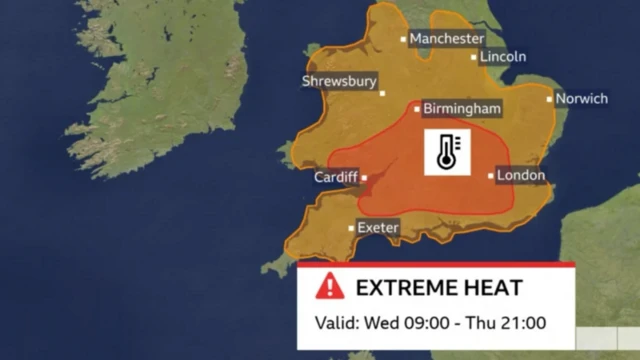
    As we’ve reported earlier, the Met Office has issued a rare red extreme heat warning from 09:00 on Wednesday to 21:00 on Thursday.

    It covers parts of southern England, as well as the Midlands and south Wales. It’s the first time Wales has been covered by a red extreme heat warning and only the second time one has been issued by the Met Office.

    A red warning is the most severe level of alert. It means dangerous weather is expected, with a high likelihood of risk to life.

    It could also lead to failures of critical national infrastructure, such as power cuts or roads and rail lines being closed.

    When a red warning is issued, the Met Office advises people to avoid travelling where possible and to follow the advice of the emergency services and local authorities.
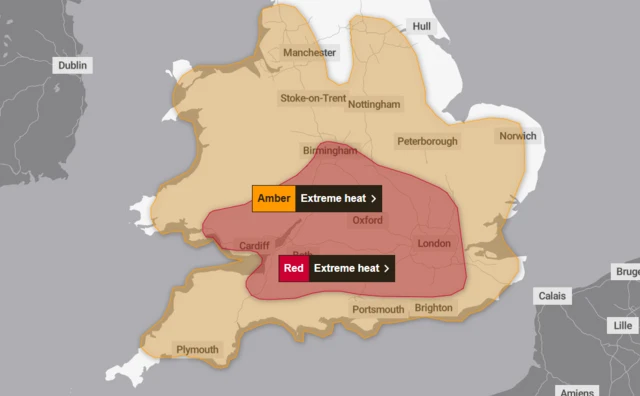
    UK weather warningsImage source, Met Office
  2. Temperatures in Northern Ireland and the Republic of Ireland approaching all-time highs this weekpublished at 15:35 BST 23 June

    Barra Best
    NI weather presenter

    Northern Ireland will avoid the extreme heat seen in other parts of the UK, but temperatures are expected to climb close to the all-time record this week.

    The current record of 31.3C was set in Castlederg, County Tyrone, in July 2021. Thermometers are likely to climb close to that on Thursday.

    It’s a similar story in the Republic of Ireland, where an almost 140-year-old record could be threatened.

    33.3C was recorded at Kilkenny Castle, County Kilkenny, on 26 June 1887 - almost exactly 139 years ago to the day.

    The Irish weather service, Met Éireann, has issued a yellow heat warning from noon on Tuesday until 09:00 on Friday.

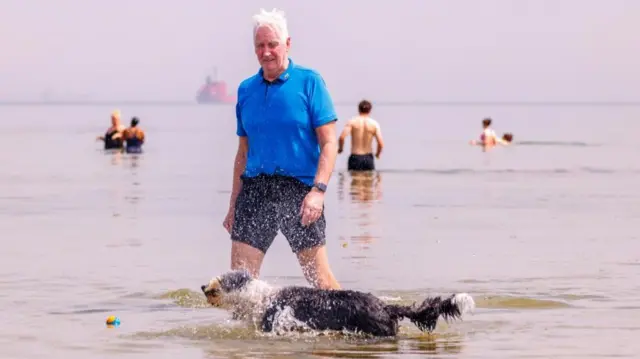
    Darren and his bearded collie Alfie enjoying the water at Helen's Bay Beach in Crawfordsburn Country Park, County DownImage source, PA Media
    Image caption,

    Darren and his bearded collie Alfie enjoy the water at Helen's Bay beach in Crawfordsburn Country Park, County Down

  3. Hottest day of year so far in Scotland and Northern Ireland - while temperatures hit 32.6C in Surreypublished at 15:17 BST 23 June
    Breaking

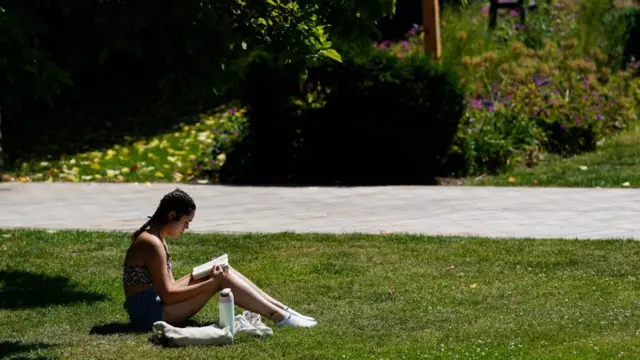
    A person reads a bookImage source, PA Media

    Today has been the hottest day of the year so far in Scotland and Northern Ireland.

    Temperatures reached 28.8C in Fyvie Castle in Aberdeenshire, and 26.4C in Katesbridge, County Down.

    The hottest temperature recorded so far today in England is 32.6C in Wisley, Surrey.

  4. Do you have any questions about the hot weather?published at 15:07 BST 23 June

    Later this week we’ll be running a live Q&A with correspondents and experts from BBC teams including climate and science, health, learning and identity, business and weather.

    You can get in touch in the following ways: 

    Please read ourterms & conditions andprivacy policy

    In some cases a selection of your comments and questions will be published, displaying your name and location as you provide it unless you state otherwise. Your contact details will never be published.

    Your Voice banner
  5. UK's largest train operator warns passengers not to travel unless necessarypublished at 14:49 BST 23 June
    Breaking

    Katy Austin
    Transport correspondent

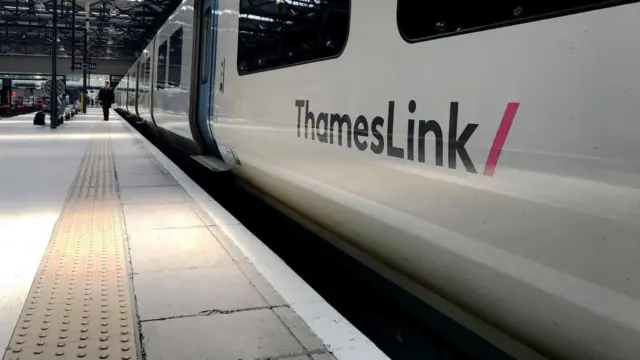
    ThamesLink train at Kings Cross station in LondonImage source, PA Media

    Britain’s biggest train operator has warned passengers not to travel tomorrow or Thursday unless it’s absolutely necessary.

    Greater Thameslink Railway (GTR), which was recently nationalised, includes Southern, Thameslink, Gatwick Express and Great Northern.

    There will be fewer trains running tomorrow and Thursday because of speed restrictions imposed for safety. GTR says there could also be short-notice cancellations.

    There will be no Gatwick Express from early afternoon Wednesday and Thursday. People can still get to the airport on Thameslink and Southern.

    Passengers can get refunds for tickets they’ve bought for today and the next couple of days if they will no longer be travelling.

    A number of other train operators have already warned of reduced timetables and told people to travel only if necessary over the next two days.

    Those who do need to go are advised to go at cooler times of day if possible, and carry water.

  6. Why does the temperature 'feel' hotter?published at 14:46 BST 23 June

    Simon King
    Lead weather presenter

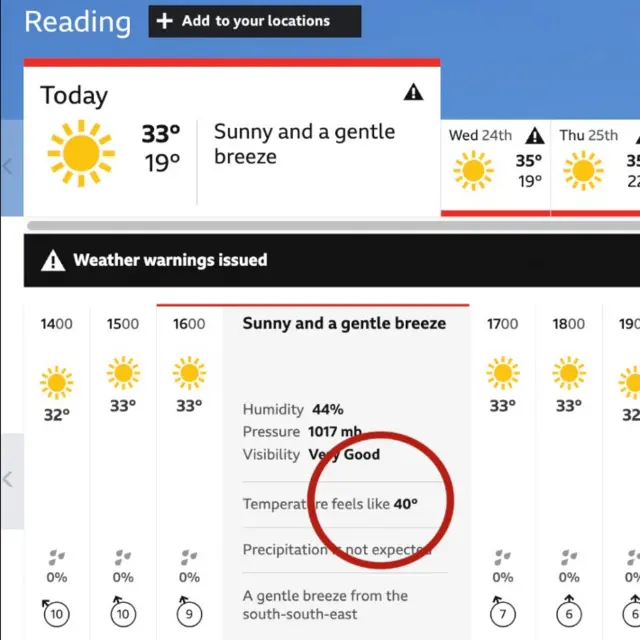
    Weather forecast for Reading

    This heatwave’s likely to feel hotter and more uncomfortable for many of us, not just because of the record-breaking temperatures, but also because of the humidity.

    If the air is more humid, it contains more moisture. That means sweat on our skin can’t evaporate and cool us down as effectively as it would if the air was dry.

    As a result, it might feel warmer than the actual air temperature, and that can be calculated.

    The BBC Weather website and app show you what the "feels like" temperature is.

    Take Reading this afternoon, for example. The air temperature is expected to reach around 33C, but with a relative humidity of 44%, that will make it "feel like" 40C.

    The "feels like" temperature may be more noticeable overnight, when it may still feel like 27C even at the coolest part of the day.

    And that’s not even taking into account how your bedroom may be hotter, where you’re lying down in one position without a breeze or airflow to help take away the sweat.

    Prepare for some uncomfortable nights.

  7. How to keep your home cool in the heatpublished at 14:38 BST 23 June

    Mark Poynting
    Climate reporter

    Smiling woman sitting with electric fan at desk in home - stock photoImage source, Getty Images

    The UK’s homes are generally poorly designed for extreme heat, and rising temperatures due to climate change amplify those risks. But there are still some simple steps you can try.

    It can help to pull your curtains and keep your windows closed during the day. If it’s warmer outside than inside, opening windows will let that warmth into your home. Open them when outdoor temperatures drop to allow cooler air to flow in.

    Another trick is putting a bucket of ice in front of a fan to blow colder air around the room - taking care to keep water away from electrics!

    If you own your home, there are more fundamental steps you can take. External shutters can help prevent direct sunlight from hitting your windows in the first place. Trees or awnings can provide shade. And, much like many Mediterranean homes, white paint can help reflect some sunlight, keeping your house cooler.

    Air conditioning systems can help too, but are energy-intensive. You could consider improving your home’s insulation, which can help keep the heat out in summer and the cold out in winter.

    Mark answers a reader's question every week in the Future Earth newsletter. Sign up here to receive the latest climate and environment news every Tuesday.

    Thin, green banner promoting the Future Earth newsletter with text saying: “Future Earth”. There is also a graphic of an iceberg overlaid with a green circular pattern.
  8. Wales could see record temperatures this week, first minister warnspublished at 14:32 BST 23 June

    First Minister Rhun ap Iorwerth speaks on the steps of the Welsh Government building in Cardiff - May 13, 2026Image source, PA Media

    Wales could see its "highest temperatures ever recorded" over the next two days, First Minister Rhun ap Iorwerth has warned.

    "We must ensure that vulnerable people are looked after as a priority," he tells the Senedd during first minister's questions.

    The most at risk are older people, babies and very young children, ap Iorwerth says.

    It comes as a Met Office red warning for extreme heat covers parts of Wales and England, beginning at 09:00 BST on Wednesday and running to 21:00 on Thursday.
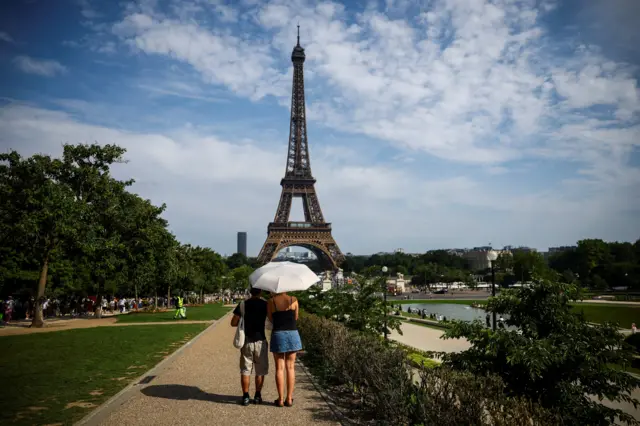
  9. Eiffel Tower closes due to high temperaturespublished at 14:20 BST 23 June

    The Eiffel Tower is closing early to the public today because of high temperatures.

    The Paris landmark will close at 16:00 local time, although its operator has given no further information on whether it will reopen as usual on Wednesday.

    "We apologize for the inconvenience," a message on its website says.

    Temperatures in Paris are forecast to reach 37C in the next hour, according to the Met Office.

    A man and a woman stand underneath an umbrella as they stand on a public footpath while looking towards the Eiffel TowerImage source, Reuters
  10. Scotland expected to reach heatwave statuspublished at 14:03 BST 23 June

    Ken Banks
    North East Scotland reporter

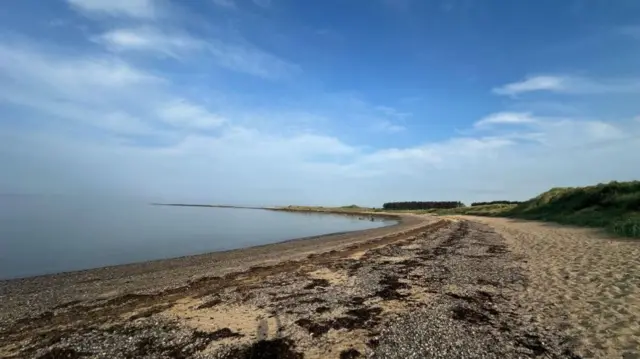
    Earlsferry in Fife, part of Scotland enjoying some sunshine this weekImage source, MrsK / BBC Weather Watchers

    Scotland is expected to see temperatures peak on Thursday.

    BBC Scotland weather forecaster Judith Ralston says that by Thursday temperatures of 29C or 30C could be seen in Ayrshire, Dumfries and Galloway, the Borders and South Lanarkshire.

    Scotland needs to see 25C for three consecutive days to officially reach heatwave status, and she expects that to happen.

    Meanwhile, Network Rail says its meteorologists and specialist engineering teams will be closely monitoring conditions across Scotland, in case the heat causes any issues.

    Conditions are expected to be cooler when the weekend arrives.

  11. Two consecutive months broke temperature records? First time since 1911published at 13:50 BST 23 June

    Simon King
    Lead weather presenter

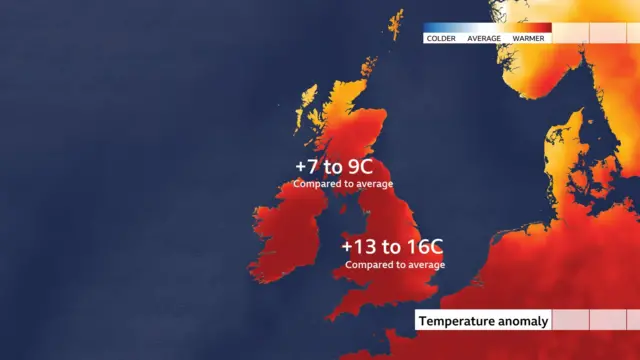
    Map of temperatures across the UK

    During summer heatwaves, we tend to get a lot of comments saying "this is just summer".

    And, yes, while we do get warm and hot spells, the heatwave we’re experiencing this week is not normal.

    Temperatures across the UK - and indeed Europe - are up to 16C above average for the end of June.

    This temperature anomaly map - or the temperature compared to average - shows clearly how much hotter than a normal June summer it is this week across the UK.

    Breaking record temperatures is also not something that happens often, especially by the margins that we’ll see in the UK and Europe over the coming days.

    It is even rarer to have two consecutive months where the monthly high-temperature record is broken. You have to go back over a century to 1911 for the last time this happened.

    But, with human-induced climate change, the heatwaves we’ve been experiencing over the last few years are going to become more normal.

  12. Number of schools partially closing this week up to at least 312published at 13:33 BST 23 June
    Breaking

    Nathan Standley
    Education reporter

    We've continued to look through council and school websites for those that are closing - partially or fully - today and later this week.

    We've seen 64 more schools listed, compared to our earlier update, taking the total to 312.

    The vast majority of those are in the south of England, where the red weather warning is in effect from 09:00 BST tomorrow until 21:00 BST on Thursday.

    There are 38 schools in West Berkshire, 19 in Oxfordshire and 15 in Hampshire, for example. Bridgend County Borough Council, in south Wales, is reporting that two of its schools are closing early today too.

    The true total number of closed schools is likely to be much higher though, as many councils do not publish lists of schools which have to close unexpectedly due to extreme weather, and a full list is not collated centrally.

    Lots of schools are also part of multi-academy trusts, which may not appear on council lists if they are closed either.

    map showing red and orange alert areas in England and Wales.
    Image caption,

    A rare red alert for extreme heat begins tomorrow in southern England and south Wales. Other areas are under an amber alert

  13. A stormy day in Westminster...published at 13:22 BST 23 June

    Bernadette McCague
    Your Voice reporter

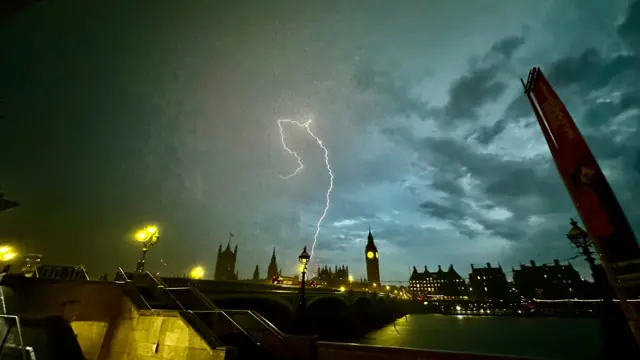
    Thunderstorm over LondonImage source, Rory Hanaway

    We've been sent this photo of stormy weather over the Houses of Parliament by Rory Hanaway, who was on an early morning walk along the River Thames.

    "It was torrential rain and a thunderstorm raging overhead," he says. He took the photo at the bottom of the stairs off Westminster Bridge on the South Bank.

    BBC Your Voice branding
  14. 'London isn't just calling,' says UN boss. 'It's cooking'published at 13:19 BST 23 June

    UN Secretary General Antonio Guterres has called for a "fast, fair transition to clean energy" during an address at London Climate Action Week, as London braces for record June temperatures.

    Referencing Charles Dickens’ novel A Tale Of Two Cities, he told attendees the world is facing a "tale of two crises" - both caused by "destructive" fossil fuels.

    "A climate crisis is pushing us deeper towards higher temperatures and closer to catastrophic tipping points and an energy crisis exposing the folly of a world hooked on hydrocarbons," the UN chief said.

    "London isn’t just calling. It’s cooking."

    Novak Djokovic cools off with an ice pack in London during practice for the Wimbledon championships, which start on MondayImage source, PA Media
    Image caption,

    Novak Djokovic cools off with an ice pack in London during practice for the Wimbledon championships, which start on Monday

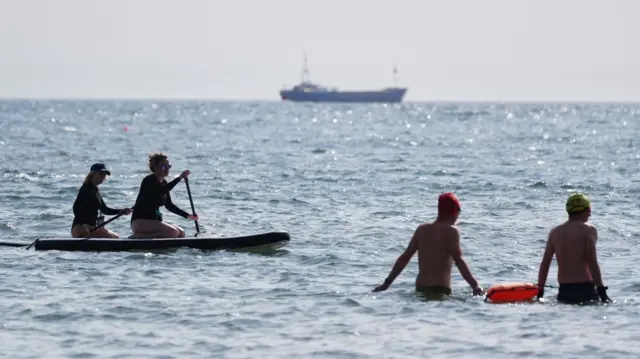
  15. Swimmers cool off in North Sea as temperatures soar across Englandpublished at 13:18 BST 23 June

    With temperatures rising across the UK today, people in Cullercoats Bay, North Tyneside, have been taking to the North Sea to cool off:

    Two women sit on paddleboards in the middle of a body of water. One has her back to the camera while her oar is resting on her legs, while the other is facing the camera and looking towards the sky with sunglasses on her faceImage source, PA Media
    A group of swimmers are walking towards the water's edge on a sandy beach. Six women are wearing bathing suits in a range of colours and one man is wearing a gold swim cap and black trunksImage source, PA Media
    Two swimmers walk in the sea while both holding an inflatable buoy. In the distance, to their left, two people row with oars on a paddle boat, while a large ship can be seen on the horizonImage source, PA Media
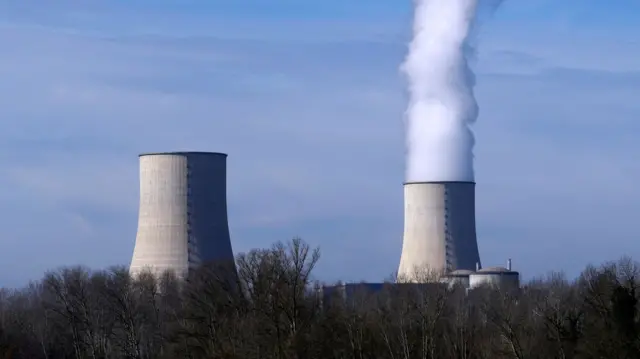
  16. French nuclear reactor stops operating as cooling water is too hotpublished at 12:54 BST 23 June

    The cooling towers of the Golfech nuclear plantImage source, Reuters
    Image caption,

    The cooling towers of the Golfech nuclear plant

    A nuclear power station near Toulouse in France has stopped generating electricity due to the extreme heat.

    The operators of the Golfech nuclear plant decided to switch off a reactor because the plant is cooled by water from the nearby river Garonne which has become too warm - beyond the safe level of 28C.

  17. 36C expected today - with temperatures even higher later this weekpublished at 12:51 BST 23 June

    Simon King
    Lead weather presenter

    The current June all-time record is 35.6C, set in 1976.

    That could be marginally beaten this afternoon as the temperature is expected to peak at around 36C in Greater London.

    However, it will easily be exceeded in the next few days as temperatures are forecast to reach 38C or even 39C on Wednesday and Thursday.

    That would beat the old record by up to around three degrees, which would be an extraordinary amount.

    This also comes weeks after we had the hottest May day on record in the UK and the first time since 1911 that two consecutive months have observed record temperatures.

    It’s also likely that Wales will have its hottest June day on record if 33.7C is exceeded.

    With some weather forecasts suggesting 40C, there’s a small chance we’ll be close to the UK’s highest temperature ever recorded of 40.3C, set in Coningsby in 2022.

    We’re also likely to see June’s warmest night on record should the temperature not fall below 22.7C - which is possible in the coming nights in south-east England.

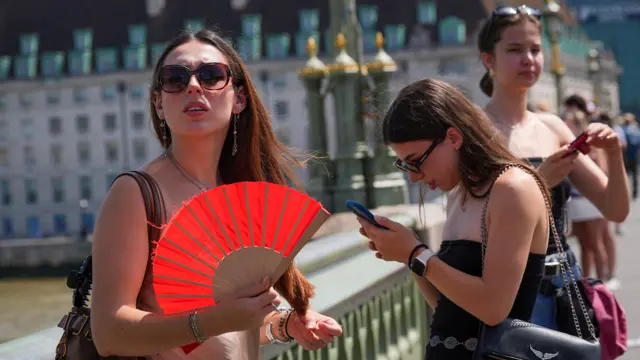
    Women on Westminster Bridge trying to keep cool earlier on TuesdayImage source, PA Media
    Image caption,

    Women on Westminster Bridge trying to keep cool earlier on Tuesday

  18. Floods, fires and rail disruption amid hot and stormy weatherpublished at 12:29 BST 23 June

    Jack Grey
    Live reporter

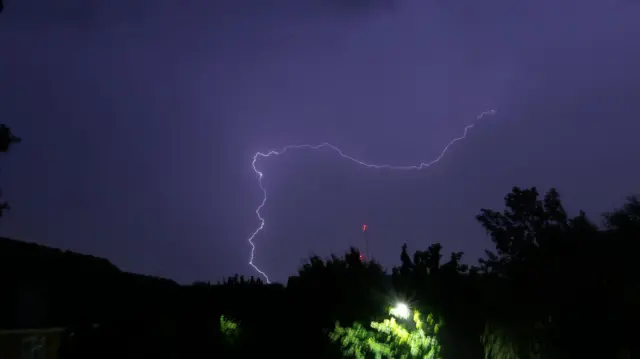
    Lightning above Slough overnightImage source, BBC Weather Watchers / zinterzog
    Image caption,

    Lightning above Slough overnight

    Intense storms and very hot weather have been causing disruption across the UK overnight and on Tuesday morning.

    Thunderstorms swept across England last night ahead of a day forecast to be the hottest June day on record.

    Here's what's been happening:

    A stormy night

    • This morning, Transport for London cancelled all Elizabeth line trains between Heathrow terminal 4 and terminals 2 and 3 due to the flooding overnight, but service has since resumed
    • It comes as the Met Office reports that 29,000 flashes of lightning were recorded across southern England throughout the night
    • The London Fire Brigade reports it has received more than 400 calls since midnight, after heavy rain led to flooding and at least two house fires were caused by suspected lightning strikes

    Rail disruption on Tuesday morning

    • Transport for London (TfL) says the entire Mildmay overground line is operating at reduced service due to "hot weather mitigation"
    • Transport for Wales (TfW) has cancelled rail services between Pontypridd and Cardiff Bay and between Heath Low Level and Penarth due to severe weather
    • While Avanti West Coast and Great Western Railway both say they are running fewer trains on some routes due to severe heat forecast
    • National Rail has urged people to "please only travel if absolutely necessary" due to severe weather warnings in place
  19. Hundreds of schools partially closed due to heatpublished at 12:08 BST 23 June

    Nathan Standley
    Education reporter

    Children playing in a playgroundImage source, Getty Images

    We know there are at least 248 schools across England and Wales that are at least partially closed over the next three days because of the hot weather.

    The number of schools which close due to extreme weather isn't collated centrally, so we've scoured through council websites to dig through lists of affected schools, most of which are situated in the red weather warning zone.

    There are 83 in Somerset, 54 in Gloucestershire and 51 in Buckinghamshire, for example. Many of them are closing early today.

    Some schools are fully closed tomorrow and Thursday, others are closing their doors early, and some are staying open but inviting parents to collect their children before the end of the school day if they wish.

    But the true total number is likely to be higher, as some councils do not publish lists of schools when they close because of the weather, and many schools are part of academy trusts which also don't appear on the lists.

  20. Free swimming pools, cancelled fireworks and 'heat refuges' in Spainpublished at 12:01 BST 23 June

    Guy Hedgecoe
    Reporting from Madrid

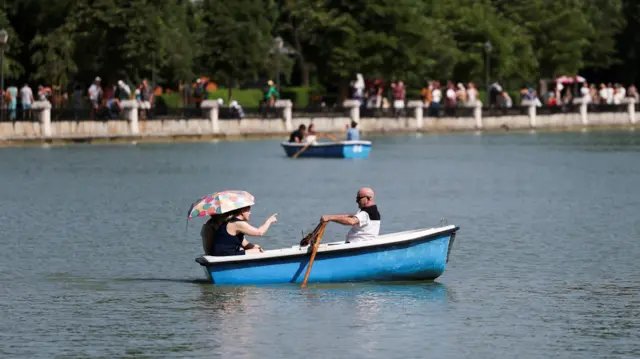
    A bald man with sunglasses rows a blue dingy in a lake while two other people hide under an umbrella at the back of the boat. Another boat can be seen in the distance, while crowds of people walk along the water's edgeImage source, Reuters
    Image caption,

    People go boating in Madrid's El Retiro Park on Tuesday

    The north-eastern Spanish region of Aragón is seeing some of the highest temperatures of the heatwave and, in the cities of Zaragoza and Huesca, local authorities have responded by reducing the price of entry for public swimming pools.

    The northern city of Logroño, which is expecting temperatures of up to 40C (104F) today, has made entrance to swimming pools free for the duration of the heatwave and authorities there have announced that ornamental water fountains will be turned on uninterruptedly between 11:00 and 23:00.

    People can also cool off under water sprinklers, which have been switched on in several areas of the city.

    Several cities and towns have suspended the traditional burning of a bonfire to celebrate the festival of San Juan (John the Baptist), because of the fire risk posed by extreme conditions.

    The northern city of León has cancelled a fireworks display, which had been scheduled for tonight to mark the festivities.

    Meanwhile, many cities have made available “heat refuges”, which are air-conditioned public buildings where anyone can go in and escape the worst of the weather.

    A 2024 law seeks to protect Spanish workers during heatwaves, ensuring employers take safety measures, including making sure outdoor manual work is not done during the hottest time of the day.