Summary

Media caption,
Why has the UK inflation rate fallen?
  1. Rate of inflation drops but the fall is unlikely to hold as energy bill increase set to bitepublished at 10:37 BST
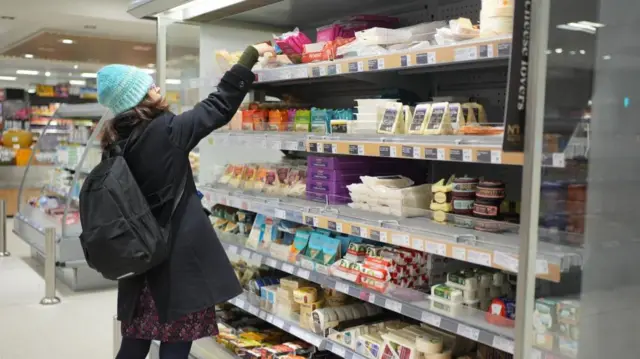
    A shopper leans across into the shelves of a supermarketImage source, PA Media

    The UK's rate of inflation has dropped to 2.6% - a fall that has been driven by drops in the prices of products such as motor fuel, chocolate, margarine and beef.

    It means that prices overall are going up, but less quickly than before, while areas including hospitality continue to see steeper rises than others.

    The figure remains above the Bank of England's 2% target - something shadow chancellor Mel Stride pointed to as "deeply concerning" while the Lib Dem's Treasury spokesperson Daisy Cooper described it as a "small" drop that would bring "little relief".

    It is also unlikely to last, with this month's 13% rise in energy bills set to become evident in the next set of figures.

    Oil prices surged by 4% overnight on Tuesday after another night of US strikes on Iran and higher oil prices get passed onto consumers via the petrol pump as well as through other goods and services.

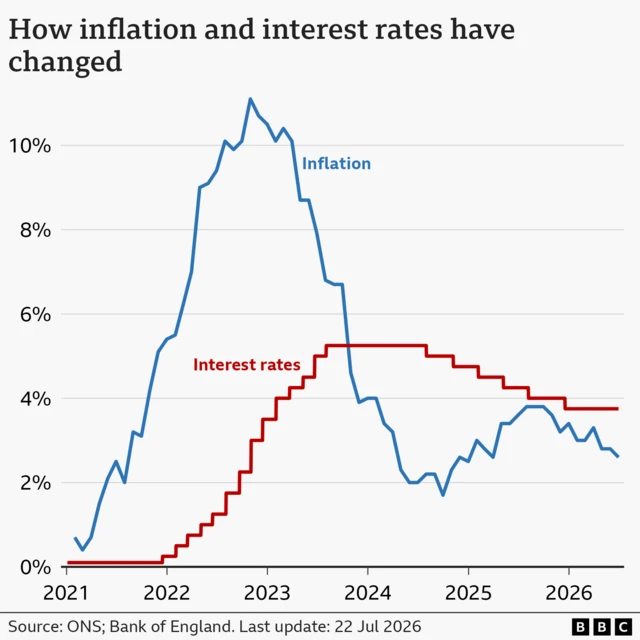
    Today's inflation rate will feed into next week's Bank of England decision on interest rates. However, our business team report that today's 2.6% is a temporary interlude with most economists anticipating the Bank to hold the rate at 3.75%.

    Our news story delves further into which items are more affected than others by price rises as well as what we can expect to hear from the Bank next week.
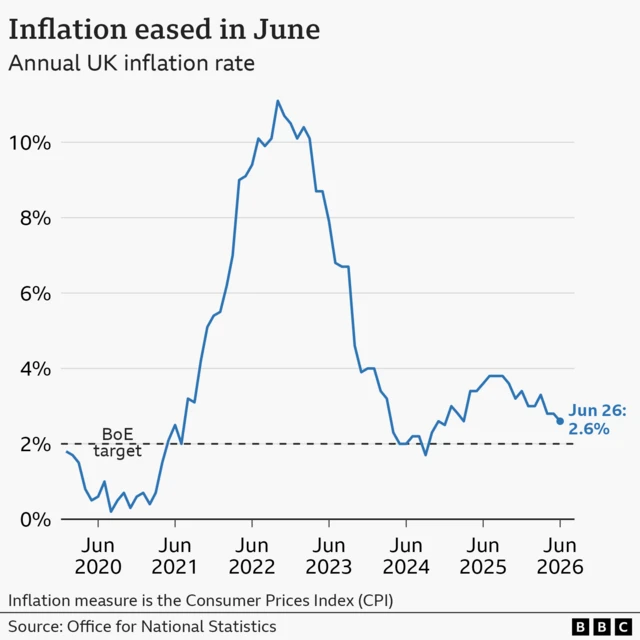
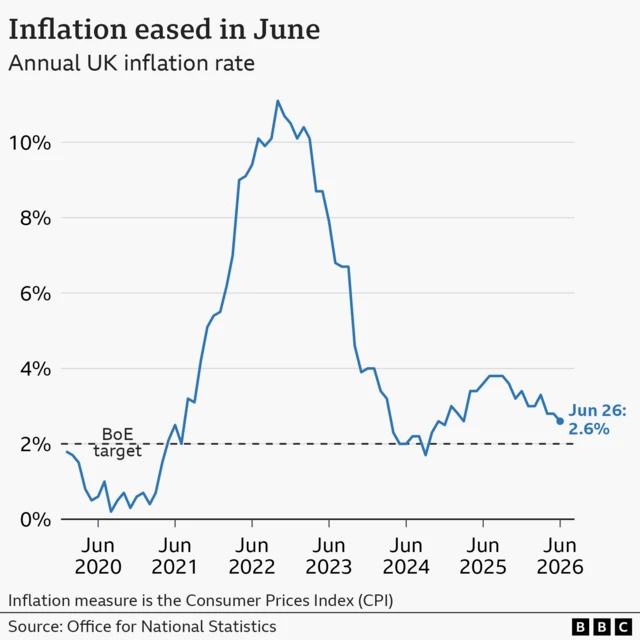
    Line chart of the UK's Consumer Price Index annual inflation rate, from January 2020 onwards In the year to January 2020, inflation was 1.8%. It then fell close to 0% in late-2020 before rising sharply, hitting a high of 11.1% in October 2022. It then fell to a low of 1.7% in September 2024 before rising again. In the year to June 2026, prices rose by 2.6%.
  2. Healey welcomes inflation drop but other parties say it will bring 'little relief'published at 10:24 BST

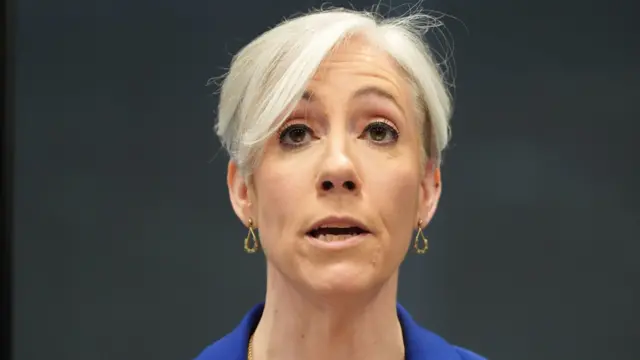
    A headshot of Daisy Cooper mid-speakingImage source, PA Media
    Image caption,

    Liberal Democrat Treasury spokesperson Daisy Cooper

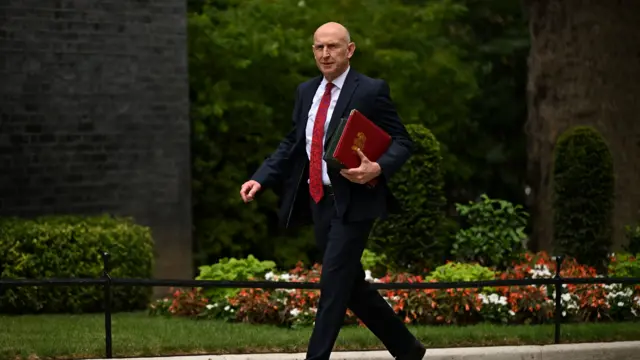
    On his third day in the job, a drop in the inflation figure was welcomed by new Chancellor John Healey who described it earlier this morning as "news families want to hear".

    Shortly after the ONS released the stats, Healey said there was "much more to do to give people the breathing space they need" and underlined the cost of living was a focus for this government.

    Shadow Chancellor Mel Stride didn't agree - instead saying the fact inflation remains higher than the Bank of England's 2% target is "deeply concerning".

    "Labour's tax hikes and reckless borrowing stoked inflation, and Andy Burnham has already made billions of pounds of spending commitments without any plan to pay for them," he added.

    Meanwhile, Liberal Democrat Treasury spokesperson Daisy Cooper described it as a "small drop" which will bring "little relief to families" and their budgets.

    She called on the government to consider the Lib Dem's energy proposals in place of the VAT cut which was announced yesterday.

  3. Restaurant and hotel price rises driven by 'regulatory costs' - hospitality trade bodypublished at 10:12 BST

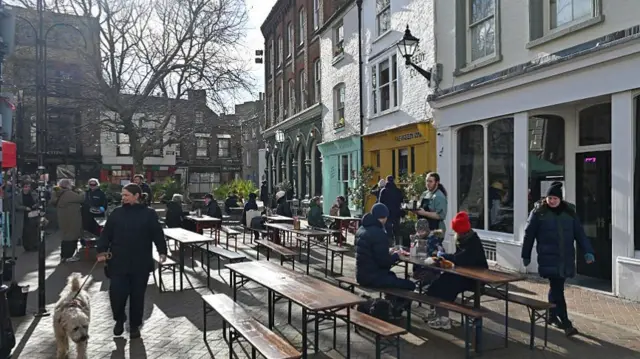
    Tables are set up outside of shops and restuarantsImage source, Getty Images

    Restaurants and hotels are one of the areas where prices continue to rise at a faster pace than the average rate of inflation.

    Kate Nicholls, chair of trade body Hospitality UK, puts this down to regulatory costs that have been imposed by the government - in particular taxes and business rates.

    "We need tax cuts across the whole of hospitality to drive down the cost of living," Nicholls says this morning.

    Shortly after winning the by-election in Makerfield, new Prime Minister Andy Burnham told LBC there is some room within Labour's election manifesto "for movement on tax".

    He had pledged to help with business rates during the Makerfield campaign - releasing a document saying pubs, clubs and music venues would receive a 20% cut, while smaller, independent hospitality, leisure and retail companies would have the threshold for paying business rates raised for the first time since 2017.

    The cuts would be paid for by higher levies on giant warehouses operated by online firms such as Amazon, his team said at the time.

  4. A lower inflation rate is helping saverspublished at 10:02 BST

    Kevin Peachey
    Cost of living correspondent

    Rising bills and prices have made it difficult for many people to put money aside in savings.

    But a lower inflation rate and competition between account providers is helping savers at the moment.

    The average savings account has moved from paying 0.34 percentage points below the inflation rate in September last year to 0.99 percentage points above today, says financial information service Moneyfacts.

    So, from the spending power of savings being eroded, it now has more oomph.

    “For many savers, what matters most isn't whether savings rates rise or fall in isolation, but whether they stay ahead of inflation, and as things stand, they are doing just that and allowing many households to preserve or grow their purchasing power,” says Adam French, of Moneyfacts.

  5. Inflation slowdown likely to be undone by oil price jumppublished at 09:46 BST

    Dearbail Jordan & Ben King
    Business reporters

    Most economists expect that the inflation rate for June will be the lowest for a while.

    Why? The world is still very vulnerable to an energy price shock.

    Oil prices are heading upwards and today Brent crude rose by nearly 4% to $94 a barrel after another night of US strikes on Iran, and reports of oil tankers turning round in the Red Sea following warnings from Iran-backed Houthi militia in Yemen.

    That's the highest price since 10 June.

    If sustained, higher oil prices will be passed on through the petrol pump, and feed into the price of other goods and services too.

    Fuel pump nozzles on a forecourt in ManchesterImage source, Reuters

    Last month, oil had fallen to around $72 as the US and Iran agreed to extend a ceasefire. The price was back to where crude was before the conflict began on 28 February.

    Now, that agreement between the US and Iran has fallen apart.

    Overnight, Secretary of State Marco Rubio said: "The problem we're having right now is that [Iran's] not serious about talks.

    "If they're serious, we're serious. If they're not, then we will do what's necessary to protect our interests, and also the interests of our allies."

  6. Potatoes or women's clothing - take a guess at which items have increased in price morepublished at 09:26 BST

    This Riddle post cannot be displayed in your browser. Please enable Javascript or try a different browser.

  7. Pizza, veal and edible offal: What's dragging down food inflation?published at 09:16 BST

    People reaching for pizzaImage source, Getty Images

    The sharpest changes in food price inflation for the year to June come from a pretty disparate group of products.

    Beef and veal price inflation eased from 9.4% in May to 5.1% while edible offal - which includes things like liver, kidneys and tongue - slowed from 9.2% to 3.4% in the 12 months to June.

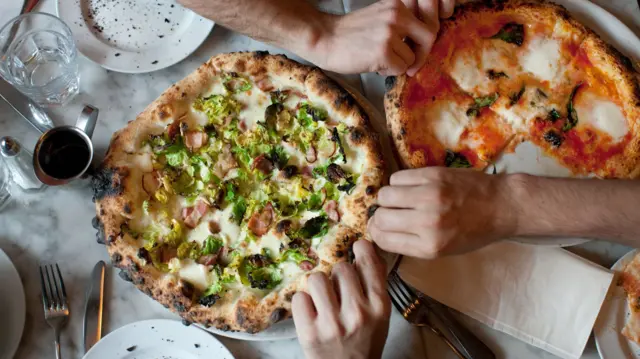
    Some food was cheaper, according to ONS data. Pizza and quiches, for example, fell by 6.7%. Margarine dropped by 1.9%.

    The British Retail Consortium's economist Harvir Dhillon reckons that the overall slowdown in food price inflation "was driven largely by intense competition between supermarkets".

    He says they've been "trying to entice their customers during a warm spell of weather, despite supply chain pressures".

  8. Quiz time! What's in the ONS shopping basket?published at 08:58 BST

    This Riddle post cannot be displayed in your browser. Please enable Javascript or try a different browser.

  9. What does this mean for interest rates?published at 08:52 BST

    Ben King
    Business reporter

    The inflation numbers matter to anyone with a mortgage or savings, as that’s the number the Bank of England targets when setting interest rates.

    Today’s dip is a temporary interlude, and inflation is expected to rise above 3% later in the year as higher energy bills show up in the numbers.

    Normally that would have the Bank’s Monetary Policy Committee thinking about an interest rate rise. But when the cause is temporary factors like a surge in energy prices, they can often choose to wait rather than respond immediately.

    And with little sign that inflation is resulting in higher wage growth, most economists expect that’s what will happen next week, and the Bank will keep rates on hold at 3.75%.

    A line chart showing interest rates and CPI inflation in the UK, from January 2021 to June 2026. Interest rates were at 0.1% in January 2021. They were increased from late-2021, reaching a peak of 5.25% in August 2023. They were then lowered slightly to 5% in August 2024, to 4.75% in November, to 4.5% on 6 February 2025, to 4.25% on 8 May 2025, to 4% on 7 August, and to 3.75% on 18 December. At the Bank of England's latest meeting in June 2026, rates were held at 3.75%. The inflation rate was 0.7% in the year to January 2021. It then rose to a peak of 11.1% in October 2022, before falling again to a low of 1.7% in September 2024 and then starting to rise again. In the year to June 2026, it was 2.6%, down from 2.8% the previous month.
  10. UK inflation lower than Europe, says ONSpublished at 08:42 BST

    Britain's official statisticians say that at 2.6% for the year to June, the UK's inflation rate is lower than the European Union, where it reached 2.9% over the same period.

    However, looking at Germany and France individually - the EU's largest and second largest economies respectively - UK inflation is running ahead.

    The most recent data shows that German inflation was 2.4% in June and France's was 2%.

  11. 'I don't switch the oven on' because of money worriespublished at 08:33 BST

    Eleanor Lawrie
    Social affairs reporter

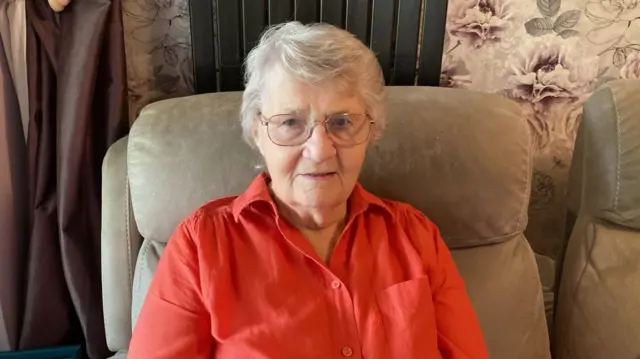
    Elaine Yates sits in an armchair

    The inflation rate falling does not mean prices are dropping, it just means they are rising less quickly.

    Elaine Yates, 77, says money worries mean she "can't remember" the last time she used her oven to cook a hot meal.

    "I don't look after myself. I can't remember the last time I put the oven on. I have got an air fryer that I probably used about three weeks ago," she says.

    The Northamptonshire pensioner spent 20 years as a full-time carer for her husband. Her finances are now "extremely tight", so she has felt particularly vulnerable to price rises since he passed away.

    Four years into the cost of living crisis, almost two-thirds of low-income families say they struggle to buy essentials such as clothes, heating and food, according to anti-poverty charity the Joseph Rowntree Foundation.

    A record 62% of low-income families were unable to afford an essential item in the past six months, the charity found - the equivalent of 7.4m households, up from 7.1m a year ago.

  12. One thing to remember about inflationpublished at 08:21 BST

    When we talk about the inflation rate falling, it doesn't actually mean that the price you might be paying for food, for example, is dropping.

    It just means prices are rising less quickly. A slowdown in the pace of inflation is to be welcomed, however.

    If it stays close to the Bank of England's 2% target, it means the Bank is less likely to raise interest rates.

    Read more about inflation here.

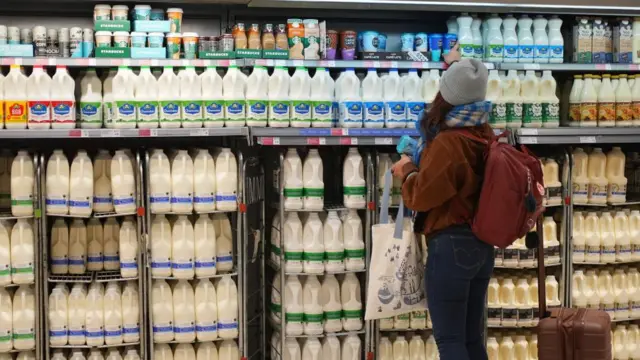
    A person looking at milk in the supermarketImage source, PA Media
  13. Where next for food prices?published at 08:06 BST

    Overall, food price inflation eased to 1.7% in the year to June.

    That's down from 2.2% in the 12 months to May and the slowest pace since August 2024.

    While there is a lot of focus on what impact the war in the Middle East in having on the rest of the global economy, food manufacturers have also had to contend with the conflict between Ukraine and Russia.

    Often referred to as "the breadbasket of Europe", Ukraine has been a major supplier of key cereals and grains.

    Food and Drink Federation chief economist Liliana Danila says businesses have been able to diversify their supply chains to guard against major shocks.

    She says: "We continue to anticipate rising food price inflation as the year goes on, however this is likely to be lower, come later and plateau for longer than the previous inflationary cycle."

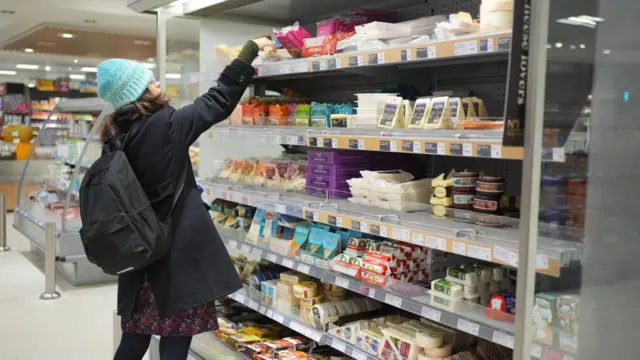
    A woman in a supermarket fridge aisleImage source, PA Media
  14. Analysis

    Falling inflation is unlikely to lastpublished at 07:43 BST

    Kevin Peachey
    Cost of living correspondent

    The new PM, and particularly the new chancellor, will welcome an inflation rate close to the 2% target.

    But the boost is unlikely to last long.

    A 13% rise in energy bills felt by millions of households in England, Wales and Scotland this month will be seen in the next set of inflation data.

    Andy Burnham and John Healey will hope that events fall in their favour and not create too much inflationary pressure.

    But in just a couple of days, they’ve already shown they are willing to intervene with policies aimed at supporting consumers and bringing the inflation rate down too - if only a little.

    Whether they will continue to have levers to pull as time goes on will be a key question.

  15. Shadow chancellor accuses Labour of stoking inflationpublished at 07:42 BST

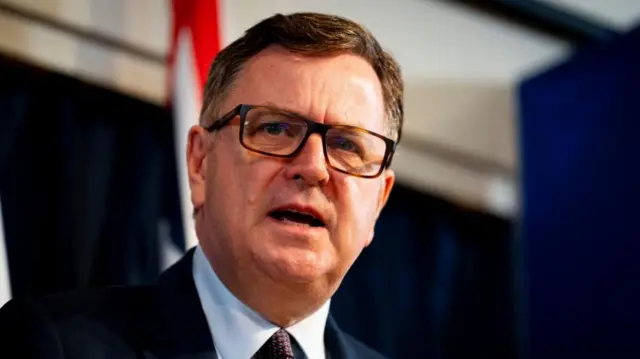
    A headshot of Mel StrideImage source, PA Media

    Shadow Chancellor Mel Stride says the 2.6% figure released today is "deeply concerning for families" - outlining that it remains above the Bank of England's 2% target.

    "Labour's tax hikes and reckless borrowing stoked inflation, and Andy Burnham has already made billions of pounds of spending commitments without any plan to pay for them," he says.

    Stride adds his party has set out a "credible plan to cut spending, cut taxes and get Britain working again".

  16. Petrol prices fall for first times since Iran war beganpublished at 07:24 BST

    Woman with petrol pumpImage source, Getty Images

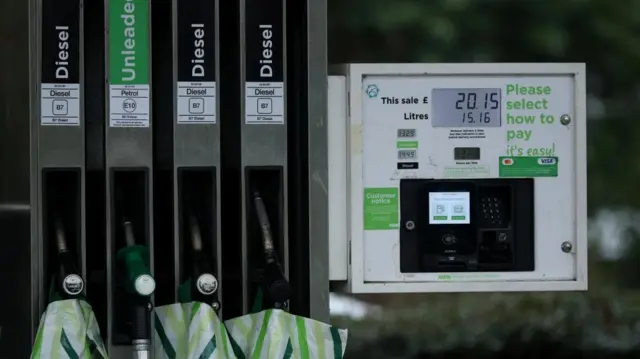
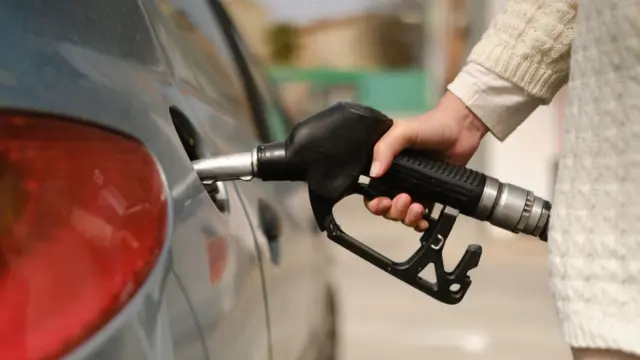
    Delving into the official statistics a little more, the ONS says that the cost of a litre of petrol dropped by 2.1p per litre, taking it to an average price of 155.3p.

    This is the first time petrol prices have eased since the start of the US-Israel war with Iran which began on 28 February.

    Meanwhile, the fall in diesel prices last month was far sharper than petrol. The ONS says that the average price of diesel fell by 10.7p per litre between May and June, to 176.4p.

  17. Healey: 'We have chosen to focus on the cost of living in our first week'published at 07:23 BST

    Chancellor John HealeyImage source, Reuters

    Newly appointed Chancellor John Healey says today's drop in inflation is "news families want to hear".

    However, he stresses there is "much more to do to give people the breathing space they need".

    He points to the two recent policy announcements from the government on cutting VAT from domestic electricity bills and the new bus fare cap on most journeys in England.

    "We have chosen to focus on the cost of living in our first week, signalling that concern for working people will be at the heart of everything we do.

    "Both these changes are a win-win. They help keep inflation down while helping people afford the essentials."

  18. Chocolate, margarine and beef prices easepublished at 07:09 BST

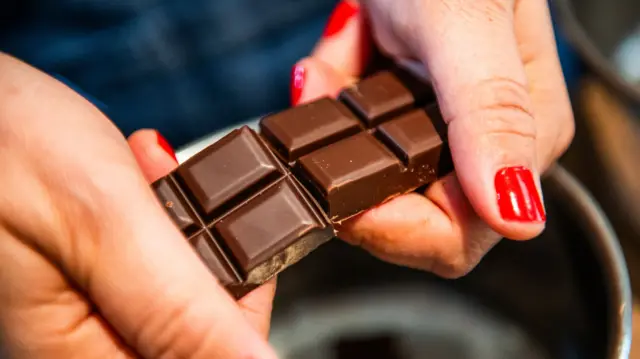
    A heady mix of chocolate, margarine and beef helped ease inflation last month, according to the ONS.

    It also says that clothing was cheaper as retailers cut prices more sharply in this year's summer sales compared to June last year.

    Woman breaking chocolateImage source, Getty Images
  19. Diesel prices pull inflation lowerpublished at 07:03 BST

    The pace of inflation fell due to motor fuel prices, according to the Office for National Statistics, in particular diesel.

  20. UK inflation slows to 2.6%published at 07:00 BST
    Breaking

    The UK rate of inflation has slowed to 2.6% in the 12 months to June, official figures show.

    That compares to 2.8% for the year to May.

    Line chart of the UK's Consumer Price Index annual inflation rate, from January 2020 onwards In the year to January 2020, inflation was 1.8%. It then fell close to 0% in late-2020 before rising sharply, hitting a high of 11.1% in October 2022. It then fell to a low of 1.7% in September 2024 before rising again. In the year to June 2026, prices rose by 2.6%.