Education in the USA
Quick version
Educational inequality is an issue in the US.
There are differences in exam results and experiences between pupils in private and public (or state-run) schools.
The quality of education pupils receive in public schools can also differ from one school to another.
States and local districts are responsible for operating public schools and setting curricula.
The federal Department of Education collects data on schools, identified educational issues, and oversees grants for students with additional education needs or from low income families.
Since 2015, Every Student Succeeds Act (ESSA) legislation has given individual states greater freedom to improve education.
In 2025, President Trump signed an executive order to close the Department of Education as much as legally possible and "return authority over education to the States".
Learn more
Educational inequality in USA
Educational inequality is an issue in the USA.
There are differences in exam results and experiences between pupils in private and public (or state-run) schools.
The quality of education pupils receive in public schools can also be very different from one school to another.
There are large differences in educational attainment by racial group in the USA.
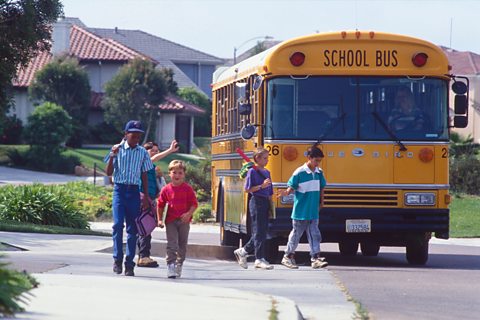 Image source, Camerique / Alamy
 A public school’s population reflects its catchment area and the economic status of those who live there.
In all states except Hawaii, schools receive nearly half of their funding from local property taxes. School districts in more affluent areas with more businesses can raise more money to fund schools.
Students from schools in more affluent areas where parents are well-educated and have the skills and resources to motivate their children, tend to achieve better exam results.
Statistics show that white Americans and Asian Americans consistently outperform black Americans and those who identify as Hispanic Americans in terms of educational attainment.
Image source, Camerique / Alamy Inequality and race in the USA
Percentage (%) of 25-29-year-olds who had completed at least high school by racial group increases from 2010-2022
| Racial Group | White | Hispanic | Black | Asian |
|---|---|---|---|---|
| Percentage (%) in 2010 | 95 | 69 | 90 | 94 |
| Percentage (%) in 2022 | 97 | 88 | 95 | 99 |
Percentage (%) of 25-29-year-olds who had completed an associate or higher degree by racial group increases 2010-2022
| Racial Group | White | Hispanic | Black | Asian |
|---|---|---|---|---|
| Percentage (%) 2010 | 49 | 20 | 29 | 63 |
| Percentage (%) 2022 | 56 | 34 | 36 | 78 |
Percentage (%) of 25-29-year-olds who had completed a bachelor’s or higher degree by racial group increases 2010-2022
| Racial Group | White | Hispanic | Black | Asian |
|---|---|---|---|---|
| Percentage (%) 2010 | 39 | 13 | 19 | 56 |
| Percentage (%) 2022 | 45 | 25 | 28 | 72 |
The tables above show that that the lowest educational attainment level, completing at least high school, there are differences between racial groups with only 88% of Hispanics at least completing high school compared to 99% of Asian Americans. However, the educational gap between the different racial groups widens as educational attainment increases.
At the highest level, completing a bachelor or higher degree, 72% of Asian and 45% of white Americans attain at this level compared to just 28% of black and 25% of Hispanic Americans.
(Source: US National Center for Education Statistics)
Deprived areas
Statistically, a greater percentage of people from minority groups live in poorer areas. This can mean schools in the most deprived areas have the following educational disadvantages:
- Greater problems attracting and retaining suitably qualified teachers, resulting in classes going untaught
- Pupils having less chance of gaining the grades to secure entry to university if the school must deal with a greater number of pupils with more complex needs
- A language barrier. Parents who do not speak English may be less able to communicate with teachers and help with homework
- Students are less likely to gain other valuable life skills in extracurricular activities such as sports and competitions. This reduces their chances to impress employers
- Students in the most deprived areas experience strong peer group pressure to join gangs and drop out of school
Government and educational inequality
Every Student Succeeds Act (ESSA)
In late 2015, President Obama signed the Every Student Succeeds Act (ESSA). The stated purpose of this act is to provide all children significant opportunity to receive a fair, equitable, and high-quality education, and to close educational achievement gaps.
The ESSA was an important piece of legislation as it shifted the responsibility of improving schools and exam performance from the federal government to individual states, giving states greater freedom to improve education to best meet the needs of their students. It also meant schools located in the most deprived areas receiving greater financial support than they had in the past.
Educational spending
When President Biden came into power in 2021, he has looked to increase educational spending as well as reduce the racial educational attainment gap. Specifically, there has been extra federal government funding to schools to improve student reading and maths results, recruit extra teachers, reduce student absence and better support for student mental health.
Department of Education
In March 2025, President Trump signed an executive order calling for the Department of Education to be dismantled.
However, closing the department completely would require approval from Congress.
Although education in the United States is largely controlled by state and local governments, the Department of Education manages billions of dollars in funding, runs the federal student loan system, oversees programmes like special education needs, and enforces laws such as the Clery Act and civil rights protections.
If the department’s role were reduced, its responsibilities could be passed to federal or state agencies.
BBC News: What does the US education department do - and can Trump truly dismantle it?
Quiz
Recap what you have learned
There are wide inequalities within schools in the USA.
A school’s population reflects its catchment area and the economic status of those who live there.
In all states except Hawaii, schools receive nearly half their funding from local property taxes.
As a result, schools in more affluent areas tend to have more funding.
Students from schools in more affluent areas, tend to achieve better exam results.
Statistics show that white Americans and Asian Americans consistently outperform black Americans and those who identify as Hispanic Americans in terms of educational attainment.
A greater percentage of people from minority groups live in poorer areas. This can mean schools in the most deprived areas have educational disadvantages.
Since 2015, the Every Student Succeeds Act (ESSA) shifted the responsibility of improving schools and exam performance from the federal government to individual states.
In 2025, President Trump signed an executive order to close the Department of Education as much as legally possible and "return authority over education to the States".
More on World power: USA
Find out more by working through a topic
- count10 of 10
- count1 of 10