Gun crime in the USA
Quick version
Gun crime is a major issue of concern in the US.
The Second Amendment of the US Constitution guarantees US citizens the right to keep and bear arms.
The USA has the highest rate of homicide in the developed world.
In 2023, it was estimated that around 42% of American households owned a gun.
Around one in five US gun owners say they are members of the NRA - and it has especially widespread support from Republican leaning gun owners.
New gun safety laws also came into force on 1 January 2024 in some US states such as California, Illinois and Colorado.
Learn more
Gun violence
In 2024, 44,447 people were killed in by firearms in the USA, according to the Centre for Disease Control and Prevention (CDC).
15,364 deaths were from firearm homicides. An additional 450 people died due to accidental gun-related injuries, and around 636 individuals were fatally shot by law enforcement.
Not all gun deaths in 2024 were homicides or murders. 27,593 deaths were suicides.
Each day in the US more than 200 people recieve emergency treatment for nonfatal firearm injuries.
(Source: John Hopkins Center for Gun Violence Solutions)
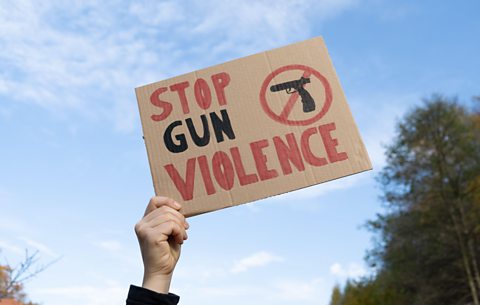 Image source, Longfin Media / Alamy
 The USA has the highest rate of homicide in the developed world. In 2023, 19,120 people were killed by homicide.
Since 2014, the USA has seen more than 39,000 gun deaths every year. Some of the those gun deaths come from horrific mass shootings. Some of the worst mass shootings in recent years include:
- Perry High School, Iowa, Jan 2024 – 6 killed
- Lewiston (bowling alley/restaurant), Maine, 2023 – 18 killed
- Robb Elementary School, Uvalde, Texas, 2022 – 21 killed
- El Paso (Walmart), Texas, 2019 – 23 killed
- Parkland (Marjory Stoneman Douglas High), Florida, 2018 – 17 killed
- Las Vegas (Music festival), 2017 – 58 killed
- Orlando (Pulse Nightclub), 2016 – 49 killed
Image source, Longfin Media / Alamy How many Americans own guns?
In 2023, it was estimated that around 42% of American households owned a gun. This figure has remained steady for several years. White Americans are the racial group most likely to have a gun in their household at 49%. The figure for black Americans is 34%, for Hispanic Americans is 28% and Asian Americans is 18%.
Of those Americans who own a gun, most say their main reason for ownership is for personal protection (72%) although some Americans also own a gun for hunting or for sport shooting.
(Source: Pew Research Center)
Who supports gun control?
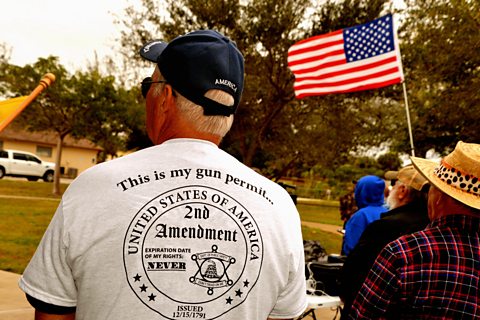 Image source, Julian Leek/Alamy
 Most Americans (61%) believe that it is too easy to legally obtain a gun. 58% also think that there should be stricter gun laws in the US.
Women, Black Americans, those with greater education and younger aged Americans, are the groups most likely to favour stricter gun laws.
Those who support the Democratic Party are more likely to support stricter gun laws than those who support the Republican Party.
There are many US interest or pressure groups which campaign for stricter gun laws. One of the most well-known is the Brady Campaign which was founded in 1974.
Image source, Julian Leek/Alamy Who opposes gun control?
The National Rifle Association (NRA) campaigns against all forms of gun control in the US and argues that more guns make the country safer. It is among the most powerful special interest lobby groups in the US, with a substantial budget to influence members of Congress on gun policy.
Around one in five US gun owners say they are members of the NRA, and it has especially widespread support from Republican leaning gun owners.
Approaches to gun control
There have been numerous attempts to introduce stricter gun laws in response to mass shootings, but these have not always succeeded. Fierce resistance from the pro-gun lobby in the courts has often made passing stricter gun laws near impossible.
11 states and the District of Columbia have passed laws which ban the sale of military-style assault weapons of the type used in several of the worst mass shootings in US history.
New gun safety laws also came into force on 1 January 2024 in some US states such as California, Illinois and Colorado.
These laws, sometimes referred to as “red flag” laws, include a ban on carrying concealed guns in certain places, restrictions on the sale of semi automatic assault weapons, increasing the waiting time for someone to be able to purchase a gun or a requirement for those buying guns to have taken safety training.
Presidential action on gun control
President Obama
In 2016, President Obama announced a series of executive actions aimed at reducing gun violence. These included tougher restrictions on gun purchases, such as:
- ensuring all firearm sellers are licensed
- enforced background checks
President Obama struggled to get any new gun control laws onto the statute books, because of Republican opposition.
In early 2017, the US Senate blocked a regulation which proposed tightened gun checks on buyers suffering from mental illness.
President Biden
President Biden has repeatedly stated the need for the US to reduce gun violence throughout his presidency. In June 2021, he announced a five-point plan which includes:
- cracking down on gun sellers who violate federal laws, with a zero-tolerance policy
- giving additional support to local law enforcement to help with crime increases
- investing in community violence intervention programs
- expanding summer employment and services, particularly for teens and young adults
- helping previously incarcerated individuals successfully re-enter their communities
In 2021, the Bipartisan Safer Communities Act became law. This law included a requirement to increase the use of background checks on those purchasing guns under the age of 21 years. The Bipartisan Safer Communities Act was the first federal government gun control legislation passed in 30 years.
In 2023, Biden also set up the White House Office of Gun Violence Protection overseen by Vice President Kamala Harris. The aim of the office is to end the US’s gun violence problem.
President Trump
After the Parkland, Florida shooting in February 2018, President Trump:
- called for the age limit on purchasing rifles to be raised
- backed legislation from 2013 to introduce widespread background checks on purchases
Following opposition from the NRA, President Trump switched to supporting the NRA’s suggestion of arming teachers and making small improvements to the background check system.
In 2025, when President Trump returned to office, he closed the White House Office of Gun Violence Prevention, removing it from the executive branch.
The Trump administration also cut more than half of federal funding for gun violence prevention programmes in the United States, reducing grants by $158 million.
(Source: Reuters)
Quiz
Recap what you have learned
Since 2014, the USA has seen more than 39,000 gun deaths every year.
White Americans are the racial group most likely to have a gun in their household at 49%. The figure for Black Americans is 34%, for Hispanic Americans is 28% and Asian Americans is 18%.
Most gun owners say their main reason is for personal protection (72%) although some Americans also own a gun for hunting or for sport shooting.
61% of Americans believe that it is too easy to legally obtain a gun and 58% think that there should be stricter gun laws in the US.
The National Rifle Association (NRA) campaigns against all forms of gun control in the US and argues that more guns make the country safer.
11 states and the District of Columbia have passed laws which ban the sale of military-style assault weapons of the type used in several of the worst mass shootings in US history.
Red flag laws, are in force in some states. These gun safety laws include a ban on carrying concealed guns in certain places, restrictions on the sale of semi-automatic assault weapons, increasing the waiting time for someone to be able to purchase a gun or a requirement for those buying guns to have taken safety training.
More on World power: USA
Find out more by working through a topic
- count10 of 10

- count1 of 10
- count3 of 10