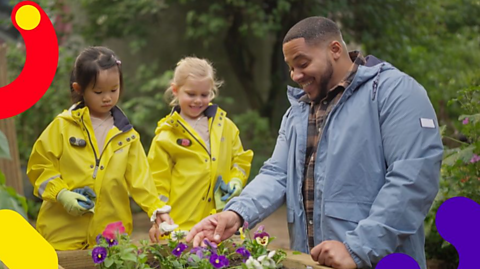
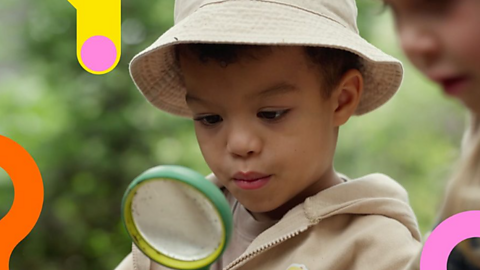
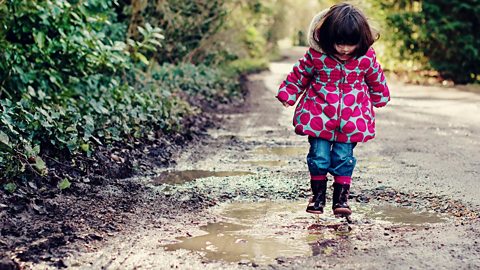
There's so much to see when you get up close to nature.
From tiny creatures to the patterns and colours of leaves and flowers - teaching your child to stop and pay attention to the details in a garden or park can open their eyes and minds to new discoveries.
Talking about the things you see is also great for their development!
Watch the film below from CBeebies show I Can Grow It to see how presenter Aaron uses shared moments and observations to help connect with children.
Aaron:
Hello.
In this film, we'll look at the power of sharing moments with our children by looking at the same things, at the same time.
When we tuned into the same thing in the 'I Can Grow It' garden, it felt like we were finding out about something, together - and those small moments helped us to connect.
Sometimes I'd spot something, and sometimes they'd surprise me with what they were interested in.
This first clip is a perfect example: the moment where Mia discovered a spider's web.
Child: "Look - two apples on that one."
Child: "A spider web."
Aaron: "What? Oh, yeah. There's a spider web just here. So if it's a spider web, what do you think lives here?"
Children: "Spider"
Aaron: "Yeah. So spiders live here."
Looking at the spider's web didn't last very long, but it was still meaningful. Children often move on quickly and don't focus on one thing for too long.
But sometimes you repeat the same little adventure again and again, just like when Adrian, Nelly and I went hunting for woodlice under the logs.
Child: "Look what I found under the logs. There's another one!"
Child: "They come out when it's damp."
Aaron: "That's a very good point. They like to be in dark places."
Child: "There!"
Aaron: "Wow and they move really fast."
Repeating things help Nelly and Adrian to build confidence, and as parents, we can join in too.
We don't need to be experts, we can just share what we notice.
Like, "I notice how fast the wood lice were scurrying about and I got a chance to learn about the knowledge they had to."
It also really helps to get on the same level.
Sometimes I would crouch, or bend down, but in this next clip, Adrian, Mia and I, lie down on the ground to look up at the tree from underneath. It helped me to see the world the way they see it.
Child: "There's a bird!"
Aaron: "Yeah. So what do birds live in here then?"
Children: "Yeah."
Aaron: "Wow, that's amazing. It's all the way towards the top."
Child: "I can see it."
As parents, when we're focused on the same things as our children, even for a moment, it can really bring us together. Something that we can try next time we're out and about with our little ones.
Three ways to use shared moments to connect with your child
Focus on the same things together
Getting out in the fresh air is great for your child's language learning. The environment provides loads of opportunities for interesting conversations.
There’s also a power in shared attention, for example a parent and child both watching a bird in a garden helps to create a connection. Children often notice things with wonder and curiosity.
The natural world is full of colours, sounds, smells and textures for your child to interact with and talk about. Engaging more than one sense can help with language learning.
Taking time to notice the simple things in nature provides children with the opportunity to talk about new things and learn about the world around them. And the more you talk about and name the things they are interested in, the more likely they are to engage and remember your words.
Get on the same level
One way to see the same things at the same time with your child is to get down to their level – for example, by crouching down or sitting together.
When you’re out and about with your little one, try to get down to their eye level and spend time naming and talking about things that you see together.
Getting down to your child’s level helps your child to:
See what you are doing or looking at
Hear your words and sentences more clearly
Show you what they are interested in
See clues to communicate and understand what is being said, as they watch your lip movements, eyes, and facial expressions.
Share what you notice and ask questions
While outside, you can both share when you notice something, for example any insects you might spot in the undergrowth.
Make statements about what you notice to encourage your child to do the same. For example, in the video Aaron says, “I notice how fast the woodlice were scurrying about.”
Ask questions to encourage joint curiosity. For example, in the video Aaron asks, “A spider’s web – who lives here?”
Asking your child open questions about what they can see around them might encourage them to use longer sentences and give more detail. Asking open questions using 'what’, ‘why’ and ‘how’ can open up conversations with your child by getting them to give you more than just 'yes' or 'no' answers.
Playing games like I Spy when out and about can help your child with their phonological awareness - the ability to recognise the sounds in words.
Being outside is a great opportunity to practise counting skills too. For example, ask your child how many insects, berries, flowers, leaves or feathers they can see.